 My second project for March — though it wasn’t finished by the end of the month — was a young boy’s pullover with a cute stripe-and-dot pattern.
Sadly, there is no colour photo in the magazine, the two contrasting colours look very similar in the black-and-white photo, and the little chart for the dot pattern doesn’t mention which colour should be used for which row of dots, so it’s not entirely clear what order the dot stripes go in. The main colour is “Moonstone”, the bottom stripe is stripe is “Horizon Blue” and the second stripe “Camel”, so I figured the bottom row of dots is also blue and the second row camel.
In any case, my colour scheme was different, as very light-colored garments for young active children are bound to get grubby, so I picked a sort of heathery grey-beige for the main colour. Camel as a contrast to that didn’t look so great, so I picked a nice shade of plum and a heathery blue. The yarn is plain Regia sock yarn — superwash wool with a bit of nylon for support.

I though the skeins looked great together but somehow, as I started to knit it up, the colour combination reminded me of jogging clothes from the 1980s. I don’t know why, exactly, but it’s something about that exact combination. I wholeheartedly hate 1980s fashion and am very disappointed to see it having come back in during the last few years, so I wish I had picked something different! On the other hand, nobody else is going to be bothered by it — a young kid won’t be prejudiced and the parents will probably think it amusing if they even make the connection.
The stranding is easy and the main pattern is just stockinette stitch with an extra purl ridge row (K on the right side) every 6th row.
At 7 stitches to the inch, it took a while, and I had to restart once as my gauge was too loose, but I do love the finished look and I hope the wearer will too. I reassured him that he doesn’t need to wear a button-up shirt, tie and shorts with it. Again, if anyone can explain to me why boys of bygone decades had to wear shorts until they were teenagers, no matter how cold outside or how warmly they were dressed on the top half of their bodies, I will be grateful!

 First project for March: this charming jacket from the jacket-and-skirt set titled “Spring Magic in Judy’s trim Outfit”. What a great title! And what a great photo in the booklet. I’m glad today’s girls don’t generally get their hair tortured into curls like litte Judy’s in the picture, but she certainly looks happy enough holding hands with her gigantic teddy bear.

 February’s project was pretty simple: a crocheted cap and “mitts” with a cute bobble pattern. I couldn’t decide on the colour (lavender or purple) and didn’t have quite enough of either to make both cap and mitts, so I ended up making the cap twice and using up leftovers of both colours plus a little extra of a different purple yarn to finish the mittens.


 My second project from January 1960 was a sewn and embroidered cushion featuring “black and white leaves on bright red fabric”. One is encouraged to “keep to the black and white embroidery but choose background linen to match your room” and I chose a medium green. (The fact that it matches the houndstooth jumper is just a happy coincidence.)


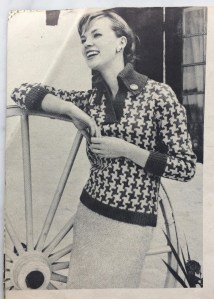
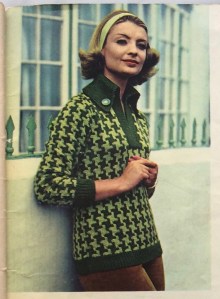 My knitting project from this issue was a houndstooth-check jumper, made in double knitting wool in two shades of green. Large checked patterns of this type were popular this year, which is presumably why Stitchcraft categorized this jumper as “fashion knitting” rather than “casual knitting”.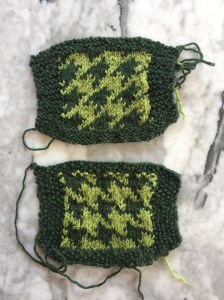


 The Stitchcraft Sixties