May 1961: Tapestry Handbag

Version 2My project from the May 1961 issue of Stitchcraft was a charming tapestry handbag with a Victorian-inspired flower ribbon design. The magazine gives directions for either the handbag or a piano-stool top. As much as I would love to have a handbag that matched my piano stool, I’m just making the bag for now.

I’ve never worked in tapestry before, but for this project it’s really just IMG_2521counted cross-stitch done on tapestry net canvas with tapestry wool. The hardest part was getting all the components together! The  original pattern calls for Beehive Tapestry Canvas No. 27 and Beehive Tapestry Wool, which as far as I can see do not exist anymore — and if they did, they could very well be quite different from the same canvas and wools manufactured in 1961. Unlike cross-stitch fabric, there’s no indication of holes per inch, so I had to sort of guess from the photo of the bag (3 purple stripes across and 3 or 4 flowers vertically in the stripes) and the number of stitches in one repeat of the chart and factor in the size that I wanted the bag to be (a little smaller than the 9 inches deep and 11 inches wide given in the pattern) and the size of the modern handles.
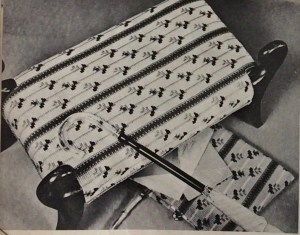
IMG_2558I found some net that seemed about right, but tapestry wool is not to be found in a craft, knitting, wool, fabric, or notions store anywhere near me. So I had to order it online… from a mail-order Internet store whose address is in my own city, but does not have an actual brick-and-mortar store. So I couldn’t see the wool before buying and they had to ship it to me, when I could and would have gladly just gone over and picked it up. And seen it beforehand… because it is really thick! About as thick as double knitting wool. It would have been so much easier to match the size of the wool to the size of the net if I could have found both of them in the same place. It’s usable with the net I bought, but I think the bag will be rather stiff.

The handles were similarly difficult. My great knitting/notions store down the street has catalogues from a company that makes knitting needles and all sorts of related knitty-crafty stuff, including a huge selection of handles and straps and whatnot for making bags. I ordered a nice (I think?) set of handles through the store and nothing happened for weeks. Then I got a message that the handles, in fact all of the handles in that catalogue from that company, were no longer available. Now I’ve ordered some more online. We’ll see what arrives!

Modern technology is lovely and all, but I would love to be able to go to an actual store IMG_2622and buy all of this stuff together. It works for knitting, sewing and embroidery, but I guess tapestry is such an unfashionable hobby that it’s not worth using store space for the materials. I should probably be glad that they’re still manufactured at all.
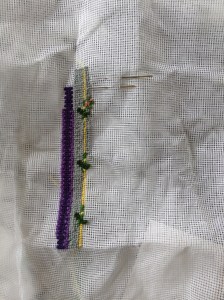
The work itself is not difficult, but I have to admit, it’s a bit boring. I do like the way it’s turning out, though. May 2019 is almost over, but this project is nowhere near being finished, so I’ll update this post when I have something more to show.

Edit a few months later: This project did not work out. The yarn is too thick for the fabric, the handles are too big for the bag, I hate counting tiny holes in tiny fabric and not being able to fix mistakes, and I really don’t know what I am doing as far as tapestry is concerned in general. Maybe I should take a class or something until I try it again. Until then, this project is permanently on hold. Better luck next time!
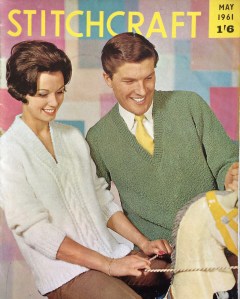
May 1961: Overview

IMG_2509Time for the Summer Forecast! “Editress” Patience Horne writes that it is “a lovely sunny day in March” as they go to press for the May issue. It’s freezing cold and pouring rain where I am on May 2nd, so my summer forecast feelings have been literally dampened.

Still, there is a lovely assortment of projects in this month’s issue, of which the prettiest (in my opinion) is featured in colour on the back cover: this beautiful summer twin-set in   “Nylox” (a synthetic, Bri-Nylon yarn) with a diagonal stripe pattern on the sleeveless top that is repeated on the lapels of the solid-colour cardigan. I love the pairing of the elegant line with the fun pattern, which reminds me of colourful rows of paper bunting strung diagonally.

Our front cover has two more of the classic, bulky, rather plain casual pullovers made in Big Ben (super-bulky) of Rimple (nubbly double knitting). For men, there’s also a classic “tennis sweater” in white with blue stripes, made fancy with a different sort of cable pattern that I don’t think I have ever seen before. It seems quite easy, as the cables never travel far and also never actually cross (so maybe technically not a “cable” pattern, but I don’t know what else to call it — you do use a cable needle to move the stitches out of line and back again.) Our model is very happy with his sweater, and his tennis game.

Besides the twin-set and the cover pullover, women’s fashions include a little short-sleeved jacket in double knitting and a cute cap in Big Ben, plus a “longline” jumper and buttoned cardigan in 4-ply wools. I love the way the pockets are integrated into the striped ribbing of the cardigan. Wide collars, shawl collars and V-necks continue to be popular.

Stitchcraft doesn’t usually have sewing patterns, but this month they’ve teamed up with Vogue to offer a flared or full-circle skirt of the type that was ubiquitous in the later 1950s and reached the end of its popularity around this time. Readers can order the Vogue pattern via Stitchcraft in their preferred size. The flared version is embroidered with “Tyrolean motifs” which can also be embroidered onto “pretty summer aprons”. How cute! Just don’t try to play the violin the way our little Tyrolean motif fiddler is doing it, or you and the instrument will both be unhappy.

(Nota bene: some folk-fiddle traditions, as well as European medieval and Renaissance vielle/violin technique, do involve holding the instrument under the shoulder on the upper chest or upper arm instead of under the chin as in modern classical violin playing. Still different from what is going on here, though.)

School-age children get some nice, basic pullovers and cardigans in washable Nylox or fun Rimple. I don’t know what’s going on with the Humpty Dumpty giant egg doll, but this seems to be a theme with Stitchcraft — I remember seeing more than one knitted or sewn or crocheted giant Humpty Dumpty mascot pattern somewhere in my collection. Check out the cute illustrations and the little castle in the air on the top right of the painted backdrop.

Homewares tend towards the fun and easy, with a “Victorian” floral ribbon design for an embroidered cushion, tapestry cushion or tapestry handbag as well as some assorted cross-stitch or drawn-thread table mats and traycloths. Oh, and also some “his and hers” bath mats. May’s Zodiac sign is Taurus the bull, which you can cross-stitch onto a fluffy-fringed lampshade. I would love to see a picture of a Stitchcraft living room with all twelve Zodiac-themed designs in one place — the lampshade, the chairbacks, the waste-paper basket cover, et cetera (spoiler: sadly, we’re not going to get one.)

That about wraps it up for May! I would love to make the twin-set, but I have such a backlog of projects that I know I won’t have time to get it done, so my project will be the tapestry handbag. I’m very excited to work with tapestry for the first time.See you soon!

Version 3


April 1961: Overview

IMG_2438April showers bring May flowers, or so they say. I’ll just say that, after the last couple of weeks of March, that umbrella on the cover of this month’s issue looks really familiar. As does the model on the right — she was featured (with a more flattering haircut)  in many issues throughout the 1950s.

April’s theme is “Holidays Ahead” and if you are planningIMG_2440 to spend your holiday in April or May on the British isles or the North Sea coast, you will definitely want to wear one of the warm, bulky wool garments from this issue. “Jenny”‘s thick, double-knit Norwegian-style jumper and hat, described as “dazzling designs to cut a dash on the beach this summer”, tells you everything you need to know about that.

The adult garments continue the warm, bulky and casual trend with a men’s “crochet-knit shirt” and “country-style cardigan” in double knitting weight. Knitting pattern stitches that look like crochet crop up every once in a while and it’s certainly an intriguing idea. That said, I don’t think this jumper particularly looks like crochet — it’s yo, k2tog on every right-side row and purl on the wrong side in staggered rows, which is just a simple lace pattern. I’m guessing they thought the word “lace” was not manly enough… The cardigan is made in three-colour slip stitch and is probably very warm and “squishy”. I like the neat, almost hidden pockets and the narrow edging band.

The women’s garments offer two more elegant, but still casual blouses, the two jumpers with fun collar details featured on the front cover and a relaxed “holiday cardigan” in double knitting. Patons “Totem” crepe wool appears in 4-ply (the blouses) or in double knitting weight (the cardigan). “Crepe” in this case meant that the wool was spun very smooth and tightly plied to minimise “fuzziness” and give raised stitch patterns a crisp, precise look. The jumpers from the cover are designed for ever-popular Rimple wool, a crinkly wool-synthetic blend intended to look like towelling fabric. Fans of truly bulky knitting can make this his-n-hers set (well, not really a “set” as they are two completely different designs, but featured together in the photo spread). Her sweater is made in fisherman’s rib stitch and if it looks that bulky on the petite, fine-boned model, I can only imagine it would make anyone else look elephantine — but good for sailing and/or April beachwear, I guess.

Housewares include the continuation of the “Zodiac” theme with an Aries motif, a traycloth in cross-stitch, a cross-stitch and pile rug, “amusing” aprons for the whole family (the father looks utterly un-amused at having to participate in the washing-up), a village townscape needle etching, a cross-stitch cushion… i.e. the usual fare. You can also make a toy “Wag” puppy for fans of the children’s comic from the last few issues, “Wendy and Wag in Wallpaper Land.” I don’t mind telling you that it had a happy ending for everyone. And with that, happy April and see you next time!

P.S. There wasn’t any project in this issue that really called to me, so I’m going to finish up a project of my own design that was inspired by this Stitchcraft children’s jacket from March 1960 that I made last year and write about that. Stay tuned…


March 1961: Posies for Cosies

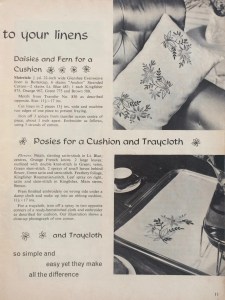
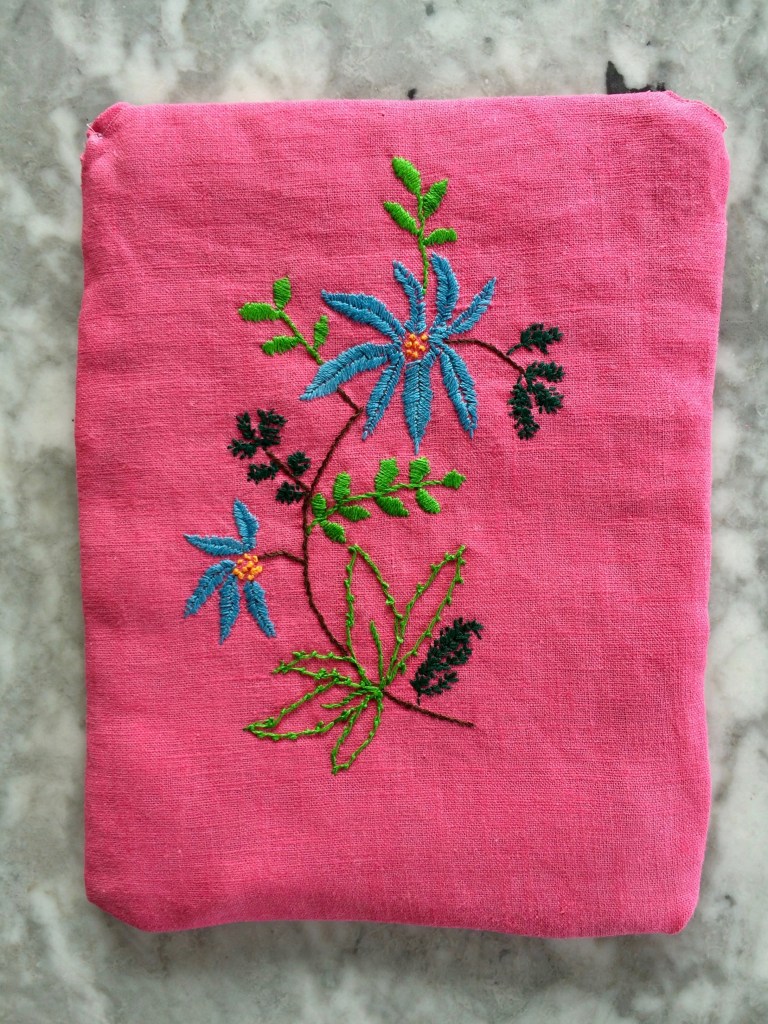
IMG_2412My Stitchcraft project this month was a simple embroidered spray of flowers, originally intended as a decoration for a cushion or traycloth. Having enough cushions and not using traycloths, I updated the design for an iPad cover similar to the one I made last year. The flowers are supposed to be daisies and fern, but the daisies have pointy, blue petals — which I set off against a bright pink background for maximum 60s effect. (The background fabric was left over from the embroidered blackwork cushion from last September.)

Of course, there was no available iron-off transfer, but this design was easy and non-geometric enough that I could copy it out onto paper freehand and then transfer it to the fabric with the “window method” and a washable embroidery marker. The stitching was easy — satin and stem-stitch for leaves and stems, slanting satin-stitch for the blue petals, Romanian stitch for the “feathery foliage” (what a lovely phrase!) and French knots for the centres of the flowers. The only (for me) unusual stitch was the double knot-stitch used to outline the large green leaves. It’s sort of like couching, except you tie a knot in the running thread with each stitch as you go along.


I made it up with an equally bright patterned cotton lining (peacock parade!) with an added layer of quilt batting and the same simple button-closure method I used for the “Gay Goslings”. I am not great at sewing, even or especially a really simple (!) rectangular (!) bag, so the lines are not 100% straight and the design is not perfectly centred. Still, I love the colours and the contrast of the very old-school, Grandma’s tea-cosy design with the modern technological device inside.


Since I don’t actually need this for myself, it will probably be given to whatever nice friend has a birthday and an iPad that needs a cosy. In the meantime, I can hold it up to a window when I want to see something that looks like Spring.

IMG_2429


March 1961: Overview

IMG_2399Are you ready to “Rendez-vous with Spring”? I sure am! This month’s issue has a lovely extra “centerfold” spread in colour, showing off Spring 1961’s latest fashions.

That said, no especially new looks, wools or techniques are introduced. The partner look is still going strong, as you can see from the his-n-hers Aran sweaters on the cover. They both have boatnecks, popular for a little while in the late 1950s and showing up again here. They are not shaped at the front neck at all, so I imagine them to be uncomfortable and awkward to wear.

Nubbly Rimple and thick, bulky Big Ben wools continue to be popular, featuring in almost all of this month’s adult garments. Big collars are still in, but one jumper utilises a contrast collar design in a different wool, with an interesting shape and ribbed texture. For larger sizes, there’s a cardigan skirt suit in purple plaid — bold colours and jewel tones are in fashion for all sizes and make a great centerfold picture all lined up together.

IMG_2418

In the homewares department, we’ve got another beautiful “peasant” design (they really love that word) for a cushion, a decorative wall tapestry with pictures of chipmunks, some flower embroideries for cushions or a tray cloth, this month’s Zodiac symbol to embroider on whatever you want (Pisces), and a really difficult-looking crocheted cushion cover.

The highlight of the homewares patterns has got to be this incredible “Willow pattern” latch-hook rug. I had heard of “willow-ware” porcelain (remember that scene from one of the Anne of Green Gables books, where Anne or Davy or someone accidentally breaks Aunt Josephine’s blue and white willow-ware platter, then Anne sees a similar one in someone’s house, climbs up on the roof of the barn or something to look at it through the window, then falls through the roof and gets stuck, having to wait in a rainstorm until the owner gets home and then explain the situation?) and I have seen this type of pattern on porcelain china, but never knew that the one was referring to the other.

IMG_2417

Stitchcraft‘s description of the rug refers to “the 3 figures in the Willow Pattern story.” I had also never heard of any Willow Pattern story, but my good friend Wikipedia told me all about the history of the Willow pattern and the associated legend (spoiler: the “legend”, like the pattern, was a 100% British invention made up to sell more porcelain goods, not any kind of authentic Chinese folk tale). Both the pattern and the associated story served as inspiration for further literary, media and commercial works. You can read all about it here.

Finally, it would not be Stitchcraft without a page of little items “for sale-of-work” at church bazaars etc., or to surprise your family on Easter morning. The continuation of Belinda the doll’s knitted outfit is quite cute, but what on earth were they thinking with these egg cosies?!? They look positively psychotic. If I were a child and my mother served my Easter morning Easter egg in one of those things, I would be surprised all right… and probably wouldn’t sleep for a week.

IMG_2424 2

Speaking of children, here are some who weren’t scared off by their egg cosies and were rewarded with bright, sunny “play sweaters from Vienna” in spring colours of lemon yellow and white. The caption on the page opposite is “Gay as a See-Saw!” I’m sure there are a lot of jokes one could make about gay and see-saws, but I won’t. The kid’s comic in the back pages has the usual continuing story — Wendy and her dog Wag are having some fun adventures in Wallpaper Land.

IMG_2423The ads are for the usual knitting machines and sewing fabrics… except for this one, for “Cooper’s moth proofer” spray, presumably made of DDT  or some other extremely toxic insecticide that kills “ants, beetles… these and other crawling insects die on contact — even months after spraying.” Just the thing to use in your enclosed, airless closet space!

With that, I wish you all a lovely, non-toxic, gay as a see-saw rendez-vous with spring. My March project will be some version of the flower embroidery.


February 1961: Tiny Cardigan

IMG_2371 3After January’s time- and labor-intensive pullover for me, I wanted to make something quick and easy in February. And there’s always a friend, colleague, or relative having a baby, so I made this simple ” Tiny Cardigan” from the cardigan and slipper set.

The wool was Lang Nova, a wonderfully fluffy and very light wool-camelhair-nylon mix. There are 180 metres in 25 grams! It is essentially made of air, but softer and warmer. I suspect it is not very hard-wearing and probably pills and breaks easily, but babies grow so fast that it will hopefully be outgrown by the time it falls apart. My swatch grew exponentially with blocking, so I converted the pattern to a larger gauge. Then the finished garment didn’t grow much at all with blocking, so it ended up more like newborn size. I hope the parents send out a birth announcement as soon as the baby arrives…

Version 2The cardigan has a basic bottom-up raglan construction with the twisted ribbing featured in January’s Snowflake Sweater. I made it in one piece from the bottom up to avoid seams, and was so busy trying to read the front, back, and sleeve directions simultaneously while working the yoke that I forgot to make the little twisted-rib sleeve insertions that would have made this otherwise very basic jacket a little bit more interesting. Whoops! But by the time I realised my mistake, it was already almost done, and I have a feeling this wool really does not like to be frogged. I pepped up the plain marble-grey colour of the jacket with some red flower buttons.


And there it is! I had to buy a second skein of wool to finish the cardigan and now have some left over, so I might as well make the slippers, seeing as the baby hasn’t arrived yet.

ETA: I went ahead and made the slippers, adding a flat spiral of red i-cord instead of a pom-pom.

IMG_2382

February 1961: Overview

fullsizeoutput_943-1

Around Christmas time, I was looking through my Stitchcraft collection to see what the new year had in store for me, and realised that the February 1961 issue was missing! Not that I had lost it, but it was one of the very few issues from the 1960s that I had not managed to find before starting this project. I buy the magazines on ebay and it is fascinating to see how some issues pop up again and again in multiple auctions, and others just never appear. But I was in luck – after searching so many times, there was February 1961, just when I needed it! Thank you, nice seller on ebay, who got this issue to me quickly and in beautiful condition.

fullsizeoutput_933

There’s a “Special Colour Feature” of extra colour-print pages in the middle of the issue, promising “Fashion Harmony” for “You and the Home.” With that in mind, it’s kind of a pity that they chose a neutral gray-beige melange for the three-piece outfit on the cover.

Thicker, bulky wools and quicker knits continue to dominate the knitting patterns, with Big Ben playing a prominent role. There’s a little waist-length jacket in an interesting pull-up-a-slipped-stitch-some-rows-later stitch pattern, a bulky cardigan or DK- weight pullover in diamond or rib pattern, and a his-n-hers Aran pullover set. Neutral colours of brown, beige and tweedy gray prevail.

The his-n-hers, unisex design idea shows up in the children’s patterns as well (how nice, for once!) with some warm, lightly colour-patterned pullovers. It’s nice to see a girl wearing trousers and doing something active in her sweater.

(Side note: As I was typing that sentence and got to “it’s nice to see a girl wearing”, the auto-suggest on my tablet offered me “makeup.” So yes, as nice as it is to see one single non-sexist knitting pattern in 1961, don’t be fooled — things haven’t changed nearly as much as they should. Also, spoiler: the rest of Stitchcraft has plenty of “boys need to be active! girls like to be pretty!” patterns and photo layouts in store for us.)

On that note, there are patterns for a complete set of doll clothes, as well, in case readers worried that their girl child playing with a ball once in her life might, I don’t know, make her grow up to direct a bank someday, or something.

But back to this month’s issue! Babies get a fluffly cardigan with the same twisted ribbing as January’s snowflake sweater as well as a lovely lace shawl. Fine-knitting fans can make an elegant, classic jumper at 8 1/2 stitches to the inch or a lace-panel blouse for larger sizes up to a 45 inch bust.

Embroidery experts can make a floral fireplace panel or a tablecloth with a “peasant” motif (not the most flattering wording, I know), a rug or a crocheted handbag. The Zodiac handcraft theme has entered the month, if not the Age, or Aquarius. Also, the turret tower look is still all the rage for hats.

And that about wraps it up! Seeing as there was so little actual colour in the designs from the special colour feature, here’s the back cover advertisement for Escorto Gold Seal striped and checked fabrics. My project will be the baby cardigan. Have a colourful February!

fullsizeoutput_93d

January 1961: Snowflake Sweater

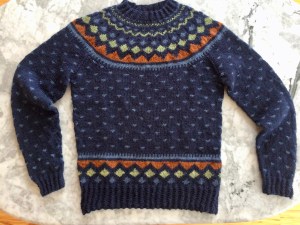
IMG_2256January’s project was — like August 1960’s twin-set — one of the reasons I wanted to start this whole mega-blog-project in the first place, namely, this beautiful round-yoke “snowflake” sweater in the style of traditional Greenlandic designs. I love the combination of curvy and angled shapes produced by the diamond-shaped rings on the yoke, and the dark background colour fits my style.

Traditional round-yoke sweaters made from the bottom up typically call for the body and sleeves to be made separately, then joined in the round for the yoke, casting off stitches under the arms and on the sleeve-underarm edges to add depth to the chest width and make the first few rounds easier to work.  But like all adult garments from this time period, Stitchcraft‘s version is meant to be made in separate pieces. The first part of the yoke is written with back-and-forth raglan decreases, until the patterned part of the yoke gets going, and even that is supposed to be knitted back-and-forth with an opening in the back for a zipper.

Besides being not very traditional, I find back-and-forth knitting on stranded garments not so much fun (stranded purling is annoying) and certainly not as fast to make (knitting is faster than purling, and in-the-round construction means no seams to sew later), so I was determined to make this garment completely in the round and without seams. Making the sleeves and body separately in the round was no problem, but I was at a loss as to how to do the raglan bits plus neck shaping before the patterned yoke began without completely re-writing the pattern. Also, I wanted to add in some short rows to make the front part of the neck drop a little farther down than the back.

img_2306After thinking it over, the most reasonable course was to work the little bit of pre-yoke between the armhole bind-offs and patterned yoke back and forth with raglan decreases as written, but beginning the front neck shaping (pre-yoke, concurrent with the raglan decreases) an inch or so lower than the back. That preserved the proper stitch count, let the sweater hang better, and shortened the yoke a bit. I didn’t mind shortening the yoke, as I like sweaters to be snug under the arms and not too high on the neck. I didn’t need a zipper, so I made the patterned yoke entirely in the round.
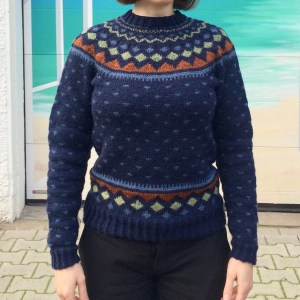
img_2311It worked out perfectly! I could hardly believe it. Raglans and round yokes may be somewhat forgiving on the body, but it is a fundamentally tricky mathematical game to make all the interdependent factors of width, depth, and pattern repeat come out right, so I was really proud of myself for making it work. My only other modifications were on the sleeves (longer) and the waist shaping (original pattern had none, I started out narrower at the waist and increased gradually at the sides to give a more figure-flattering look.)
Version 2
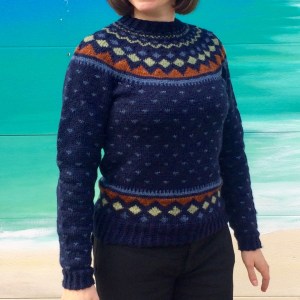
Don’t let the tropically-painted background fool you — it’s cold outside!

The yarn was a mixture of plain Regia 6-ply (DK) sock wool for the dark and light blues, and some of the lovely 100% wool that my knitting colleague hand-dyes with plants (the brown and green, made with onion skins/walnut shells and some kind of green reed plant, respectively.) It is very warm and has the right balance of firmness and softness.

All in all, I am 100% happy with this pullover and will probably wear it a lot this winter.


January 1961: Overview

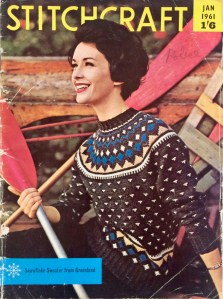
IMG_2256Happy New Year 2019! Or 1961, if you prefer. January 1961’s issue “starts with a swing” with “lots of colour” and “tip-top designs” like the gorgeous Greenlandic-style sweater on the cover.

Looking through the issue, I feel like this is the point in time where the 1960s started, fashion-wise. The closely-fitted, fine-knit, waist-length jumpers of the 1950s have made way for bulky, quick-to-knit garments, and nylon-mix wools like Rimple are more common.  Skirts are still long and hairstyles modest — we’re not in the “Swinging Sixties” yet — but colours are bolder and the whole look seems fresher, somehow.

The little girl’s outfit on the inside cover definitely embodies the new look. Yes, her legs are still going to freeze, poor child, but her little red Rimple outfit is swingy and fun. And look at that wonderful cap and muff! The decorations are made by cutting the bobbles out of a length of bobble fringe and sewing them onto a crochet chain made in contrasting green or red wool, then sewing the bobble chain onto the cap and muff. Mum and daughter can both sport the latest in “Paris Hat News”, which seems to be a sort of turret tower worn on top of your head. The loops on the bottom part of the adult hat are made by pulling loops through the knitting ridges with a bodkin or blunt tapestry needle and holding them in place with your thumb until they are all made and the wool fastened off.

Women’s and men’s fashions feature loose-fitting garments in bulky wools, either hip-length and unshaped like the Greenlandic sweater or the embroidered Viennese cardigan on the inside back cover, or “cropped and bulky” like the “slick jacket” made in thick Big Ben wool. For a more elegant look, you can knit a suit in double knitting weight and top it with a detachable fur collar.

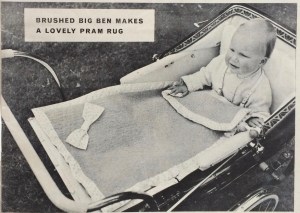
In addition to the little girl’s sets, babies and children can enjoy a warm cape or dressing gown in Rimple yarn, or a pram blanket in brushed, bulky Big Ben wool. The brushing felts the wool for a true blanket effect. It was done with a teasel, which is a metal brush that breaks up the fibres and lifts the nap of the fabric. Readers are instructed to send the finished blanket to Patons and Baldwins in Scotland, who will brush the blanket for you “at a very reasonable charge.”

IMG_2263

Jacobean embroidery, stitched hall rugs, and Victorian-style chair seat tapestry remain steadily in fashion, or you can embroider pictures of a kitten and puppy to hang on your wall. I don’t know about you, but to me they look kind of melancholic! This month’s Zodiac sign is Capricorn, and you can use it to decorate a pyjama case. In the children’s features, Wag and Wendy have tea with a toadstool fairy and kids can sew a simple tea-cosy set for their mother’s birthday.

My project will be the fabulous sweater from the front cover. I’ll be modifying the fit, though, as big and bulky is not my style. Thanks for joining me for the first year of this blog, and best wishes for 1961 — er, 2019!