May 1960: Overview

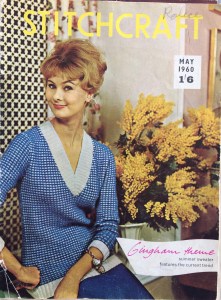
Apr1960coverIs it already May? Nothing makes time fly like writing monthly blog posts! May 1960 is a “Roundabout of Holiday Knitting” (complete with a little circus-fair logo that fills up any little dead space in the page formatting, how cute) where in “today’s story”, “no one thinks of going away without 2 or 3 brand-new woollies packed away in their luggage.”  So let’s get started…

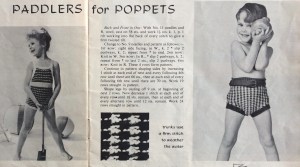
Check patterns are still in, this time in a “gingham” (two-colour slip stitch) pattern for the woman’s jumper on the cover and a “firm stitch to weather the water” (also two-colour slip stitch) for a toddler boy’s swim trunks. totsbeachI am quite sure no small child wants to swim in hand-knitted wool trunks with a belt these days, but I imagine the sun-suit on the opposite page would be fun and practical for beach wear if made in cotton. The baby and older girls of the family get pretty cardigans or a tunic “to wear with her jeans.” I’m glad to see activewear for girls, since generally one is assumed to make pretty, decorative stuff for girls and strong, “manly” stuff for boys — sexism that is not surprising in 1960, but which always depresses me to see in today’s knitwear patterns for children.
For adults, there is a “Trio of Summer Fashions” (“Two to look pretty and one for sports”) and a great cable pullover in bright yellow.  The “sports” pullover is machine-knitted.

There’s still plenty of stuff to make for the home, too (just in case your holidays are too relaxing). Table mats to match your willow-ware platter are actually really cute, and look at that beautiful appliqué tea cosy! Cross-stitch is popular as always for chair-backs and tea-tray ideas, or you can crochet yourself a bedside mat. But what on earth is this “contemporary screen” that uses your scraps?

In the comics pages, we are introduced to Mr. Tuckett, a tailor who receives a magic needle from his friend the wizard. What will the magic needle do? Stay tuned…
roundabout

My projects for this month will be the baby’s jacket and a modified version of the tea cosy.

Enjoy your holiday roundabouts!
 

April 1960: Popular neckline

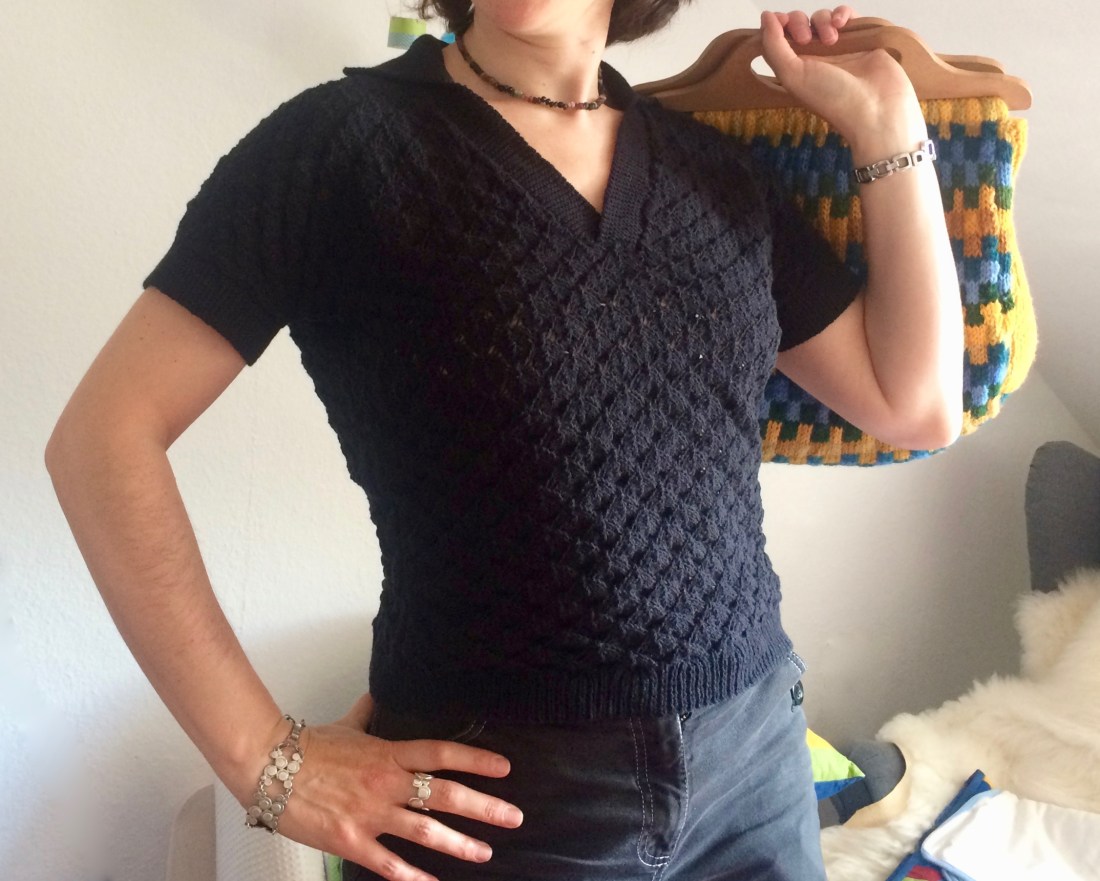
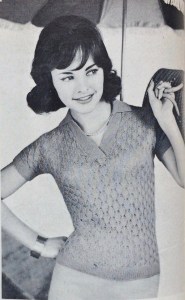
Version 2My second project for April (obviously not finished before the end of the month, seeing that I started it two days before) was this cute lace blouse with a “Popular neckline.” I do love the neckline, and the leaf pattern.

The pattern is written for wool, of course, but I made it in cotton for summer. It is very, very difficult for me to find any kind of yarn, especially cotton, that is fine enough to get the pattern gauge of 8 stitches to the inch in stockinette stitch. I can hardly even get 8 stitches to the inch on lace-weight wool on 2 mm needles! But crochet cotton thread would be too thin, and I don’t think I’ve ever seen it in black. So I found a cotton that gets me 7 stitches to the inch on 2 – 2 1/2 mm needles and fiddled with making the middle size and having it come out as the large size.

popneck_wipThe biggest problem was making the side-seam increases. The lace pattern has a repeat of 12 stitches, but a sort of varying number of edge stitches. I honestly had no idea where to fit in the extra stitches, or how to keep them in pattern when the increases and decreases within the pattern are broadly spaced. Time to hit the Ravelry forums! I did try charting it out (the pattern has written instructions only) and at first it made it easier to “read” the knitting, but didn’t give me any fundamental technical answers. I realised I had to chart out  not just the pattern itself but all of the increases and decreases, with the changes that had to be made row by row. That worked, but by then I had already made the back piece, so those increases on the sides weren’t perfect. But everything else was!

The fit is incredible. I was wary of the horizontal cap sleeves, which are really just made by casting on extra stitches instead of decreasing under the arms. I thought it would make a lot of baggy fabric under the arms, like those 1950s (or 1980s) dolman-sleeve fashions that must be extremely inconvenient to wear. But no! The armholes are snug without being too tight, and I appreciated the extra width and give in the upper chest and back, where I am quite wide.

All in all, it is wonderful and I am very happy. Here I am having fun “recreating” the original picture. The bag is from a Stitchcraft pattern, too!IMG_1929

April 1960: Gay Goslings

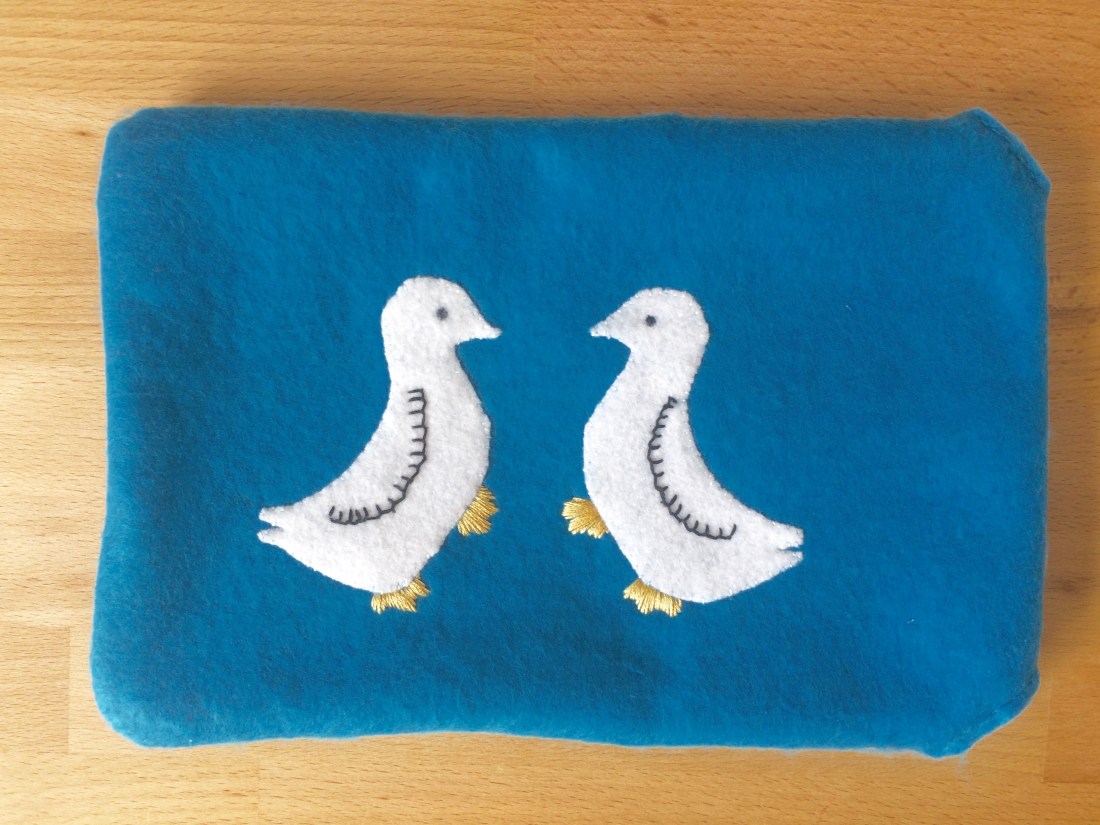
Version 2“Cheerful goslings make gay kitchen ideas” — who could resist? There are patterns for a serving glove and a felt tea cosy, neither of which I particularly needed, but the tea-cosy pattern is just about the right size for an iPad case. So this became the modern version.

As always, the pattern came from a transfer that is no longer commercially available, but since the appliqué was so simple, it wasn’t a problem. I used the good old pencil-grid-transfer method that had already worked so well with January’s leaf cushion, and it worked fine.


I had never done appliqué before, but it was really quite easy, especially with felt, so this was a great beginner project. The eyes, wings and feet are embroidered in simple satin stitch and blanket stitch. There were supposed to be yellow stem-stitch outlines around the eyes, but I tried it and it made my poor innocent gosling look kind of demonic, so I stuck with plain black dots. I made it up with a scrap of fun blue cotton print for lining (Geese… In… Space…!) and a simple closure made out of a bit of twisted yarn cord and a sparkly white button.


Everything worked great and the whole thing took only about 5 hours total to make, including sewing all the seams by hand, as I didn’t have my sewing machine on hand at the time.  Definitely a change from the never-ending John’s new pullover! Now I have the gayest, warmest, best-dressed, space-age spring fever iPad that anyone could wish for and am very happy.

goslingsfo1


April 1960: Overview

coverapr60“Already there is talk of holidays” says the introduction to the April 1960 issue, “and whether it’s to be the sea, country, sight-seeing or sailing, you can’t go without your holiday hand-knits.” At the same time, spring and April mean Easter, with lots of opportunities for hand-made accessories and knickknacks.

For knitters, there is a larger variety of wool weights and styles than in the last couple of issues. Houndstooth and checked patterns are still going strong — look at that great jacket on the front cover! — but lace and Rimple designs are offered too, and garments for babies, toddlers, and adult men and women.

For the patient, there is a cute 3-ply top and a shirt in cotton crochet yarn at 12 stitches to the inch. (This is the only type of cotton yarn I’ve ever seen featured in Stitchcraft, but usually it’s used for making doilies or other fine crochet items.)

For those who prefer to actually get their garment finished before the summer holidays start, there are “partner look” sailing sweaters, the houndstooth jacket on the cover, and pullovers in Rimple and Big Ben yarns. Rimple will continue to not be my taste in terms of texture, but isn’t the model cute?

Easter embroidery is big, and around this time, Stitchcraft started to include designs for church accessories — hassocks and kneelers in tapestry or cross-stitch. For those for whom Easter is less of a religious experience, there are some great “Easter novelties” (cosies for teapots and toilets) and who could resist those gay kitchen ideas? Standard needlework ideas for the home include a fitted chairback and a lovely Persian-inspired cushion.

One thing that is really different in this issue is a sewing pattern, common in 1940s and 50s Stitchcraft but rare in the 1960s. It’s a very simple nightdress (for Easter and/or your holidays, of course) that is recommended to be made in “one of the easily laundered non-iron materials”, i.e. nylon or early synthetics.

nightdress

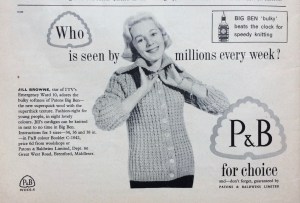
April’s celebrity “plug” is given to us by Jill Browne, the actress who played Nurse Carole Young on the soap opera Emergency – Ward 10, which aired on ITV from 1957 to 1967.  I have to admit I have never seen it, but it seems to have been quite progressive for its time, with Joan Hooley playing a female surgeon in an interracial relationship that was sealed with a kiss onscreen.

starad

On the back pages, it is the end of adventures for Good Teddy Bear and Naughty Teddy Bear, but they got two gay jerseys knitted for them in the end, so I think everyone was happy. Plus you can make your very own teddy bear to commemorate the series! The ads are for the usual things, except for this gem of a potty-training stool called “Bambino”, appearing for the first time.

My projects from this issue will be the 3-ply top and the appliqué goslings on a tea cosy. Happy Spring, everyone!


March 1960: John’s new pullover

IMG_1550My second project for March — though it wasn’t finished by the end of the month — was a young boy’s pullover with a cute stripe-and-dot pattern.

Sadly, there is no colour photo in the magazine, the two contrasting colours look very similar in the black-and-white photo, and the little chart for the dot pattern doesn’t mention which colour should be used for which row of dots, so it’s not entirely clear what order the dot stripes go in. The main colour is “Moonstone”, the bottom stripe is stripe is “Horizon Blue” and the second stripe “Camel”, so I figured the bottom row of dots is also blue and the second row camel.

In any case, my colour scheme was different, as very light-colored garments for young active children are bound to get grubby, so I picked a sort of heathery grey-beige for the main colour. Camel as a contrast to that didn’t look so great, so I picked a nice shade of plum and a heathery blue. The yarn is plain Regia sock yarn — superwash wool with a bit of nylon for support.

IMG_1588

I though the skeins looked great together but somehow, as I started to knit it up, the colour combination reminded me of jogging clothes from the 1980s. I don’t know why, exactly, but it’s something about that exact combination. I wholeheartedly hate 1980s fashion and am very disappointed to see it having come back in during the last few years, so I wish I had picked something different! On the other hand, nobody else is going to be bothered by it — a young kid won’t be prejudiced and the parents will probably think it amusing if they even make the connection.IMG_1591

The stranding is easy and the main pattern is just stockinette stitch with an extra purl ridge row (K on the right side) every 6th row.

At 7 stitches to the inch, it took a while, and I had to restart once as my gauge was too loose, but I do love the finished look and I hope the wearer will too. I reassured him that he doesn’t need to wear a button-up shirt, tie and shorts with it. Again, if anyone can explain to me why boys of bygone decades had to wear shorts until they were teenagers, no matter how cold outside or how warmly they were dressed on the top half of their bodies, I will be grateful!

pulli_fo

March 1960: Spring Magic

Version 2First project for March: this charming jacket from the jacket-and-skirt set titled “Spring Magic in Judy’s trim Outfit”. What a great title! And what a great photo in the booklet. I’m glad today’s girls don’t generally get their hair tortured into curls like litte Judy’s in the picture, but she certainly looks happy enough holding hands with her gigantic teddy bear.

The pattern calls for Patons Double Knitting at a gauge of 18 stitches to 4 inches over the stitch pattern. The child I knit this for can’t wear wool, though, so I made it in wonderful, easy-care, electric red and blue acrylic Bravo Originals from Schachenmayr. It did turn out to be a bit bulkier than Patons DK, so I adapted the stitch counts to reflect a gauge of 15 stitches to 4 inches.IMG_1566 (1)

The stitch pattern looks complicated but is actually very easy — fundamentally just k1, p1 on the right side and k on the wrong side, but the k stitches on the right side are made through the purl bump of the row below, giving a sort of check pattern without stranding or slip stitches. It has stockinette-stitch hems on the cuffs and bottom edge and a row of double crochet (British terminology, i.e. single crochet for Americans) around the front and collar edges.

It knit up so fast, and the colours were so bright, and the yarn so space-age, that I bought a whole lot more of it in order to make a 1960s-style, short-sleeved, A-line minidress for myself. I can’t wait!

judysfo

March 1960: Overview

IMG_1544

March 1960 promises “Spring Magic” and a special pull-out supplement with designs in “Big Ben”, Patons’ new Aran-weight wool that promises to knit up especially quickly, so you can have your thick, warm woolies finished in time for the summer holidays. (Anyone who lives in Northern Europe or who has taken a holiday on the northern Atlantic or North Sea coast will understand perfectly.) Fine-gauge knitting is right out: the designs not written for Big Ben, like the excellent yellow pullover and sleeveless waistcoat for men, the “Young Style Designs” for teenage girls, or the fabulous checkered coat for a toddler, are all in DK-weight wool. The only exception is “John’s new pullover” in 4-ply.


The embroidery and homecraft projects focus on springtime and Easter, with a floral tablecloth and a cushion and chairback in traditional Hungarian design. It’s a pity nobody uses chairbacks these days, as they are a nice decoration and certainly prolong the life and cleanliness of a chair or sofa. The stitched rug is a “quick and easy modern design” and there are tapestry and needle-etching pictures of quaint-looking English town streets.


In comic land, Good Ted and Naughty Ted (two teddy bears) and their human friends Beth and Bill take a balloon ride to Magic Way, where a fairy turns Beth and Bill into animals in order for them to visit Noah’s Ark. As usual, the ads are for Lux soap, Opti-Lon zippers, Cow & Gate baby formula and various sewing and knitting machines.


One older style of ad is the Patons and Baldwin’s testimonial, in which a famous personage shows off their favorite hand-knit garment made from P&B wool. Here we have Russ Conway, the popular music pianist, at the peak of his career and wearing a lumber jacket in “man-weight wool”. Russ Conway was a multi-talented, self-taught piano player and composer who enjoyed enormous success, producing multiple No.1 hits and playing in a distinctive “honky-tonk” style. Though plagued by serious health conditions, he continued to compose, produce, and fund-raise for charity until his death in 2000 at the age of 75. You can read more about his life and career and hear some of his music on his tribute website .

IMG_1560I will be making two children’s designs: the fabulous checkered coat for a toddler, and “John’s new pullover” for a soon-to-be six-year-old.

February 1960: Chic cap and mitts

Feb1960_capmittsFebruary’s project was pretty simple: a crocheted cap and “mitts” with a cute bobble pattern. I couldn’t decide on the colour (lavender or purple) and didn’t have quite enough of either to make both cap and mitts, so I ended up making the cap twice and using up leftovers of both colours plus a little extra of a different purple yarn to finish the mittens.

Apropos “mitts” and “mittens”… Stitchcraft calls them mitts, though I guess these days most people would call them mittens. What we now call mitts, i.e. fingerless gloves, were not in fashion in the mid-20th century.

The cap is made in the round from the top down with double crochet and bobbles, then stranded with fringe around the crown, which in turn is held down by a plait (braid). The crocheting was easy even for a non-crocheter like me, but the fringe was really difficult to hold in place with the proper tension.

The mitt(ens) have a really interesting construction — back and palm done separately from the middle out. You make a chain and work on both sides of it, back and forth and back and forth until it is wide enough. The thumb is a sort of loop of chain stitch added on and worked in double crochet with the rest of the palm, then sewn up.

I used contrasting dark purple wool for the wrist and the making-up (the lavender was used up) and crocheted palm and back together on the right side for a decorative effect.

Here are the finished caps — both slightly different, both fairly imperfect, but I think the intended wearer will like them. Modeled photo to come when she receives them!

February 1960: Overview

Feb1960_coverFebruary 1960, the “Spring Knitting Number”, features an extra 16-page pull-out booklet with garments in Patons Rimple, a nubbly wool-with-a-bit-of-nylon yarn that looks like terrycloth toweling when worked up. The Ravelry yarn database has more information with pictures and modern projects. The wool itself gives so much texture that it would be pointless to knit intricate patterns or multi-colour pieces with it, so the “zippy designs” in the supplement are made on very classic lines: V-neck pullovers, a plain cardigan, a child’s cap and mittens.

The only slightly more ambitious design is this double-breasted A-line coat for a child.IMG_1488 The model, like all children of the 1960’s and earlier, must have very cold legs. Why children of earlier times didn’t wear trousers or warm stockings or tights is a mystery that an older person will have to explain to me someday. It’s particularly strange to see in a knitting magazine, as often the child will be wearing a thick wool jumper or even a wool pullover under a wool sleeveless dress with a knitted wool coat over it, plus a hat and mittens if outside… but nothing on their poor bare legs.

The non-Rimple knitted garments are long, like this “Fashionable Dress” in 4-ply fingering at 7 stitches to the inch, or the long coat in a two-colour slip stitch pattern. Even the dolman cardigan is hip-length. The embroidery and needlepoint projects cover various traditional styles with a Victorian ribbon-band pattern for a stool top, a cushion with Tudor-inspired pears and acorns, and a very zig-zaggy “modern” Swedish rug and cushion set. The Swedish rug has a neat three-dimensional effect thanks to tufting.


As the focus of the issue is the Rimple supplement, the other projects in the issue are fairly basic: cardigans for men and boys, a crocheted cap and mitts, an embroidered wall panel and counted-stitch cushions. The ads are for fabric, knitting and sewing machines, and “Cow and Gate” baby formula — all standards — and the two teddy bears in the comic are heading off on Magic Way in their enchanted toy village.

Rimple is not my style, so I’ll be making a small project this month: the crocheted cap and mitts with an intriguing bobble pattern and plaited crown.Feb1960_2


January 1960: Leaf cushion

leafcushion_issuefotoMy second project from January 1960 was a sewn and embroidered cushion featuring “black and white leaves on bright red fabric”. One is encouraged to “keep to the black and white embroidery but choose background linen to match your room” and I chose a medium green. (The fact that it matches the houndstooth jumper is just a happy coincidence.)

Finding appropriate fabric was not easy, as I’m not experienced with embroidery or needlepoint and can’t always “translate” the brands and fabric types called for into something I can buy now.  This pattern, like many in Stitchcraft, calls for “Glenshee Embroidery Fabric 212” which does not seem to exist (anymore?) as a specific brand, but this very useful website told me that “Glenshee” is a general name for a certain kind of evenweave linen available in “various counts”. That description matches my fabric pretty well, which is an evenly woven linen-viscose mix that seems to have a similar texture to the fabric shown in the picture.

The biggest challenge, of course, was getting the design onto the fabric. At the time, one ordered a transfer from Stitchcraft for a small sum, which was then sent by post. Sometimes an issue contained a free transfer, and these days, vintage Stitchcraft transfers are sometimes available on Ebay, but good luck finding one for a specific project at the time you want to make it! There are surely computer programs for embroidery transfer design these days, but I did it the old-fashioned way:

First I made a paper pattern by taping pieces of ordinary white paper together to the correct size, then marked both a photocopy of the booklet pattern and my paper pattern with a grid to get the correct placement of the leaves:


I made a little leaf stencil out of cardboard, measured the proper placements for the leaves and pencilled around the stencil to get the shapes, then traced them in thick black marker:


I used the paper pattern to cut out the green fabric and the inner cushion fabric (plain white cotton-polyester decorating material), then taped the paper pattern to a window, taped the green fabric over it, and traced the leaves with dressmaker’s chalk — luckily, it was a sunny day, as the green fabric is not naturally very transparent. Then I added the inner details freehand:


And it worked! A washable marker would have been better, but I didn’t have one.

The embroidery itself is stem-stitch with a couple of loop-stitch and satin-stitch details, which was within my limited ability. Still, it was difficult to get the stitches even and the shapes symmetrical. Here are two photos from the work-in-progress — the leaves in the bottom row are quite wobbly, and the double leaves are very uneven, but I am happy with the spotted leaf in the next row up from that.


After the embroidery was finished, it was time to make the piping! Stitchcraft didn’t give specific instructions how to do that, just to “make up piping using extra fabric.” Luckily, I have this wonderful book that I borrowed from a friend, which not only helped me with the embroidery, but has a page on making up piping. You have to make a long bias strip and sew it around the cord… not as complicated as I thought.


And that was it! I made a simple cushion of cheap cotton/polyester fabric stuffed with fluffy stuff and made up the cover with the piping and a zipper.

Seeing that this was my first time really embroidering, first time making piping, and even the first time making a cushion, I am very happy with the results.

leaf_final

January 1960: Green check jumper

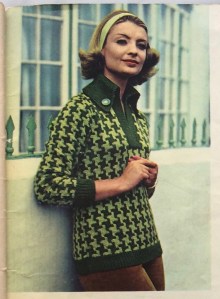
greencheck_issuefoto2My knitting project from this issue was a houndstooth-check jumper, made in double knitting wool in two shades of green. Large checked patterns of this type were popular this year, which is presumably why Stitchcraft categorized this jumper as “fashion knitting” rather than “casual knitting”.
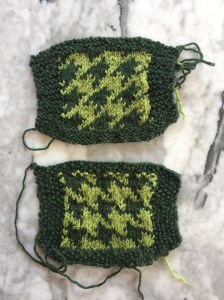
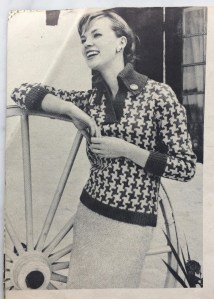
I love the big green collar and the interplay of the two colours. What I didn’t like as much was the pattern itself. It looked fine in the photos but in a swatch, I found it looked too much like plusses or crosses and not like what I think of as houndstooth. Also, the straight vertical placement of the stitches made the fabric pucker. I experimented with a couple of other houndstooth variations and decided on the second one (lower swatch in photo.)greencheck_2swatches

My only other intended modifications were minimal: knitting it in the round with invisible fake “side seams” instead of in pieces with real seams, as I don’t like purling in two colours, and making the sleeves full-length instead of the 3/4 or 7/8 shown in the photos. However, once the body and upper back were finished, it looked as though the upper back would not be wide enough. I suppose the average Stitchcraft reader of 1960 was not particularly athletic, by modern standards… The shoulder width was fine, so the solution was to simply space the decreases from the beginning of the armhole farther apart (at each end of every 4th row instead of every other row). I did the same on the upper fronts and increased the total stitch count on the upper arms by 4 stitches, making the decreases more gradual on the sleeve caps as well.

greencheck_issuefoto1

The pattern calls for Patons Double Quick Knitting. I got a good gauge (6 sts to an inch in pattern) and a fantastic colour match with Patons Diploma Gold DK, a wool-acrylic-nylon blend. I had plenty of it on hand from a frogged project, but the work in progress was nubbly. I thought it would get smooth again with blocking, but alas, the original project was probably blocked “too well” and the finished product is not quite smooth. Since it’s the same all over, though, I decided to think of it as a design feature.

The fit is excellent, everything worked out wonderfully and I am very satisfied with the final result.


January 1960: Overview

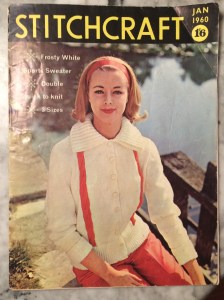
jan1960cover

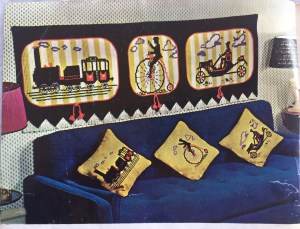
January 1960 wishes us a Happy New Year with designs for “fashion” and “casual” knitting, a machine-knitted jumper, children’s and baby clothing to knit, a matching rug and cushion, and “something completely different in embroidery” — cushions and wall hangings with Victorian-era train, carriage and bicycle motifs.  I find it strangely appropriate that Stitchcraft started a new and, one would expect, exciting decade with a look to an even more conservative past — the magazine was not exactly innovative, and its readership enjoyed patterns that give a nod to current styles without being all too forward-thinking.

victorian
Dashing away!

The jumpers (or sweaters: Stitchcraft appears to use the two words interchangeably) continue the trend for somewhat thicker yarn — as Patience Horne writes in the introduction to this issue, “we all seem to get busier and busier these days” and the 9-stitches-to-an-inch creations of the 40s and 50s were slowly getting rarer. Five of the eight adult garments in this issue use double knitting yarn.

coldweatherlineup


On the embroidery front, there is a lovely design for a glass-topped coffee table, an adaptable Jacobean design in colour on the back cover, and a simple “leaf” cushion.


The Victorian cushions are “gay”, as are the children’s gloves. One of Stitchcraft‘s endearing qualities is its use of the word “gay” to mean charming, colourful, sprightly et. al. long after the word’s more modern meaning eclipsed its original one. It’s not yet quite so funny in 1960, but the word still appears in post-Stonewall issues up into the early 1970s. Yet another sign that Stitchcraft did not move with the times! I love all things gay no matter what sense of the word, so will be sure to point out this charming feature whenever it appears.

The ads feature Lux soap flakes, Wearwell facing ribbon and a Tru-Matic knitting machine  — all repeat customers.  There is always a little comic for the kiddies, and we’re already at part 3 of this one, “A Tale of Two Bears.”

I will be making the leaf cushion and the “green check jumper”, shown in colour on the inside back cover.