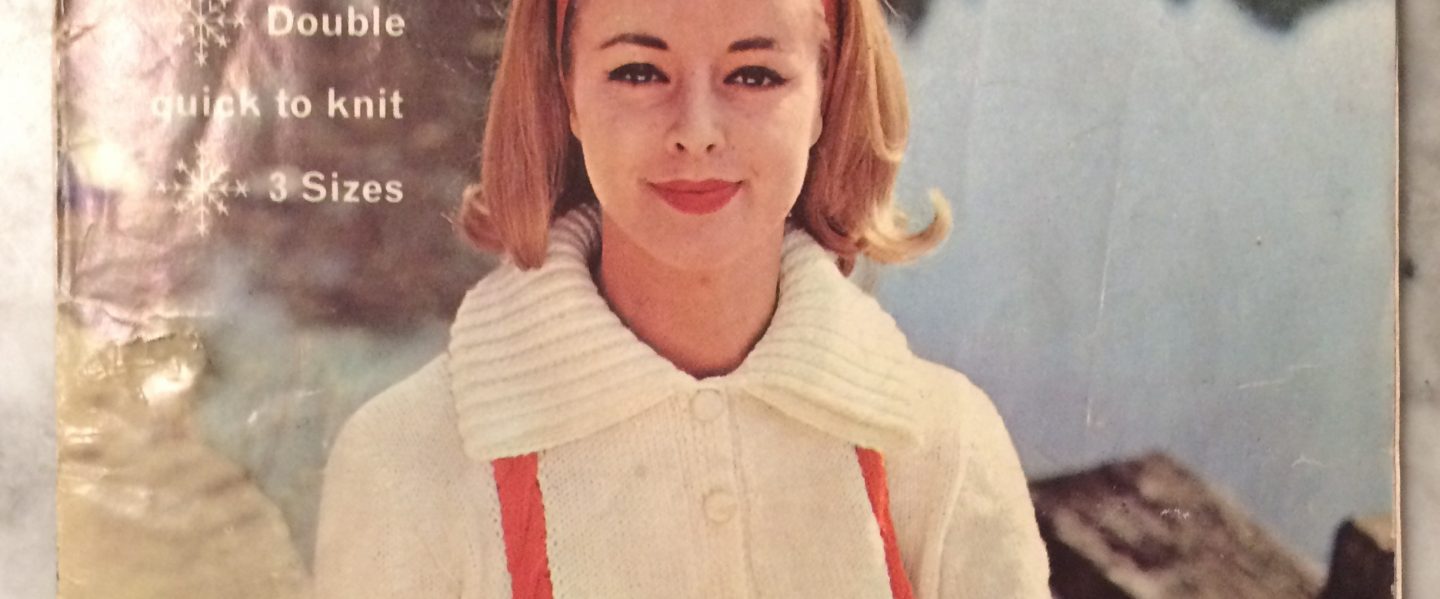

March 1960 promises “Spring Magic” and a special pull-out supplement with designs in “Big Ben”, Patons’ new Aran-weight wool that promises to knit up especially quickly, so you can have your thick, warm woolies finished in time for the summer holidays. (Anyone who lives in Northern Europe or who has taken a holiday on the northern Atlantic or North Sea coast will understand perfectly.) Fine-gauge knitting is right out: the designs not written for Big Ben, like the excellent yellow pullover and sleeveless waistcoat for men, the “Young Style Designs” for teenage girls, or the fabulous checkered coat for a toddler, are all in DK-weight wool. The only exception is “John’s new pullover” in 4-ply.


The embroidery and homecraft projects focus on springtime and Easter, with a floral tablecloth and a cushion and chairback in traditional Hungarian design. It’s a pity nobody uses chairbacks these days, as they are a nice decoration and certainly prolong the life and cleanliness of a chair or sofa. The stitched rug is a “quick and easy modern design” and there are tapestry and needle-etching pictures of quaint-looking English town streets.


In comic land, Good Ted and Naughty Ted (two teddy bears) and their human friends Beth and Bill take a balloon ride to Magic Way, where a fairy turns Beth and Bill into animals in order for them to visit Noah’s Ark. As usual, the ads are for Lux soap, Opti-Lon zippers, Cow & Gate baby formula and various sewing and knitting machines.


One older style of ad is the Patons and Baldwin’s testimonial, in which a famous personage shows off their favorite hand-knit garment made from P&B wool. Here we have Russ Conway, the popular music pianist, at the peak of his career and wearing a lumber jacket in “man-weight wool”. Russ Conway was a multi-talented, self-taught piano player and composer who enjoyed enormous success, producing multiple No.1 hits and playing in a distinctive “honky-tonk” style. Though plagued by serious health conditions, he continued to compose, produce, and fund-raise for charity until his death in 2000 at the age of 75. You can read more about his life and career and hear some of his music on his tribute website .
 I will be making two children’s designs: the fabulous checkered coat for a toddler, and “John’s new pullover” for a soon-to-be six-year-old.
 February’s project was pretty simple: a crocheted cap and “mitts” with a cute bobble pattern. I couldn’t decide on the colour (lavender or purple) and didn’t have quite enough of either to make both cap and mitts, so I ended up making the cap twice and using up leftovers of both colours plus a little extra of a different purple yarn to finish the mittens.


 February 1960, the “Spring Knitting Number”, features an extra 16-page pull-out booklet with garments in Patons Rimple, a nubbly wool-with-a-bit-of-nylon yarn that looks like terrycloth toweling when worked up.
  The model, like all children of the 1960’s and earlier, must have very cold legs. Why children of earlier times didn’t wear trousers or warm stockings or tights is a mystery that an older person will have to explain to me someday. It’s particularly strange to see in a knitting magazine, as often the child will be wearing a thick wool jumper or even a wool pullover under a wool sleeveless dress with a knitted wool coat over it, plus a hat and mittens if outside… but nothing on their poor bare legs.


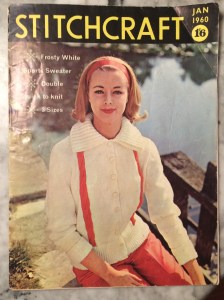
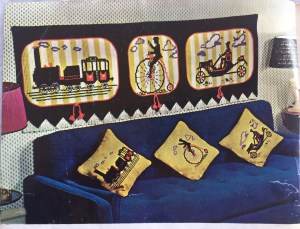
 My second project from January 1960 was a sewn and embroidered cushion featuring “black and white leaves on bright red fabric”. One is encouraged to “keep to the black and white embroidery but choose background linen to match your room” and I chose a medium green. (The fact that it matches the houndstooth jumper is just a happy coincidence.)


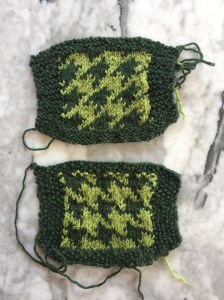
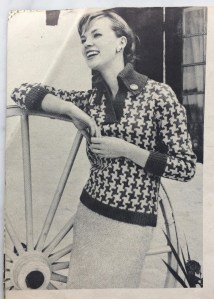
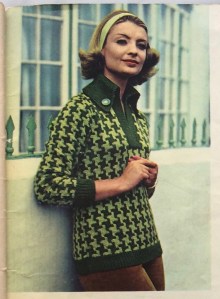 My knitting project from this issue was a houndstooth-check jumper, made in double knitting wool in two shades of green. Large checked patterns of this type were popular this year, which is presumably why Stitchcraft categorized this jumper as “fashion knitting” rather than “casual knitting”.