 I love this cover. The yellow stripes on the hats, the yellow trim on the sweaters and the yellow sans-serif lettering all harmonise perfectly with the off-white garments in the center focus. Even the models’ hair colour looks like it was chosen to match the wooden wall. And we can see that typical 1960s hairdo coming into fashion, with more volume on the top and curled ends.
The rest of the photography in this issue is amazing as well. Let’s start with little Georgina in her beach dress, striking a Napoleonic pose from the back of her inflatable elephant! The dress is totally cute and definitely on my project list for this month, for my friend’s kid who just turned three. Those are seahorses, in case that wasn’t clear (the ones on the front panel of the dress and matching sunsuit look weird to me — I think I’ll fill in the bodies to make the shape more clear.) The sunsuit and dress are made in wool-nylon blend Nylox, but I’ll be making the dress in cotton.
 (Speaking of tiny children in goofy poses, am I the only one who finds this advertisement for next month’s Stitchcraft strangely funny? What is it about this baby that comes off looking so weird? Too much hair? The quasi-adult-looking face? The indescribable expression?)
Back to this month’s issue, somewhat larger children can get a pretty summer dress with an embroidered yoke. It wasn’t necessary to order a sewing pattern, as the skirt of the dress was really just a square with a little cut-out (shown with scaling grid in the issue) and the yoke outline was included with the embroidery transfer. Larger children than that (age 6-10) get a warm “Continental playtop” with a big collar in double knitting.


Big collars are still fashionable for adults, too, as we can see from the women’s version of the cover sweater or the “Husky Sailing Sweater” in bulky Big Ben wool. White or off-white and yellow are trending colours. The men’s garments both have round necks — I’m guessing designers assumed men would be wearing collared shirts under their pullovers no matter what they were doing, and “layering” big collars over each other didn’t happen until the 1970s. For warmer days or more elegant occasions, there’s a short-sleeved cardigan-jumper in 4-ply and a lacy cap-sleeve top in 3-ply wool. The cap-sleeve top is yellow and the buttoned blouse has a collar, so we’re right in fashion here too.


Homewares are fantastic this month as well, starting with some really easy garden cushions (padded with plastic foam to try and make them more damp-proof). We are still in the year of the embroidered Zodiac signs, and June brings us a Gemini-themed beach bag.


 And then there’s this incredible birds-in-a-tree number, to be worked either in wool on linen for a firescreen or in felt appliqué with wool embroidery on linen for a picture. I’m normally not so crazy about 1950s and 1960s neo-Jacobean designs, but I love this one and definitely want to make the felt appliqué version as a cushion (with a more greeny green for the tree and not quite so much brown-orange-yellow in the appliqué work.) I imagine it might be tough without a transfer, but they gave us two very clear photographs including one in full colour, so what could go wrong?
 Last but not least, there’s a lovely, elegant two-piece suit in nubbly Rimple double knitting wool, featured in the most magnificent photo I have ever seen in any magazine, ever. If I remember correctly, I saw it in one of those Internet lists of “best/worst/weirdest knitting pattern photos” long before I started collecting vintage patterns. It’s definitely at the top of my list and if you haven’t seen it yet, you saw it here first!
There is nothing I can possibly add to that, so I’ll just get to work on that cap-sleeve jumper… and the little girl’s beach dress … and the garden cushions… and the Jacobean appliqué… Happy June, everyone!
 My project from the May 1961 issue of Stitchcraft was a charming tapestry handbag with a Victorian-inspired flower ribbon design. The magazine gives directions for either the handbag or a piano-stool top. As much as I would love to have a handbag that matched my piano stool, I’m just making the bag for now.
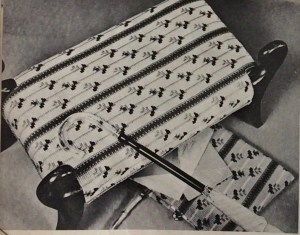 counted cross-stitch done on tapestry net canvas with tapestry wool. The hardest part was getting all the components together! The original pattern calls for Beehive Tapestry Canvas No. 27 and Beehive Tapestry Wool, which as far as I can see do not exist anymore — and if they did, they could very well be quite different from the same canvas and wools manufactured in 1961. Unlike cross-stitch fabric, there’s no indication of holes per inch, so I had to sort of guess from the photo of the bag (3 purple stripes across and 3 or 4 flowers vertically in the stripes) and the number of stitches in one repeat of the chart and factor in the size that I wanted the bag to be (a little smaller than the 9 inches deep and 11 inches wide given in the pattern) and the size of the modern handles.
 I found some net that seemed about right, but tapestry wool is not to be found in a craft, knitting, wool, fabric, or notions store anywhere near me. So I had to order it online… from a mail-order Internet store whose address is in my own city, but does not have an actual brick-and-mortar store. So I couldn’t see the wool before buying and they had to ship it to me, when I could and would have gladly just gone over and picked it up. And seen it beforehand… because it is really thick! About as thick as double knitting wool. It would have been so much easier to match the size of the wool to the size of the net if I could have found both of them in the same place. It’s usable with the net I bought, but I think the bag will be rather stiff.
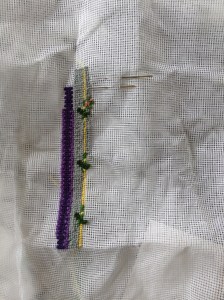 and buy all of this stuff together. It works for knitting, sewing and embroidery, but I guess tapestry is such an unfashionable hobby that it’s not worth using store space for the materials. I should probably be glad that they’re still manufactured at all.
 I do have a project from the May 1961 issue and will post about it soon, but it won’t be done by the end of May. In the meantime, I made a very cute coat for a friend’s child from the January 1976 issue of Stitchcraft, using the leftover yarn from the
  As usual, you’re supposed to make everything in separate pieces, and for once, I almost did! That is to say, I made the back, fronts and sleeves up to the raglan underarm join in pieces, then made the raglan yoke all in one piece working back and forth. Sewn raglans always look so messy (when I make them…), so it was worth it for that, and making the rest in pieces gave the sides some stabilising seams and didn’t take any longer than making the body in one piece working back and forth would have done.
 I noticed that it wasn’t quite going to work out with the total amount of yarn in the proper colour scheme, so I played with the amounts of red and blue and ended up just perfectly using up the rest of the red with a few metres left over should the coat ever need repairing. Of course, that meant I couldn’t make the hat. The project was fast and fun, though, so who knows, maybe I’ll make another one when January 1967… wait, when will that be again… January 2025 ?!? comes around. If we’re all still here! Hang in there and stick around.
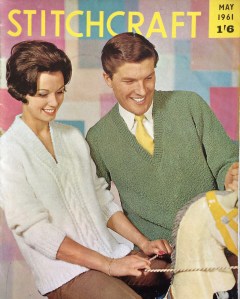 Time for the Summer Forecast! “Editress” Patience Horne writes that it is “a lovely sunny day in March” as they go to press for the May issue. It’s freezing cold and pouring rain where I am on May 2nd, so my summer forecast feelings have been literally dampened.


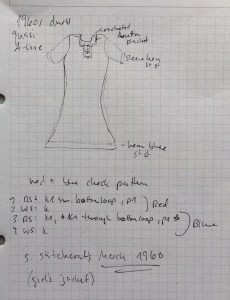 This month’s project was a little bit different than usual. Instead of making something from the April 1961 issue, which didn’t have any projects that really spoke to me, I decided to finally make something I’ve been dreaming of ever since I made
  I chose a typical basic construction with front, back and sleeves all made flat and separately from the bottom up and sewn together, and made a stockinette-stitch hem with the blue yarn. The dress shape is a modified A-line: flared at the hem and narrowed to the top waist, then increased slightly at the bust. I used another knit dress as a pattern, but had to deviate from it as the stitch pattern made the fabric behave differently. The sleeves are short, simple and set-in. The front piece is essentially the same as the back, but divided in half after the armhole cast-offs and rounded a bit at the neck. The button band is plain crochet.
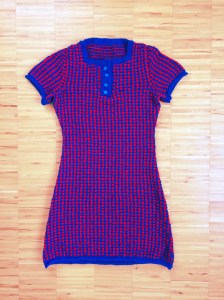 After it was all done, I realised that I liked the roll of the blue stockinette stitch hems, so I decided to just leave them as is. That means the bottom hem is a little bit narrow in the blue part where it should flare out. I may or may not fix that in time, depending on my laziness levels.

 April showers bring May flowers, or so they say. I’ll just say that, after the last couple of weeks of March, that umbrella on the cover of this month’s issue looks really familiar. As does the model on the right — she was featured (with a more flattering haircut) in many issues throughout the 1950s.
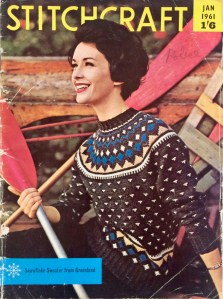
 to spend your holiday in April or May on the British isles or the North Sea coast, you will definitely want to wear one of the warm, bulky wool garments from this issue. “Jenny”‘s thick, double-knit Norwegian-style jumper and hat, described as “dazzling designs to cut a dash on the beach this summer”, tells you everything you need to know about that.


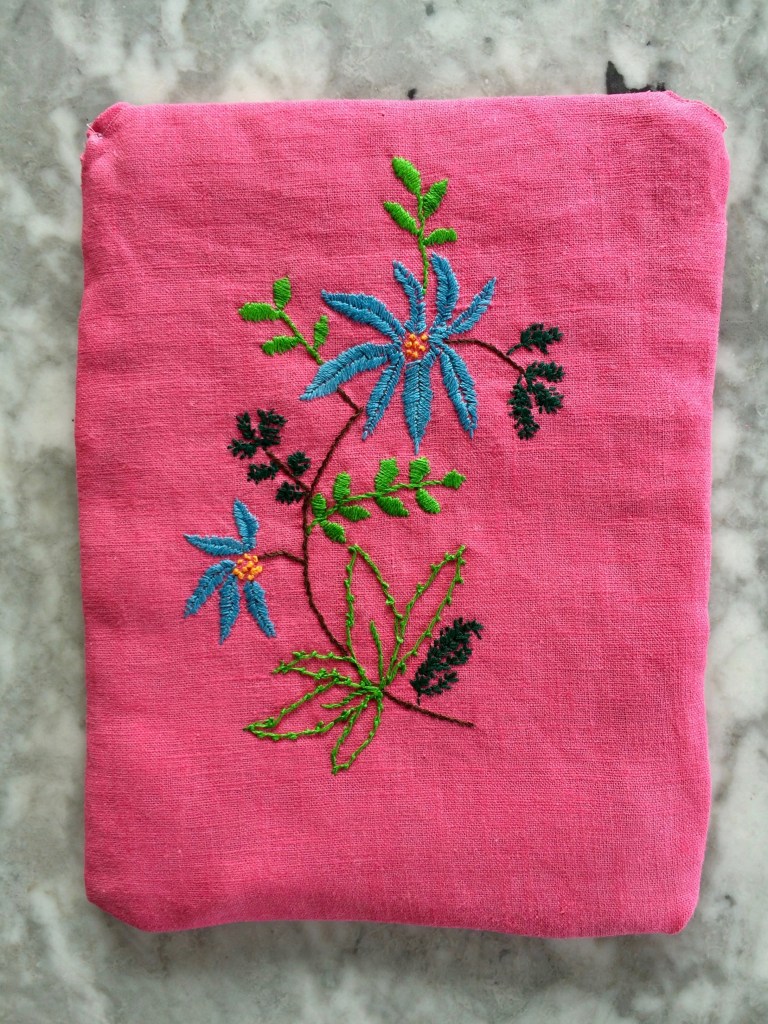
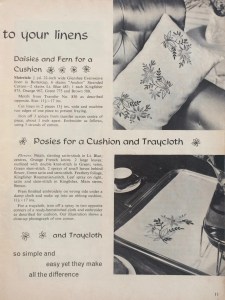 My Stitchcraft project this month was a simple embroidered spray of flowers, originally intended as a decoration for a cushion or traycloth. Having enough cushions and not using traycloths, I updated the design for an iPad cover similar to


 Are you ready to “Rendez-vous with Spring”? I sure am! This month’s issue has a lovely extra “centerfold” spread in colour, showing off Spring 1961’s latest fashions.


 The ads are for the usual knitting machines and sewing fabrics… except for this one, for “Cooper’s moth proofer” spray, presumably made of
  After January’s time- and labor-intensive pullover for me, I wanted to make something quick and easy in February. And there’s always a friend, colleague, or relative having a baby, so I made this simple ” Tiny Cardigan” from the cardigan and slipper set.
 The cardigan has a basic bottom-up raglan construction with the twisted ribbing featured in January’s


 January’s project was — like


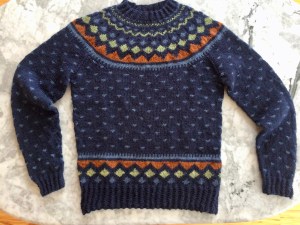 After thinking it over, the most reasonable course was to work the little bit of pre-yoke between the armhole bind-offs and patterned yoke back and forth with raglan decreases as written, but beginning the front neck shaping (pre-yoke, concurrent with the raglan decreases) an inch or so lower than the back. That preserved the proper stitch count, let the sweater hang better, and shortened the yoke a bit. I didn’t mind shortening the yoke, as I like sweaters to be snug under the arms and not too high on the neck. I didn’t need a zipper, so I made the patterned yoke entirely in the round.
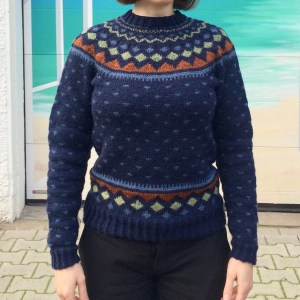 It worked out perfectly! I could hardly believe it. Raglans and round yokes may be somewhat forgiving on the body, but it is a fundamentally tricky mathematical game to make all the interdependent factors of width, depth, and pattern repeat come out right, so I was really proud of myself for making it work. My only other modifications were on the sleeves (longer) and the waist shaping (original pattern had none, I started out narrower at the waist and increased gradually at the sides to give a more figure-flattering look.)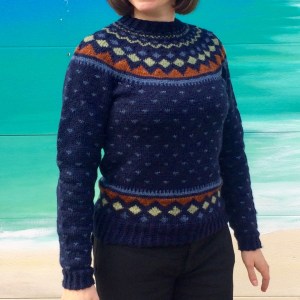


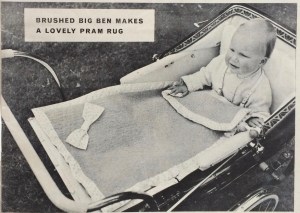


 My December project was a warm winter dress for a baby, part of the “Baby’s Special Outfit” of dress, bootees and mittens that continued the baby set started in the November 1960 issue.
 I used a lovely 100% wool that was hand-dyed by a fellow knitter in my local knitting group. She uses natural dyes from plants in her garden, or the bits of food items that are normally not eaten: walnut shells, onion skins, and so on. This green-melange wool was dyed with red onion skins! She did explain to me how that worked, but please don’t ask me, because I forgot the answer already. Anyway, it’s very nice. I was worried that it might be too scratchy for sensitive baby skin, but wash-blocking it and rinsing with hair conditioner softened it up quite a bit.

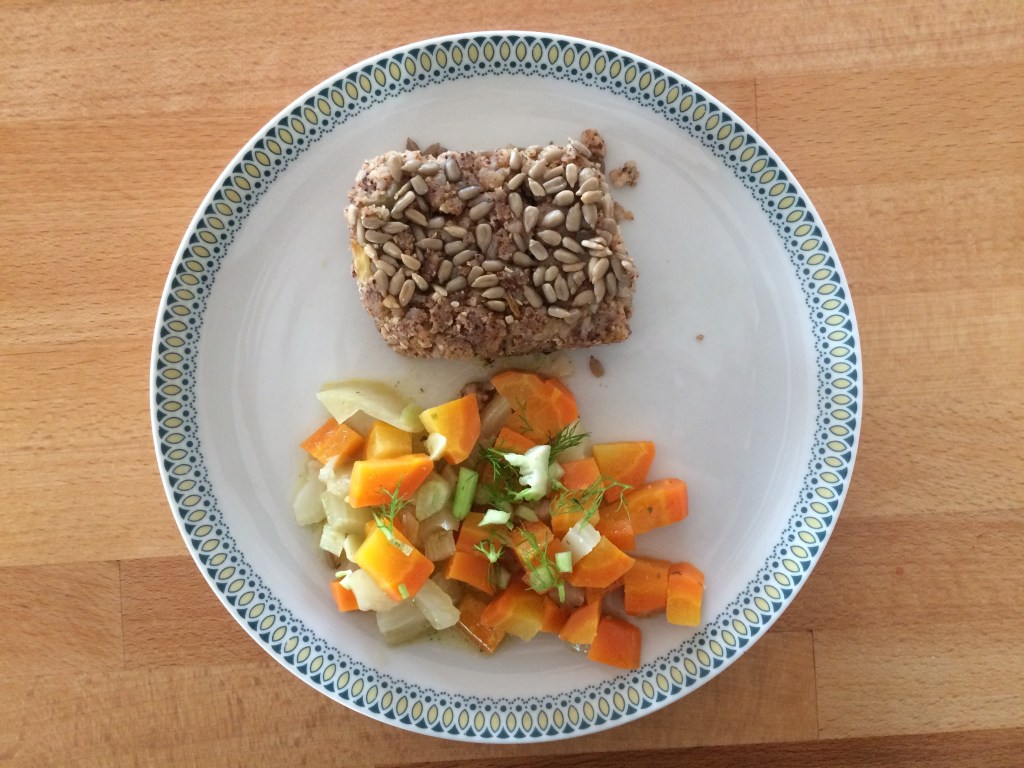
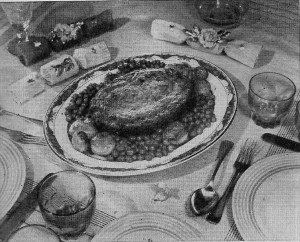 In its earlier decades, Stitchcraft included a page of easy and economical recipes in each issue, mostly for tea-time cakes or pastries. The tradition ended around 1950, so none of my 1960s issues have a recipe page, but I do have a few magazines from the late 1940s and thought this would be a fun time to try out their “Christmas Cooking” ideas.


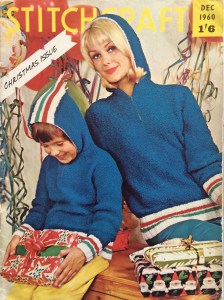 This year (1960 or 2018, take your pick) draws to a close with Stitchcraft’s “Christmas Issue”, which, as you may expect, is full of holiday-themed novelties to decorate and give.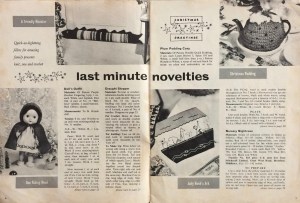


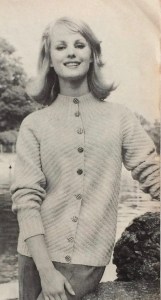 Adult women, having hopefully embraced the “new length” (long) and “new sleeve style” (3/4 or 7/8) from last issue, can get ready for Paris’ “new necklines” — a high turn-down-and-rib combination or a buttoned-up turtle (polo) neck. No turn-down collars this time — are they on the way out? There’s a new yarn to go with them, Cameo Crepe, which is smooth and less “hairy” than other wools, for good stitch definition.


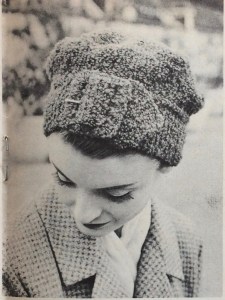 November’s project was a little cloche hat, made out of leftover wool from July’s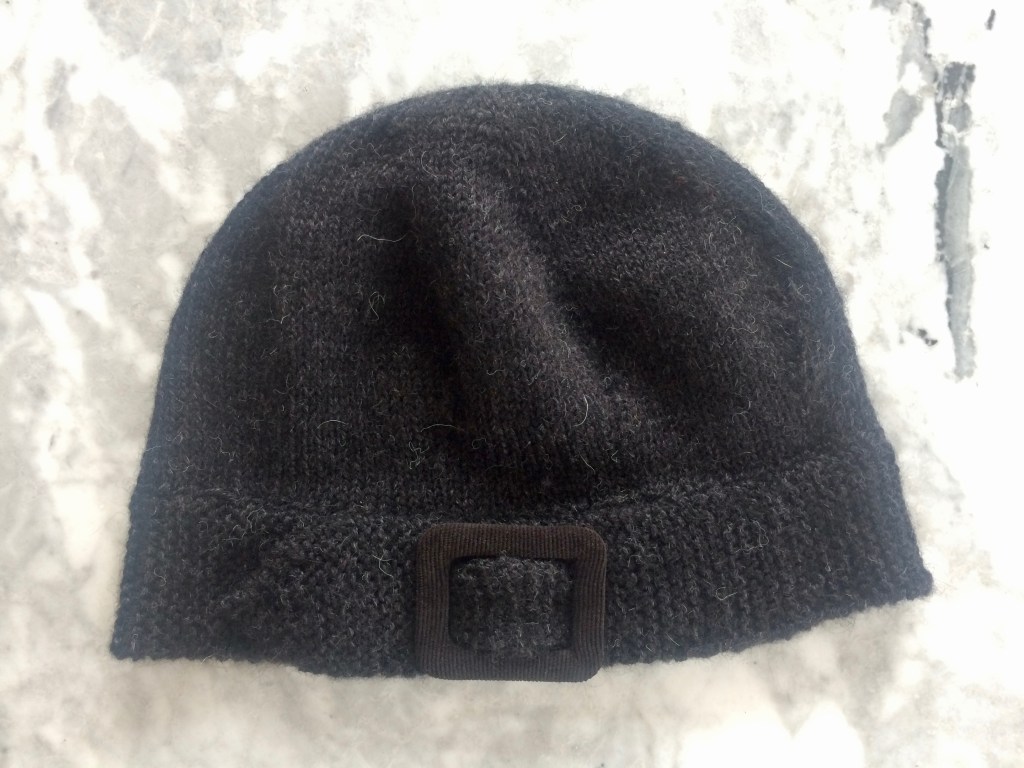
 The Stitchcraft Sixties