
EDIT March 18, 2025: Finished!
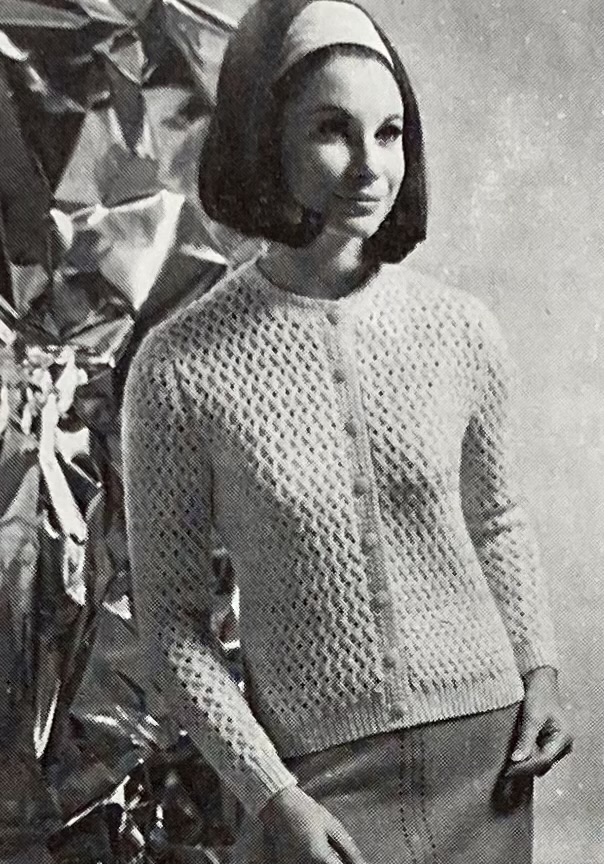
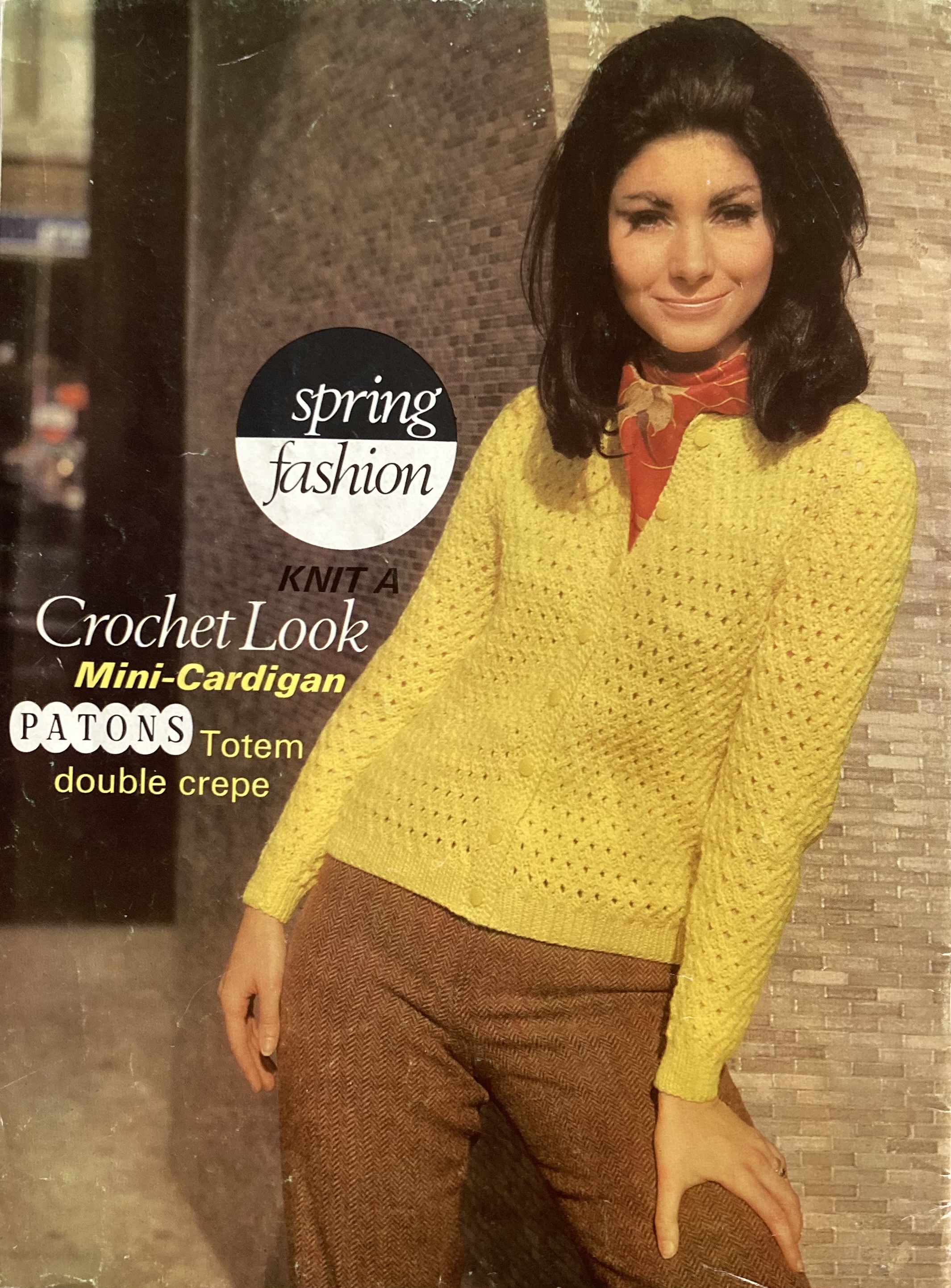
The February 1967 issue of Stitchcraft picked up the trend for knitted work that looks crocheted with a “mini-cardigan” featured on the back cover. Interestingly, it bucks the other, longer-lived trend for oversized and shapeless garments, being more close-fitting and just above hip length. (Though more on that later…) The construction of the cardigan is quite basic, with no shaping in the body (the pattern makes it conform to shape nicely… though more on that later) and a plain, high neck. The edgings are actually crocheted.
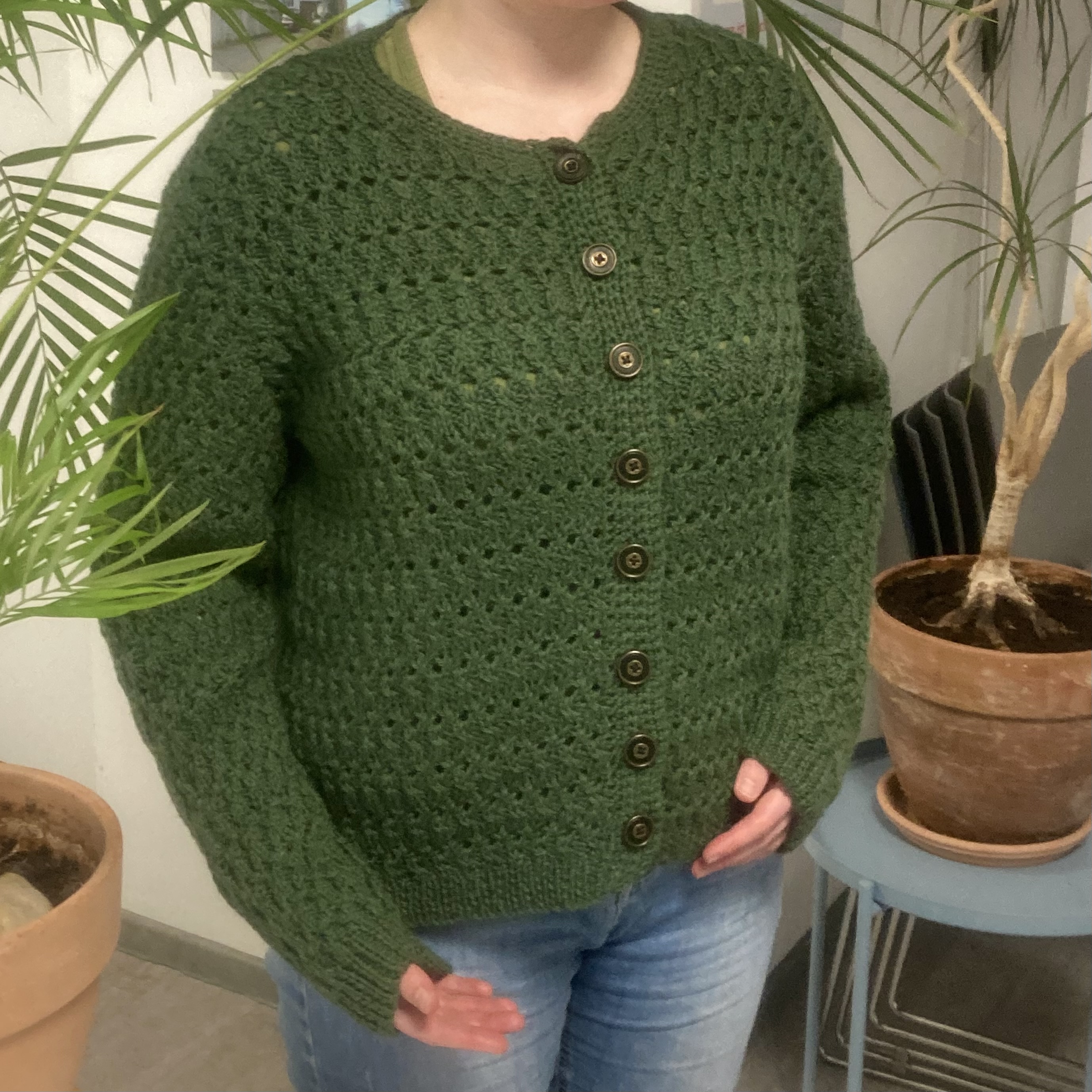
It’s designed to be made in Patons Totem Double Crepe, a very smooth, worsted-spun 100% wool that shows the pattern well. A merino wool or something like Lana Grossa Cool Wool would have be the most appropriate modern equivalent. but I was still trying to reduce my stash and I had 200 grams of Drops Lima that I could add to that and hopefully buy just the right amount to use everything up. Lima is less smooth than it “should” be for this cardigan, since it’s 35% alpaca, but it’s spun tightly enough and anyway, I like it and it works. The color is more “loden” green than it appears in my photos. For some reason it doesn’t photograph very well — I’m guessing that the three-dimensionality of the stitch pattern messes up the automatic light sensors.

The pattern is sort of based on 2×2 rib, overlaid with twisted stitches and double yarn-overs to give a trellis effect. It was also very slow to knit, with twisted stitches on both RS and WS rows and a fairly large number of stitches per row, as it pulls together quite a lot. The fabric it makes is both stretchy and clingy, and quite warm in a thermal-blanket type of way, as well as being very heavy. I calculated it out from the Totem DK yarn weight and started with 600 grams. That started to look like it wouldn’t be enough at all, and I was on tour and hadn’t packed all of the wool, so I bought another 150 grams while on the road. That was, of course, more than necessary and now I have almost 150 grams extra. So much for destashing!
Apropos pattern, here it is:
- Tw2L = k into back of 2nd st, then front of 1st st, slip off tog
- Tw2R = k into front of 2nd st, then front of 1st st, slip off tog
- Tw2M = p into front of 2nd st, then front of 1st st, slip off tog
- Row 1: p2, *k2, p2*
- Row 2: k2, *p2, k2*
- Row 3: p2, *Tw2L , p2*
- Row 4: as Row 2
- Row 5: p1, *k2tog, bring wool forward to front of work, wrn, sl1-k1-psso*, k1
- Row 6: k1, p1, *(k1, ktbl) into the two new loops, Tw2M* to last 4 sts, (k1, ktbl) into the two new loops, p1, k1
- Row 7: p1, *Tw2L, Tw2R*, p1
- Row 8: as Row 4
For whatever reason, I couln’t make Row 6 work the way it was supposed to. There were two “extra” loops from the yarn-overs in Row 5, but the way they lay on the needles made it impossible to knit the first and then ktbl the second. I tried making the yarn-overs in the other direction on Row 5 and that didn’t work either. What did work was k1tbl, k1 on Row 6. I’m guessing the designer held her needles differently or did the yo / wrn from another direction.
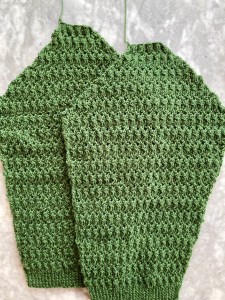
After the ribbing (on 3.5 mm needles), it is supposed to be knit on 4.5 mm needles. I started with 4 mm needles, since I didn’t want to yarn to stretch out too much. That seemed too tight, so I switched to 4.5 mm needles after a couple of inches on both the sleeves and the body. I finished the sleeves at the end of February and the rest on the long tour with many plane and train rides, making the back and fronts in one piece.
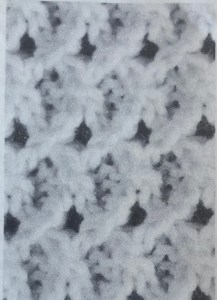
Somewhere near the end of the fronts, I re-read the pattern and realised that I had been knitting it wrong all along! After one pattern repeat, you are supposed to repeat rows 3-8. I repeated the whole pattern, rows 1-8. So my stitch pattern was slightly elongated vertically. It honestly didn’t look much different from the pattern close-up photo in the magazine, though.
The jacket seemed to be knitting up a bit larger than I wanted, but I couldn’t try it on properly until it was finished. It was a little bigger and floppier than I wanted (so heavy!) but the pattern would make it pull in tighter… right? right? No! I made the (crocheted) borders nice and tight in the hopes they would rein it in… not enough. After blocking, it just ballooned in all directions and ended up too big for me — I don’t like the “oversized” look. I decided to sell it or give it to a good home, and luckily a fellow knitter from my knitting group liked it and bought it from me.
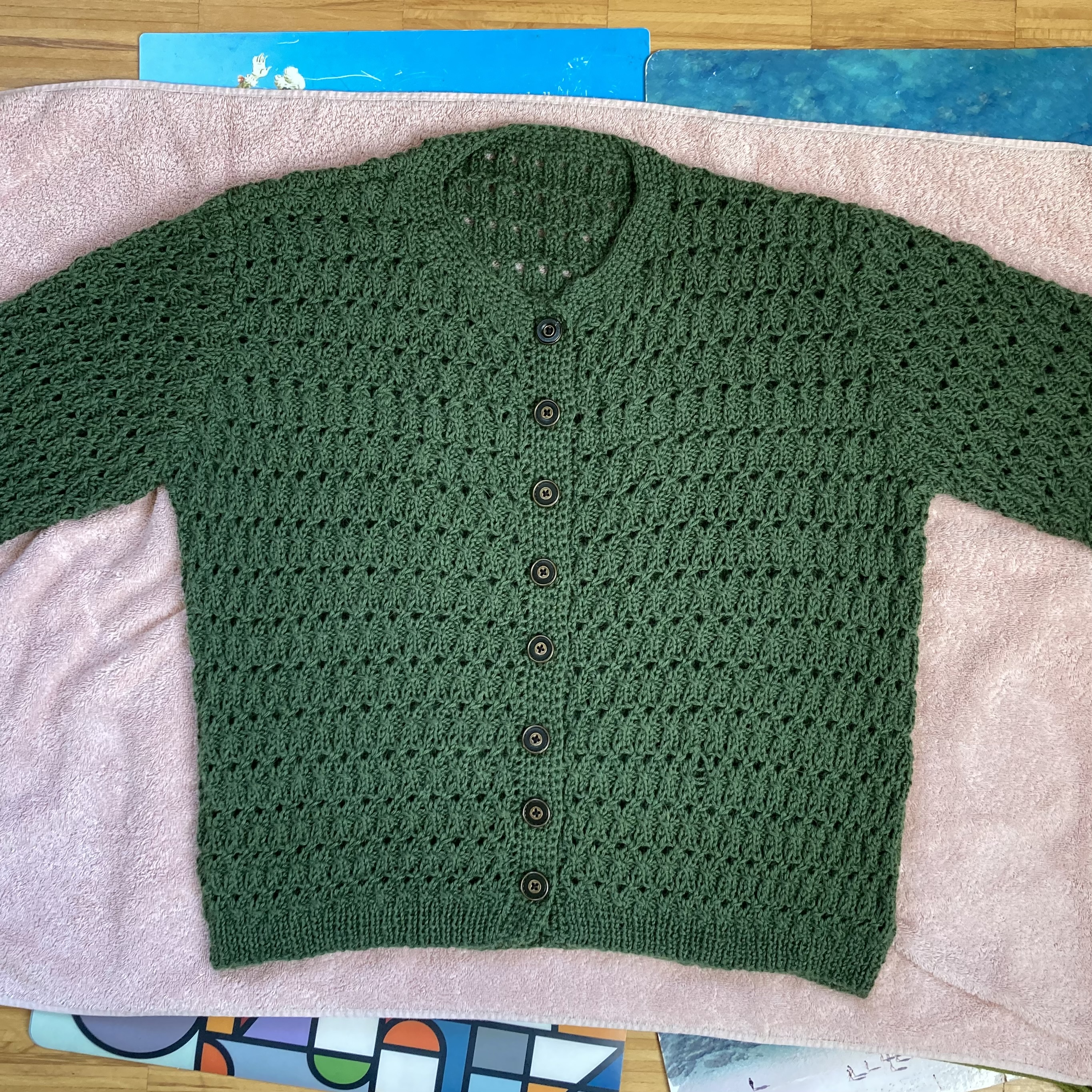
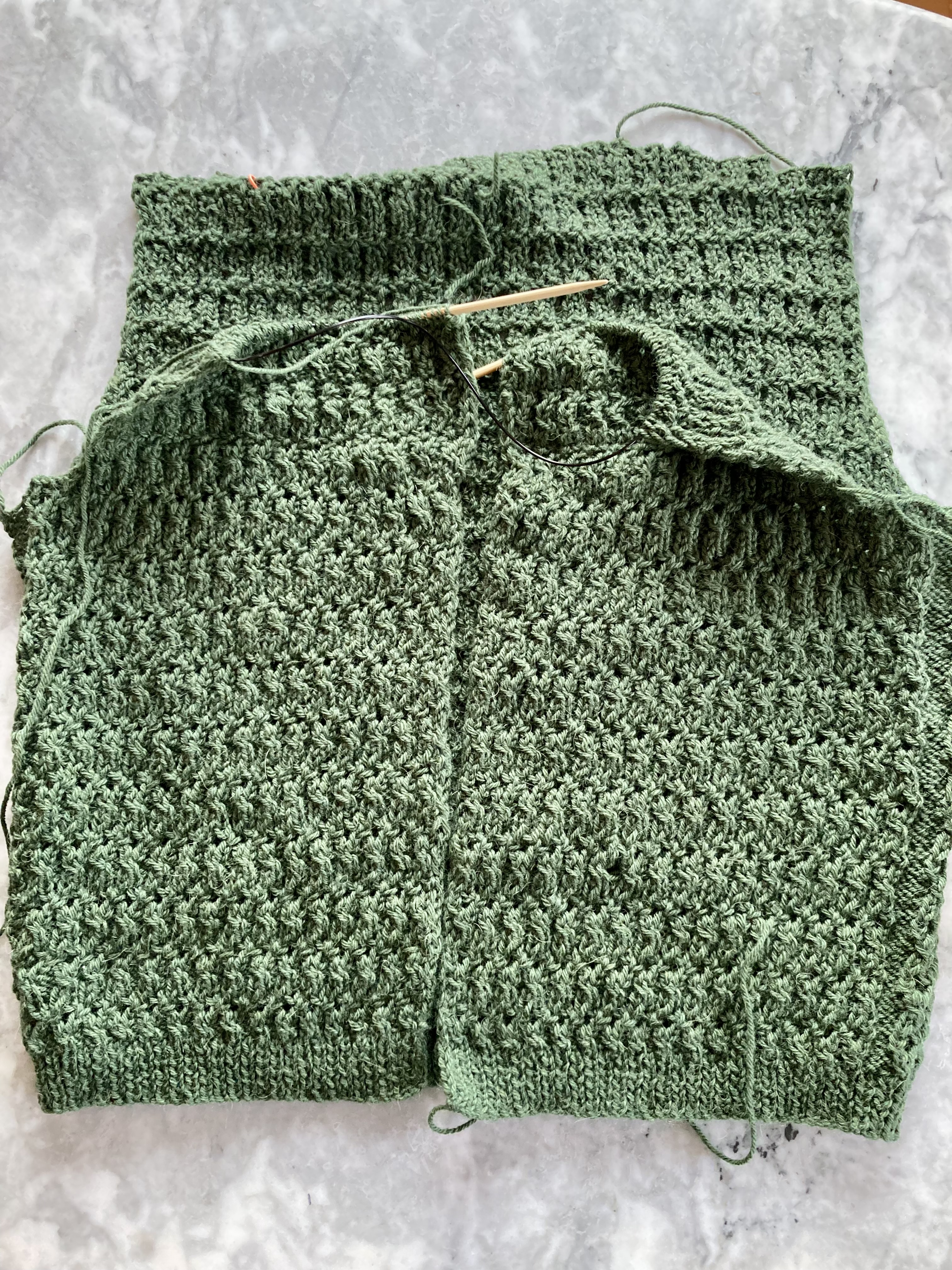
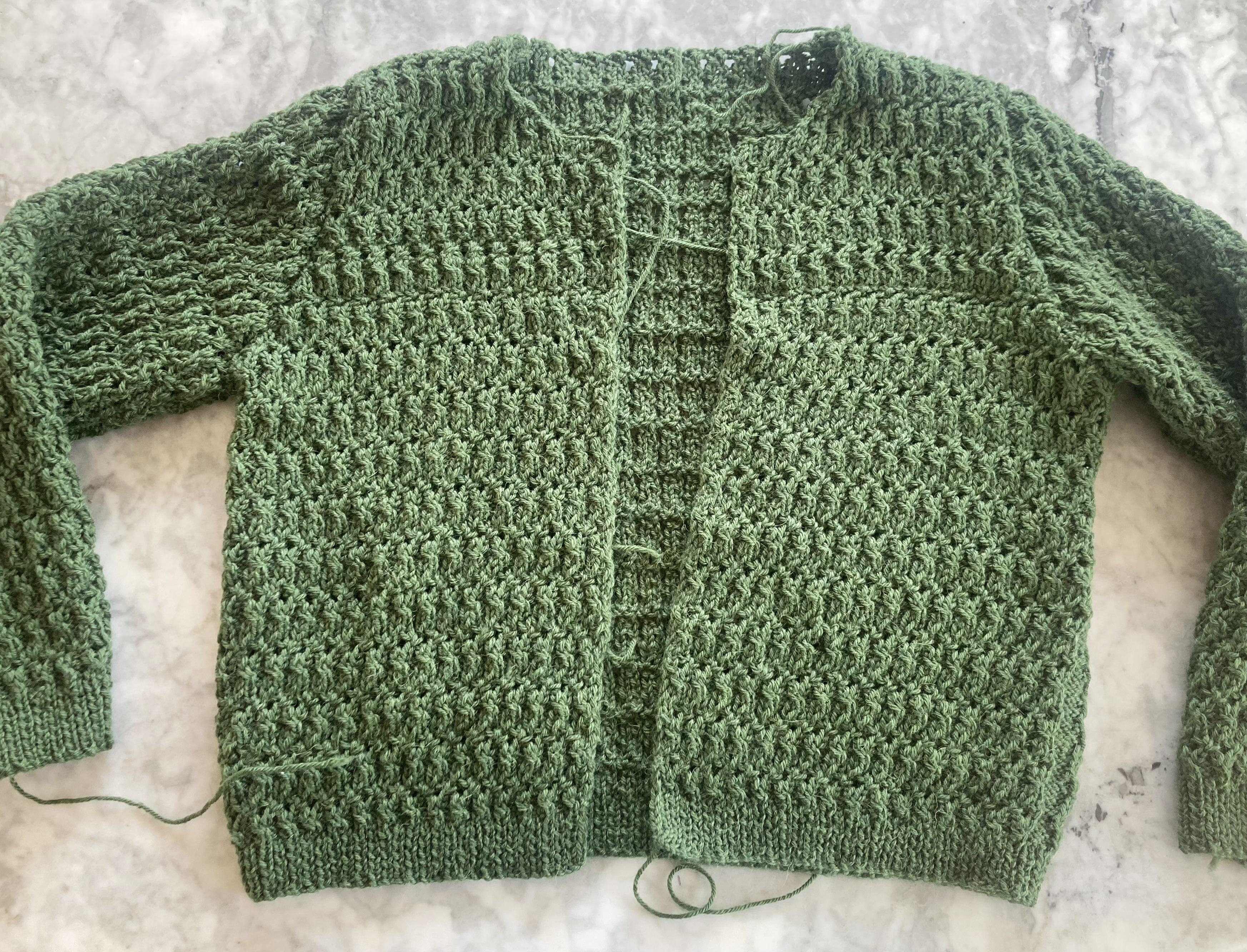
Sadly, this project was more frustrating and less successful than I wanted. The sizing did not work out, the wool was too heavy, I made the stitch pattern wrong… there were just too many problems. On the up side, I love the pattern and the colour, the wool is warm and soft and cosy, and I even found incredible buttons that match the colour and style perfectly. Most importantly, my knitting friend is happy to have the cardigan, so I guess “all’s well that ends well.”

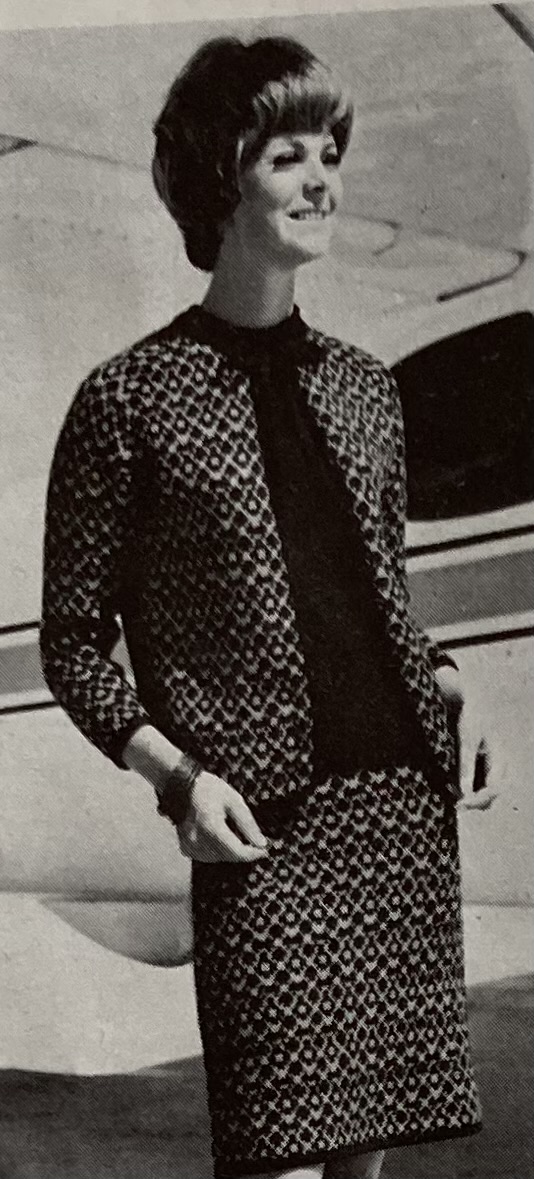




 The Stitchcraft Sixties