August 1963: Overview

End of the Season! Sadly, yes, the “holiday” season is drawing to a close and although it’s only the last day of July, it feels like autumn is around the corner. On the bright side, the late summer and autumn issues of Stitchcraft are always the most fun, with a good range of lighter-weight and warmer garments, children’s things for school, and more intricate homewares.

“The trend for colour use is in these bold clear motifs” writes “editress” Patience Horne, a trend which is reflected in “chunky”, boxy shapes, bright colours and simple stripe or geometric designs. The cover illustration shows two of a three-piece “his and hers” set — cardigan and mock-layered turtleneck for her and a buttoned-collar pullover for him– that all make use of single bold stripes. The woman’s matching pullover is made to look like a deep V-neck over a turtleneck top, but the under-layer is just an insertion knitted separately and sewn in.

There’s more use of simple, geometric motifs in the other women’s garments: a classic pullover with a wide check stripe down the front in double knitting and a colour-block cardigan with diamond motifs made in bulky “Ariel” wool. Diamond shapes are still trending from last month. There’s a bulky indoor-outdoor cardigan jacket in Big Ben wool, made in a slightly less simple striped waffle stitch. Necklines are high, whether buttoned or not, and collars are either big and square or non-existent.

Continuing the interesting neckline/collar trend, we’ve got unisex “tomboy tops” for children, with a cute “tie” decoration on one of the pullovers. Simple, bold stripes and pointy diamond patterns show up here as well, whether in colour or as a stitch pattern element. The one lighter-weight design is a square, buttoned-neck pullover with double stripes near the hem and a coordinated skirt. Rounding out the garments is a lovely classic cardigan for men featuring cables on the upper yoke and — you guessed it — in two simple lines down the fronts.

Unlike the knit designs, some of the embroidery and tapestry projects are quite elaborate and ornate. Look at these Chippendale chairseats! That seems quite out of place to me in a modern 1963 home of clean lines and unfussy decoration, but of course many of Stitchcraft’s readers were older and/or conservative in their style, and probably not on the cutting edge of home redecoration even if they had the money to spend on it (which I’m guessing most of the readership didn’t.) The “peasant motif” tablecloth and cross-stitch place mats have more of a clean, colour-block aesthetic. I really love the tablecloth design! It can also be adapted for a cushion. Speaking of cushions, here’s a fancy one made of essentially two very large, intricately knitted lace doilies joined together around the cushion base.

And let’s not forget that standby of every proper 1960s home… the fluffy hand-made bathmat and matching well-dressed “pedestal” aka toilet! Hats off to every grandmother and great-aunt who kept true to this amazing home furnishing concept throughout the rest of the 20th century. (Seriously, one of my great-aunts had a setup like this in her guest bathroom in the plushiest, fluffiest, yellow and black shag carpeting you could imagine, and I’m pretty sure it stayed there until the turn of the millennium.)

That about wraps it up for this month’s issue. The ads are unspectacular and a new children’s comic is starting up, featuring twins Joe and Jenny on their hunt for the legendary “Smuggler’s Sack” that just might be waiting to be found in the caves near the beach. Good luck, little friends! My project for this month will be the men’s cabled cardigan.

July 1963: Diamond Yoke Design

UPDATE August 21st, 2021: Finished!

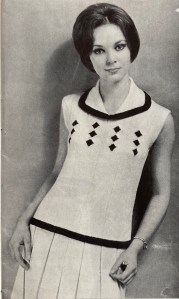
My July project was this sleeveless jumper with contrasting colour accents on the collar, upper bust and hem.

It’s written for Patons Cameo Crepe wool, but I thought a summer top like this would be more practical in cotton. Sadly, it is nearly impossible to find a truly fingering-weight, non-mercerised cotton yarn. Crochet cotton is always mercerised and I don’t like the stiff and shiny look and feel. Non-mercerised cotton is generally DK weight i.e. too thick. The only company I know that makes a nice, soft, pretty much fingering-weight cotton is Mayflower and I can’t get their yarn anywhere at the moment. Also, it’s summer, and cotton yarns, especially seem to be only available in “summer colours” of white, neutral and pastel, which I do not like or wear. What to do?

Well, remember my May project — the child’s T-shirt made with cotton from the Hamburger Wollfabrik? (Again, city, not food…)When ordering the yarn for that project, I went ahead and ordered 250 grams of the same cotton 4-ply yarn in a slightly darker colour, thinking that I would probably want to make a summer cotton top for myself at some point. That was good forward thinking… only, after making the May project, I realised I really didn’t like the yarn, as it was un-plied and therefore splitty and difficult to work with. The green colour I chose for myself was also still too “cold” — not dark enough or green enough for my taste. But since I didn’t know what else to do with it, I went ahead and used it for this month’s project.

The pattern is basically stocking stitch with “lines” of purl stitches to make a just-slightly-like-ribbing, geometric effect. It has a hemmed bottom edge, which was very much in fashion for knitted garments in 1963. As far as hems are concerned, I should probably have learned a lesson from this jumper from last year, which was also lightweight and hemmed, and has continually gotten shorter and wider with time — the hem neither weighs enough nor cinches in enough to keep the sideways expansion in check, thus ruining the “long-line” effect and making me look short and dumpy in it. At this point I am convinced that hems do not belong on knitted garments unless they are heavy enough and really need to be flared at the bottom, e.g. an A-line coat, but of course I didn’t have the foresight to think about that before starting and replace the hem with ribbing. We’ll see how it turns out.

The knitting itself was boring and slow. The intarsia diamonds were fun, at least. (I used bits of leftover black merino for the contrast colour parts.)

The sleeves are finished with simple ribbing that is supposed to be turned in and hemmed, like the bottom edge, but I decided it looked better with just ribbing. The collar is made, in typical 1960s style, without short-rows as one would probably make it these days — there are increases and decreases at the front “corners” to make the shaping. The black edge of the collar is also hemmed and then the collar is sewn on.

This will probably never be my favourite project, but it turned out better than expected. The colour is not the best for my skin tone, but it looks much better now that I have pink hair! Also, I should have made the larger size. It fits OK, but a bit longer and wider would be more in keeping with the way it is supposed to fit. Also, the neckline is very tight — I can hardly get it over my head and definitely not over a bouffant hairdo. (And a top should always fit over your bouffant hairdo.) But it’s comfortable and fun — and best of all, it’s finished!

July 1963: Overview

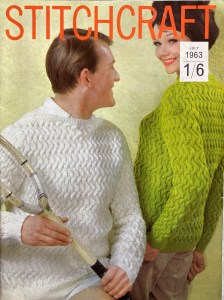
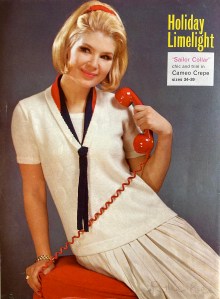
Cover photo of Stitchcraft magazine, July 1963

“In the Holiday Limelight” is the theme of this month’s issue, covering sporty, casual garments for holiday wear, a few slightly more dressy options and — with one incredible exception — quick and easy homeware projects.

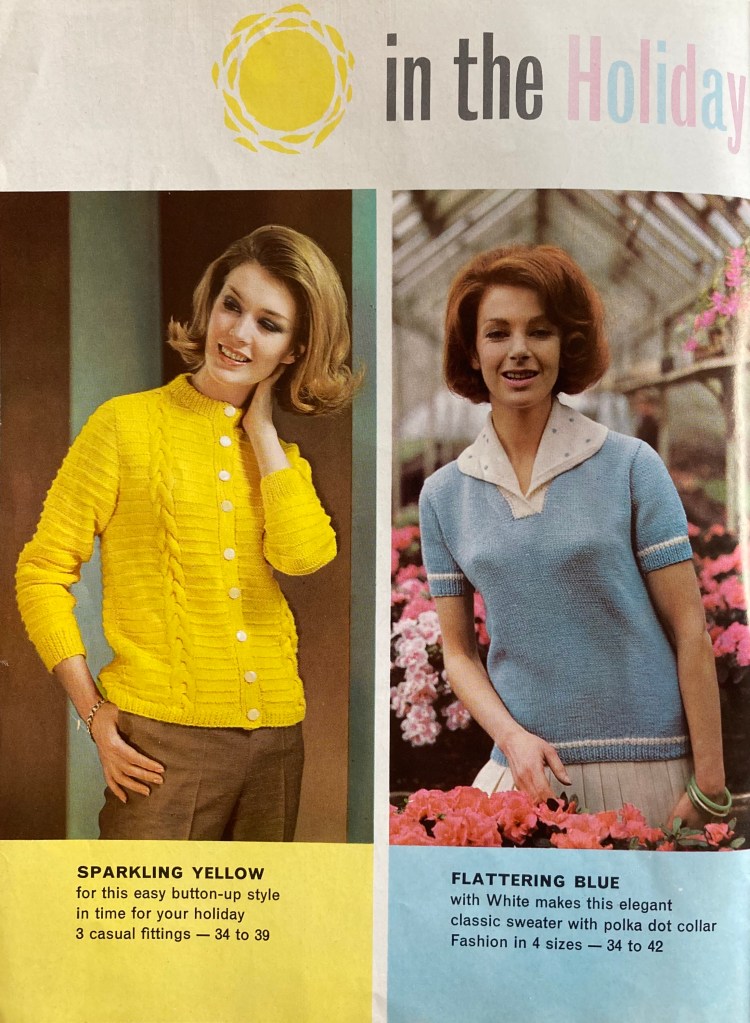
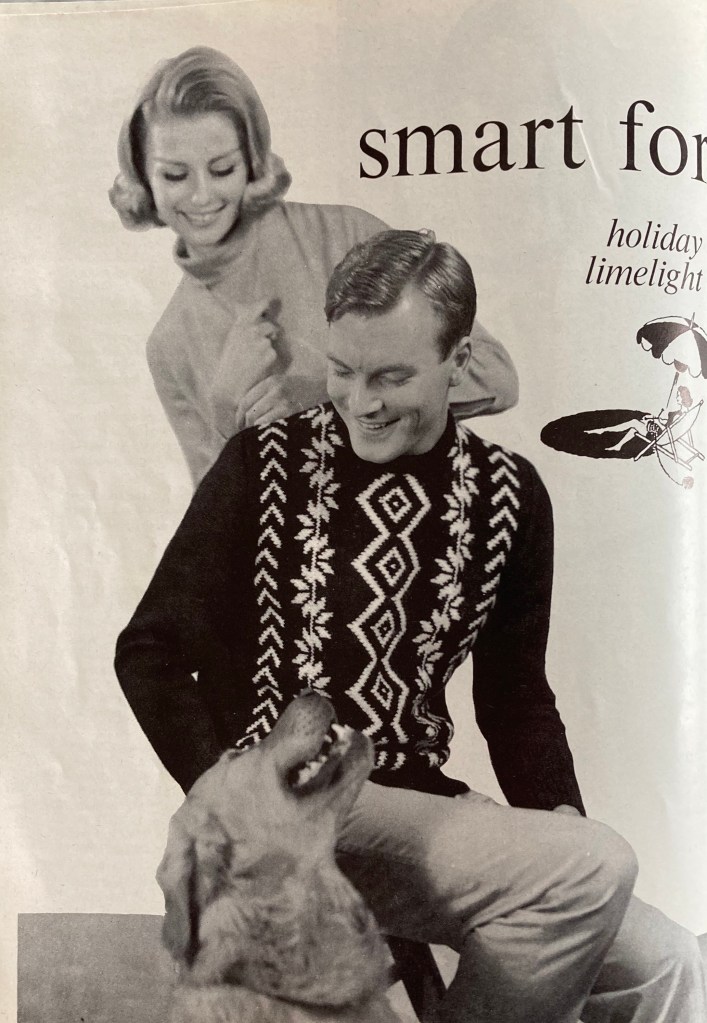
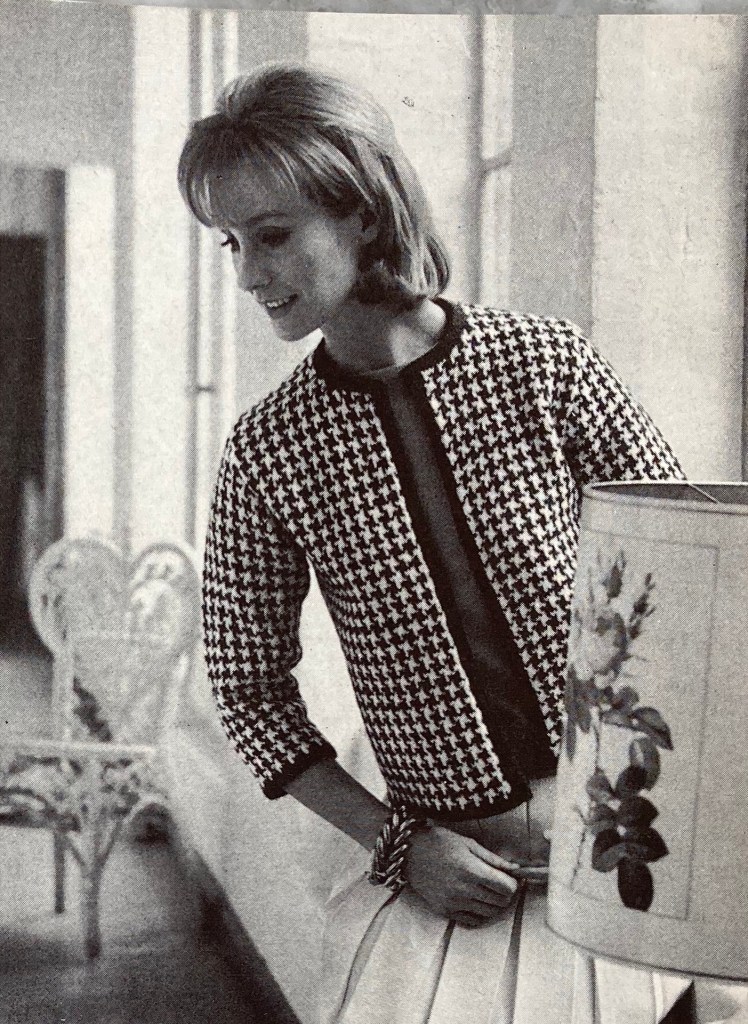
Most of the adult garments seem quite warm and heavy for summer wear, but most are meant to be worn as outerwear in an unpredictable northern-maritime climate. Our partner-look cover duo, for example weighs in at 22-24 (hers) or 28-30 ounces of heavily cabled DK wool and is expressly touted as “in colour for sailing” (hers) or “white for tennis” (his). I imagine it would be quite warm for tennis but probably very good for sailing, as the textured stitch pattern would ward off splashes and insulate from cold winds. Unusual cables are also featured on the bright yellow button-up cardigan, while the design (“from Vienna”) of the mens’ black-and-white pullover suggests a cable-like vertical movement in the sideways-knitted colourwork front piece. A short-sleeved collared jumper and houndstooth-pattern jacket round out the warmer, double-knitting-weight garments.

For more dressy occasions, there are two lightweight jumpers made of Patons Cameo Crepe (fingering-weight wool with a tight twist for a smooth texture in stocking stitch). Both have a slightly nautical theme, at least in the names and colour choices. The “sailor collar” jumper is excellently photographed with matching red hairband and telephone! The diamond-pattern jumper in white with marine blue has a similar round collar to the heavier short-sleeved jumper, as well as a similar idea of using little dots or diamonds as decoration. (I imagine the diamonds must be placed very carefully to fall above the bustline.)

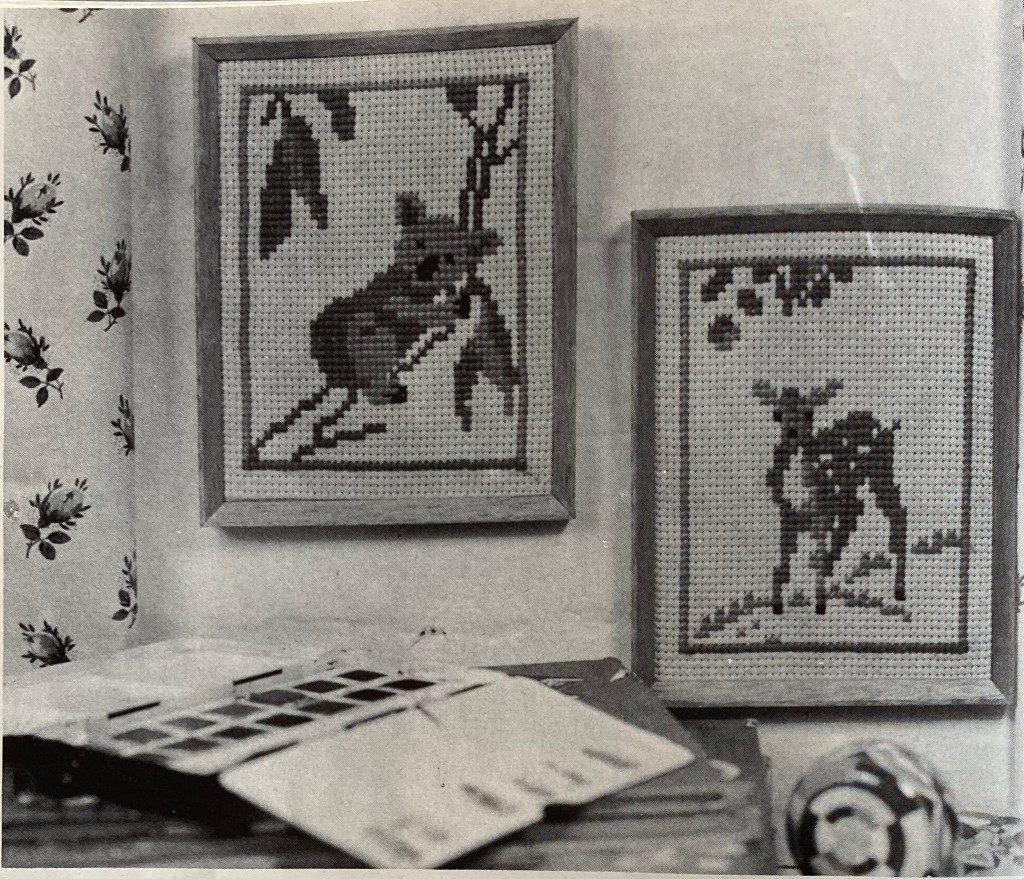
There’s a charming striped cardigan for a young girl, who could be encouraged to practice her budding handcraft skills on two miniature cross-stitch pictures — a deer and a koala bear. Embroidered on Bincarette mesh fabric (an older word for Binca fabric, roughly the same as Aida but slightly fewer threads per inch), the background is not filled in, so there are very few stitches to actually make and they could be easily done by a young child to hang in her room. More experienced “embroideresses” can make this densely-worked cushion, which combines cross-stitch with Holbein or double running stitch in a tessellated design.

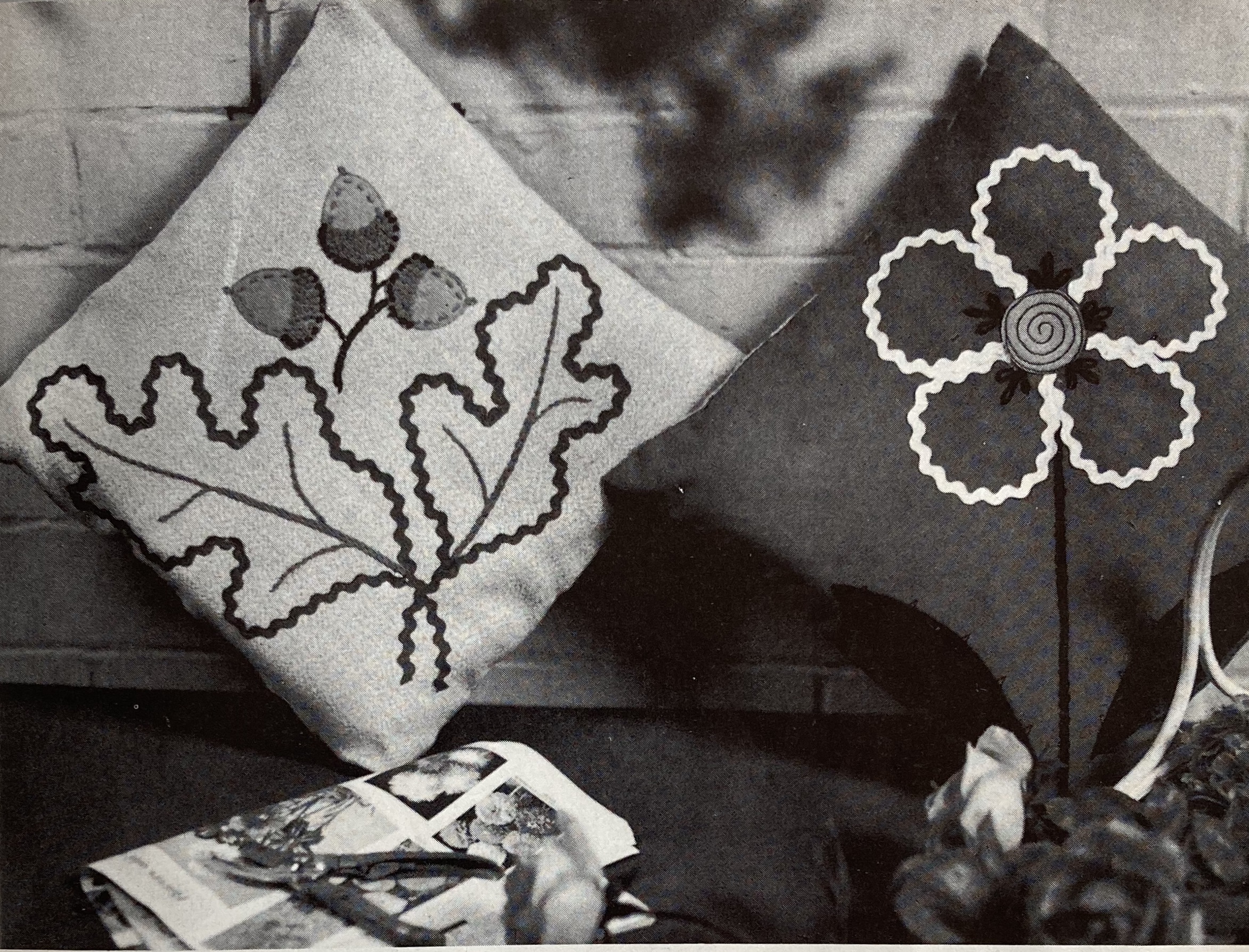
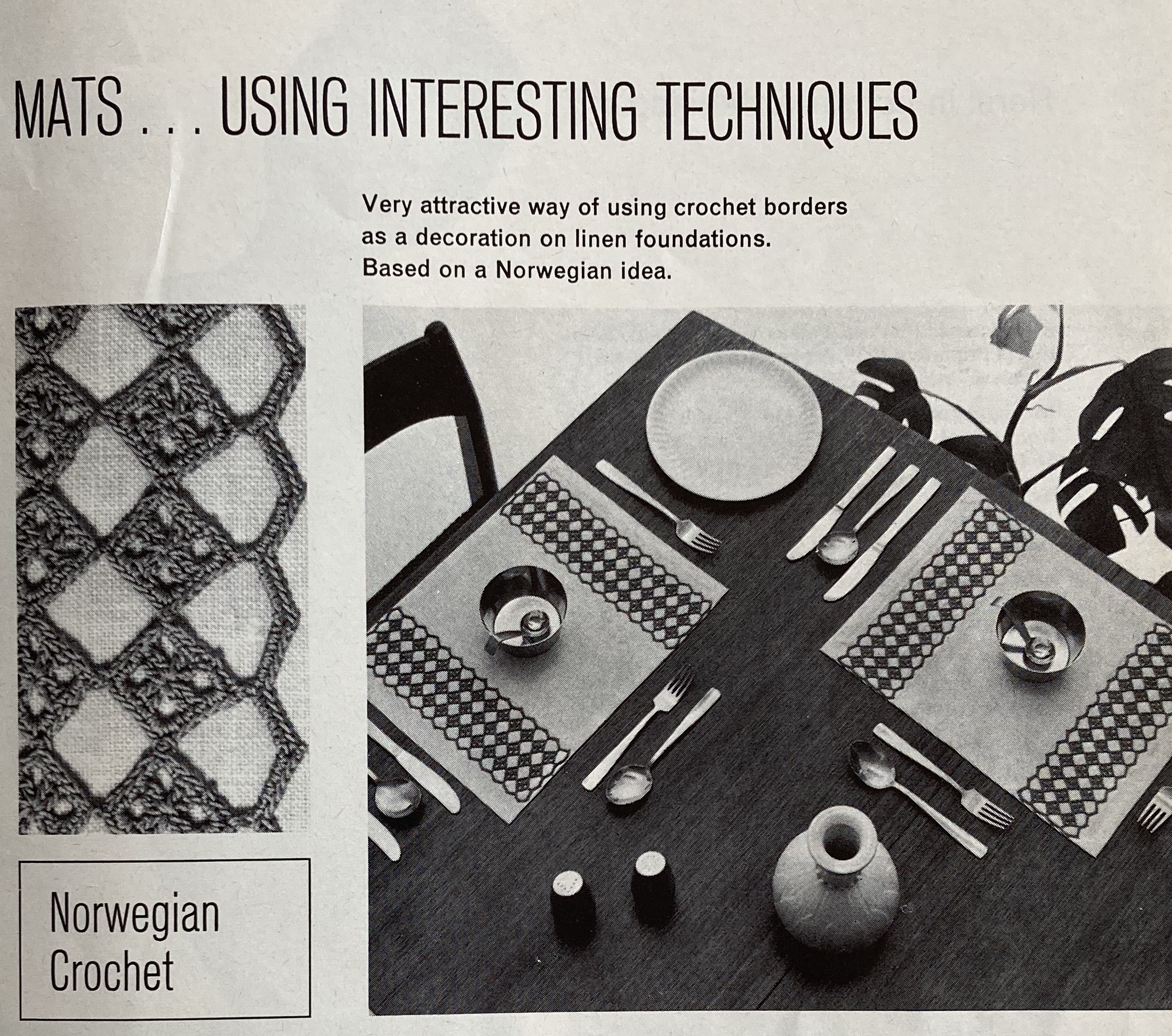
Continuing the homeware designs are two hard-wearing, but very easy to make, applique/embroidery cushions for the garden. Perfect for a staycation, they are made with strong sailcloth material and stuffed with foam clippings to repel moisture. Readers could set their garden table with interesting placemats made in blackwork or with appliquéd crocheted bands. Especially pious readers who prefer to spend their holiday doing church work can even make a kneeler, a Bible marker and/or a secular footstool cover in tapestry.

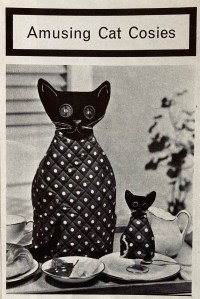
Oh yes, and in the is it-for-a-bazaar-or-is-it-just-bizarre category, here are some “amusing” coffee-pot and egg cosies in the form of sad, legless, eyes-follow-you-around-the room-quilted cats! Add them to your collection of murderous crocheted clowns, evil felt Father Christmases and disembodied-head egg cosies, or demand that your church sell them at their next bazaar in return for the lovely Bible marker you made for them.

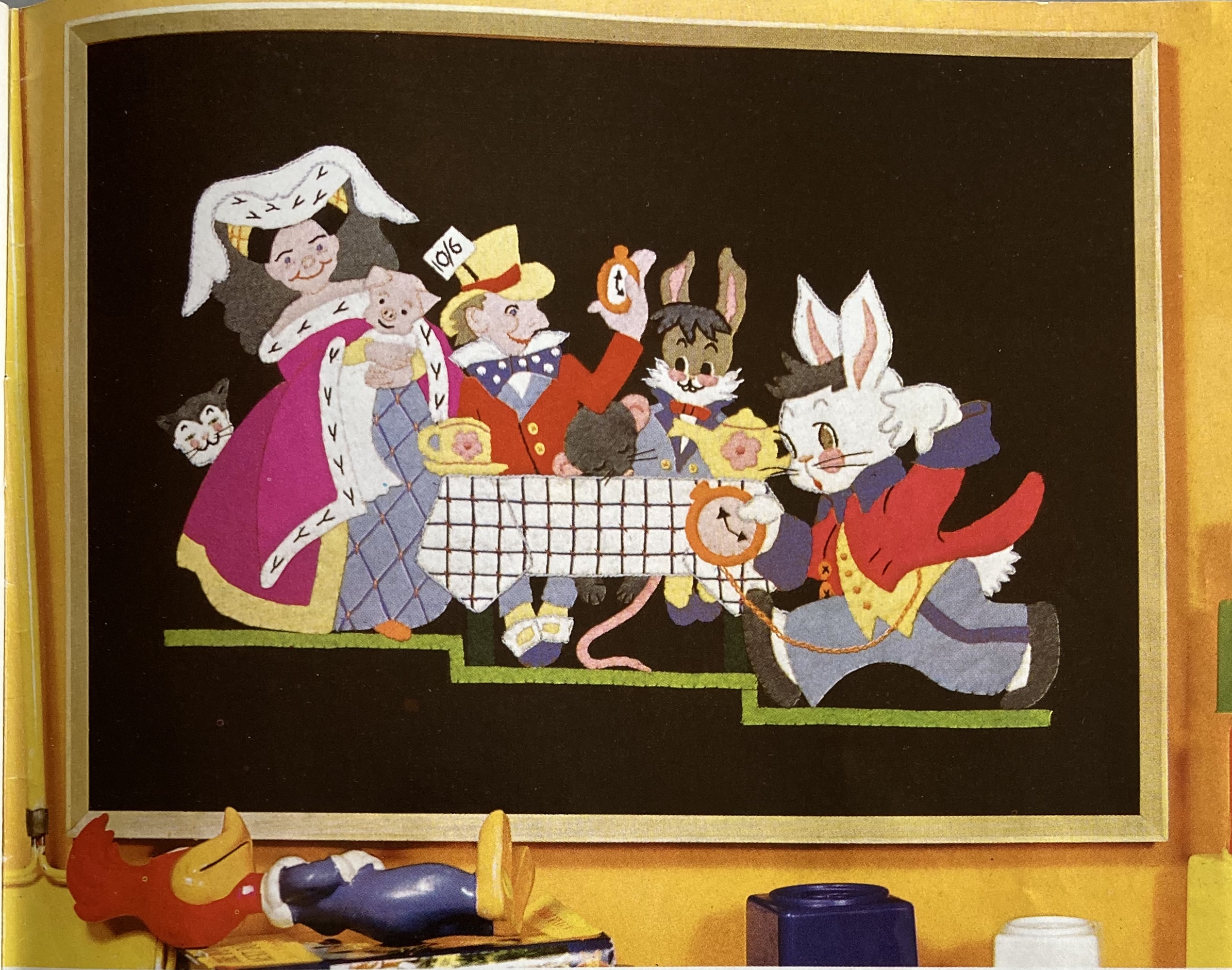
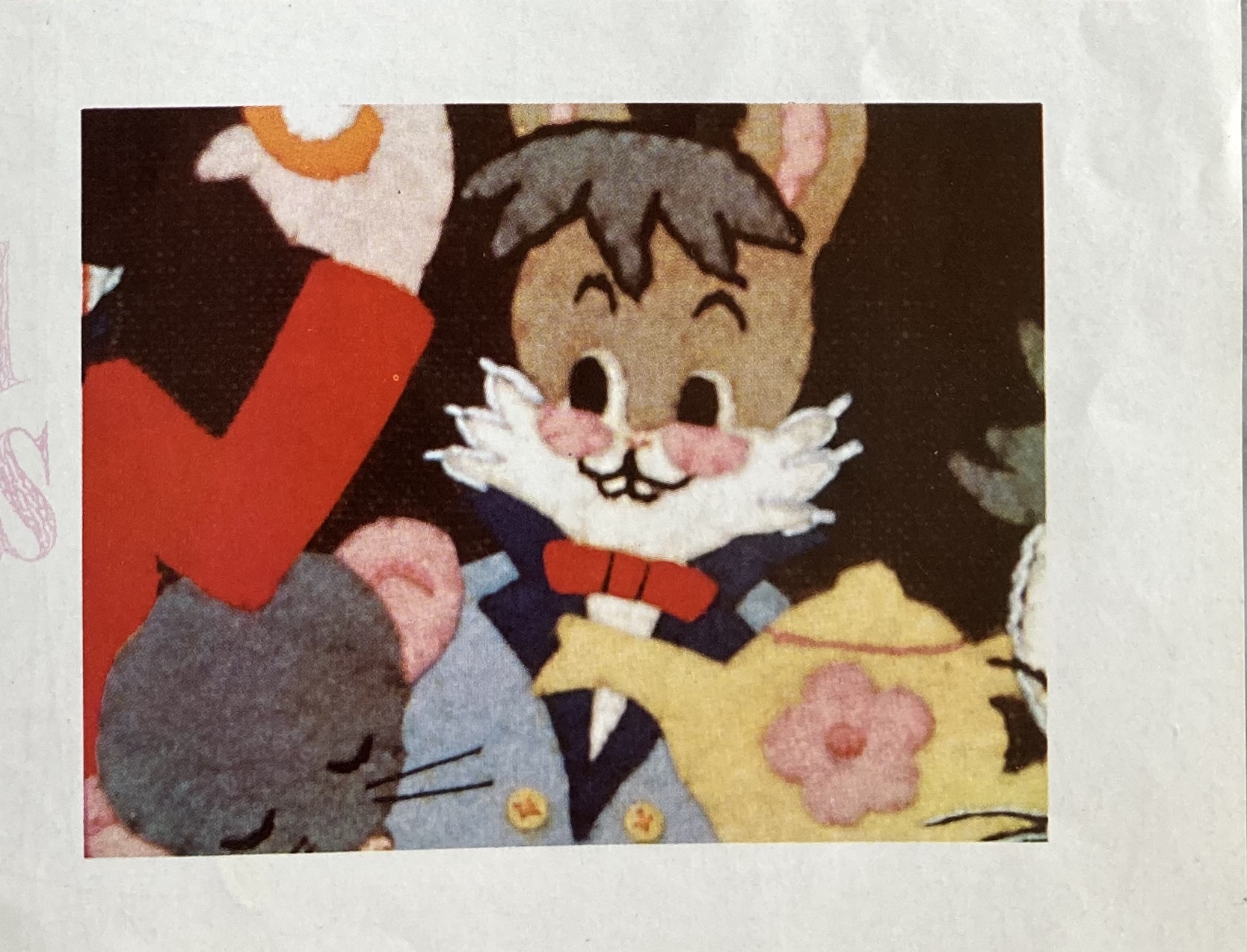
But wait, there’s more, and as always, the best comes last… Did I say that the homewares were easy, with one incredible exception? I am in awe of this large (16×22 inches) yet finely detailed appliqué wall hanging depicting the Mad Hatter’s Tea Party from Alice in Wonderland. It is the companion piece to the “Alice” wall hanging showing the Queen of Hearts and the gardeners from the August 1962 issue, and is designed so that both pictures can be fitted together to make a single panel. The stitch detail and precision required to make all those tiny felt pieces fit perfectly is amazing.

That wraps it up for our July 1963 issue! I will probably make the diamond-pattern jumper, since I have some more of the annoying un-plied cotton from the Hamburger Wollfabrik that I might as well use to make something with, and the long-line style will suit me well. I might, just might, also finish the blackwork butterfly cushion sometime soon. Happy Summer!