May 1963: Viennese

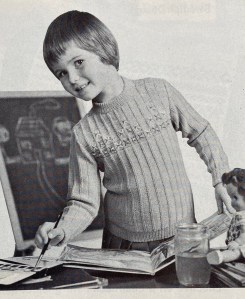
Photo from Stitchcraft magazine, May 1963

My May project was this jumper “from a Viennese design” for a young relative whose birthday was in May. Spoiler: unfortunately, the jumper was not ready in time for the birthday. May went by so quickly and I feel like I hardly made progress on any of my multiple unfinished projects. Let’s hope the kid doesn’t have a growth spurt before I finally get this done.

The jumper is written in a narrow reverse-rib pattern and the interesting stitch design on the yoke is embroidered on later. The recipient of this project was not opposed to the embroidery but very adamant about wanting the garment to have a “smooth texture”, i.e. stocking stitch. I aim to please, so stocking stitch it was, except for the yoke.
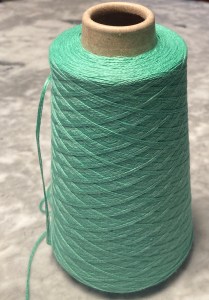
Cone of green cotton yarn

Said relative lives in a warm climate and is somewhat sensitive to wool at the moment, so I decided to make it in fine cotton. The tension according to pattern is 14 1/2 stitches in 2 inches, which is as much as I can ever accomplish even with very fine yarn and tiny needles, so finding cotton that works for me at that gauge is difficult — most cotton yarns are mercerised DK weight for making dishcloths, accessories, amigurumi, etc. Of course, there is always fine crochet cotton, but that is usually also mercerised (I don’t like the shininess of mercerised cotton.) Mayflower DK makes a lovely fine-gauge cotton that is hard to find in stores and can’t be ordered from their (Danish-language only) website. Yarn stores were still closed in my area in any case when I started this project and I didn’t have anything appropriate in stash. Luckily, the wonderful Hamburger Wollfabrik spinning mill company (as in, the German city of Hamburg, not the food! I realise that name sounds funny when you read it in English…), which was closed for a long time after a burst pipe caused severe water damage a while ago, is back up and running online with a brand new website and a beautiful selection of yarns of different fibres and weights. I chose the super-combed cotton in a 4-ply weight and a spearmint green colour.
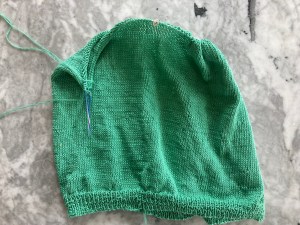
Work in progress -- knitted children's jumper

I was happy with the weight and colour of the yarn but unpleasantly surprised to see that it was completely un-plied! Nowhere on the website does it say what kind of twist they use, nor is there an option to select what you want, but the yarn in the sample colour photos definitely looks plied and my yarn was utterly not. It is really, really hard to work with un-plied cotton, as it just splits everywhere. I guess I should call them next time I order from them and ask about that.

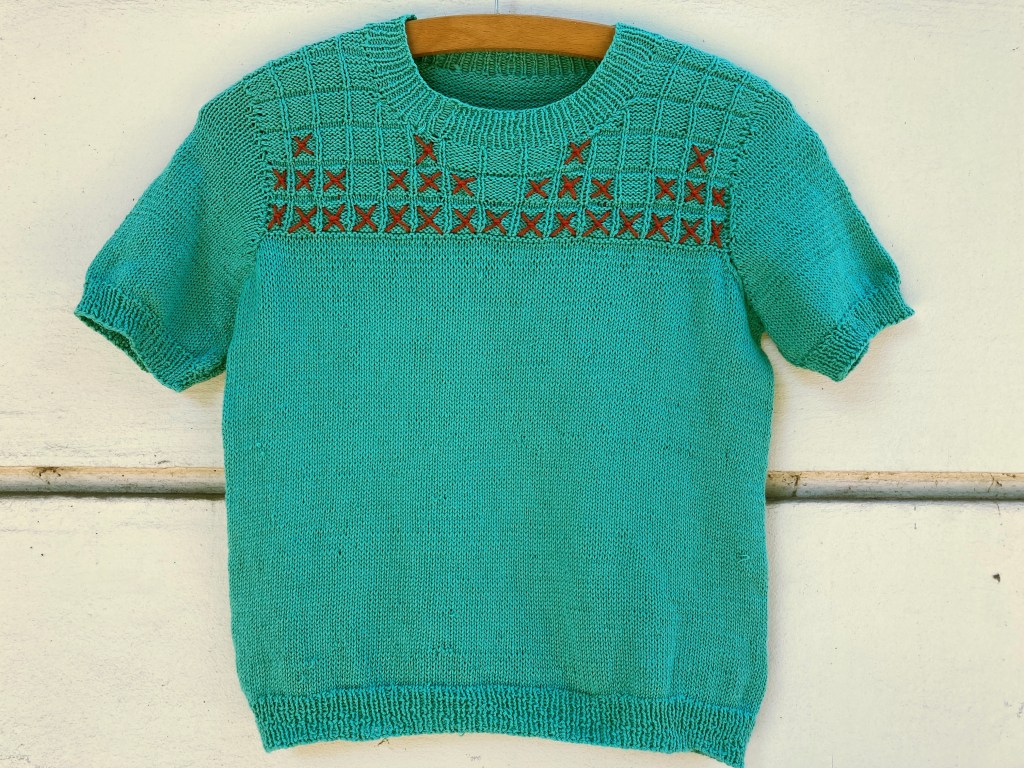
It is also very lightweight, which is lovely. I used that to my advantage by making the finished garment short-sleeved, making it a fancy knitted T-shirt and not a jumper. but the finished garment will be more like a T-shirt than a jumper. I tried a couple of combinations for the yoke and decided to make it in the pattern stitch with the large contrasting cross-stitch “pyramid” design in bright orange.

It blocked out kind of uneven, as I didn’t have a clothes dryer. Strange to have a knitted item that should not be dried flat! But I think this cotton needs the evening-out and fluffing-up effect of a dryer.

The combination of boring stocking stitch and un-plied yarn made progress very slow, but I got it finished by the middle of June, at least. Let’s hope the kid likes it!
May 1963: Overview

Cover image from Stitchcraft magazine, May 1963

“Fashion At Ease” is the motto of the May 1963 Stitchcraft issue, in keeping with both the beginning summer holiday season and the fashion for casual, loose-fitting, bulky-knit garments. Our cover model is getting the picnic chairs ready in a cardigan made of “Ariel” yarn — a synthetic mix that is bulky but somewhat lighter-weight. (It’s always described as “light-as-a-feather”, “feather-weight” and so on, but the cardigan uses 9 or 10 2-ounce balls, which comes out to 18/20 ounces or about 510/560 grams in the basket rib and slip stitch patterns. That may be a bit lighter than the same type of garment made in bulky-weight 100% wool, but “feather-light” it is not.)

Other than that, the women’s garments are very similar: hip-length, made in plain, smooth stocking-stitch with V-necks and somewhat smaller pointy collars. The pullover of the green suit on the inside cover photo looks so similar to the raglan-sleeved “overpull” a few pages later that I had to check twice to make sure they were two separate designs and not a continuation of one pattern on a different page with another picture. The 4-ply collared pullover is also very plain (it’s even listed in the contents as “Plain 4-ply sweater”) and has gentle raglan sleeves and a similar small collar. There will be no rocking of the boats on this holiday, fashion-wise!

There’s a little more design interest in the “Italian” boatneck pullover with a stranded colour stripe across the hips as well as the wonderful “Tyrolean” cardigan and “Viennese” pullover for children. The use of different countries’ names in the descriptions seems more a way to highlight the international “continental” travel-holiday theme than any reference to traditional or regional design elements. I certainly don’t associate the stranded knitting pattern with Italy, as it’s much closer to traditional Fair Isle/Scandinavian/Baltic/northern stranded patterns. The children’s garments claim to be a “design from the Tyrol” and “From a Viennese design”, but you can make of that what you will. They are definitely cute and probably fun to wear.

Rounding out the knitting designs are a “crunchy” men’s pullover in Bracken Tweed, one of the early multicolour/tweed-flecked wools that became popular with hand-knitters in the early- and mid-1960s as well as an interesting hybrid cardigan featuring “waistcoat styling” — the front and back are knitted in plain stocking-stitch and the sleeves in a slip-and-drop textured stitch pattern in a lighter shade of the same DK wool. I’m not sure the look is successful, but it is an interesting idea.

There are plenty of ideas for housewares, starting with a coordinated latch-hook rug and cross-stitched floor mat for a child’s room. The puppy and kitten are quite cute and (not coincidentally) look a lot like the characters in some of the children’s comics printed in the back pages of the magazine. They are intended to be easy enough to make that “your young daughter” (only the daughter, of course) could help make it and thus expand or improve her handwork techniques. For any children who don’t have to help with housework (guess that would mean the boys eh), our happy housewife can make a felt bag for dirty linen shaped like a postbox, complete with a helpful embroidered sign with collection times (9:30 am Monday to Friday, no collection on Saturday or Sunday). There’s also a purely decorative Punch and Judy wall hanging and a nightdress case shaped like a tortoise. (I will never understand the point of a nightdress case, but I love the tortoise design.)

Going with the international/holiday theme, there are embroidery patterns for a chairback and tablecloth inspired by traditional Scandinavian designs, a flowery cross-stitch cushion and table mats and a very interesting tapestry pattern for a stool top. There’s also a knitted doily and — unusual for Stitchcraft — a design for a patchwork cushion with some very well-written basic instructions for doing patchwork with the paper piecing method. For the unacquainted: you cut out pieces of paper from a cardboard template in the desired shape, stitch the pieces of fabric around these paper pieces, then stitch the fabric pieces together at the side to make the larger patches. The paper pieces are then removed and re-used. The advantage of this method is that you don’t have to cut the fabric to perfectly accurate shapes or pay too much attention to the seam allowance.

That wraps it up for May 1963! The ads are the usual and in the alternative-nursery-rhyme children’s comic, Miss Muffet has shrunk to insect size and made friends with the very nice spider, who helps her get out of a flower and gives her a ride on a floating leaf. That sounds like fun.

My project for this month will be the “Viennese” child’s pullover, made for a young relative. Said child was adamant about wanting a “smooth texture” on the pullover and not the reverse-stocking-stitch-rib in the pattern. I am also making it for summer wear in a very lightweight cotton, so the finished result may or may not look anything like the original design, but we’ll see. Also: many WIPs to finish. Happy Spring!