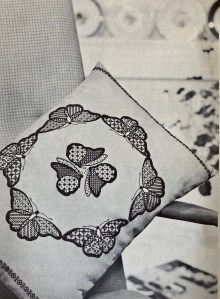
UPDATE December 18, 2021 – Finished!
“For the embroideress who likes to tackle something different” came this amazing design from Stitchcraft‘s April 1963 issue. I am daunted by blackwork embroidery, having tried it only once until now with this cushion from the September 1960 issue. It’s fundamentally a form of counted embroidery, like cross-stitch, except that the stitch patterns aren’t crosses. The fillings are worked first using different geometrical counted patterns and the outlines and details are then added in (non-counted) crewel stitches like stem stitch, satin stitch, buttonhole, etc.
My biggest problem with all forms of counted embroidery is finding the proper ground fabric. The standard “Aida” fabric often used for cross-stitch is way too large, but furnishing linen, like the kind I mistakenly used for the fish cushion, is too tightly woven, making it impossible to count the holes properly and get the filling stitches to line up properly and look right. With the fish cushion I ended up just freehanding it, which is fine if you don’t look too closely but is obviously not the right procedure. I resolved to find the perfect-size linen this time!
… during a never-ending pandemic, where even if there were a shop nearby that sold all different sorts of embroidery fabrics, it would not be possible to go in and look at them to see how tightly woven they really are, as retail stores were closed in my area at the time. Of course, online shops give you information about the thread count and weight! Well… some give information about the weight, and some the number of threads per centimetre, and some just show a photo, which is utterly useless because who knows from how close it was taken?
The pattern is written for Glenshee Embroidery Fabric quality 212, a type of fabric that apparently does exist again after being unavailable for decades, but which seems to be available from exactly one distributor in two colours (beige and grey). At least I was able to find out what kind of thread count it had: 29 threads per inch, which converts to 11.6 threads per centimetre. I would be happy with anything between 11 and 12 and I wanted the fabric to be blue.
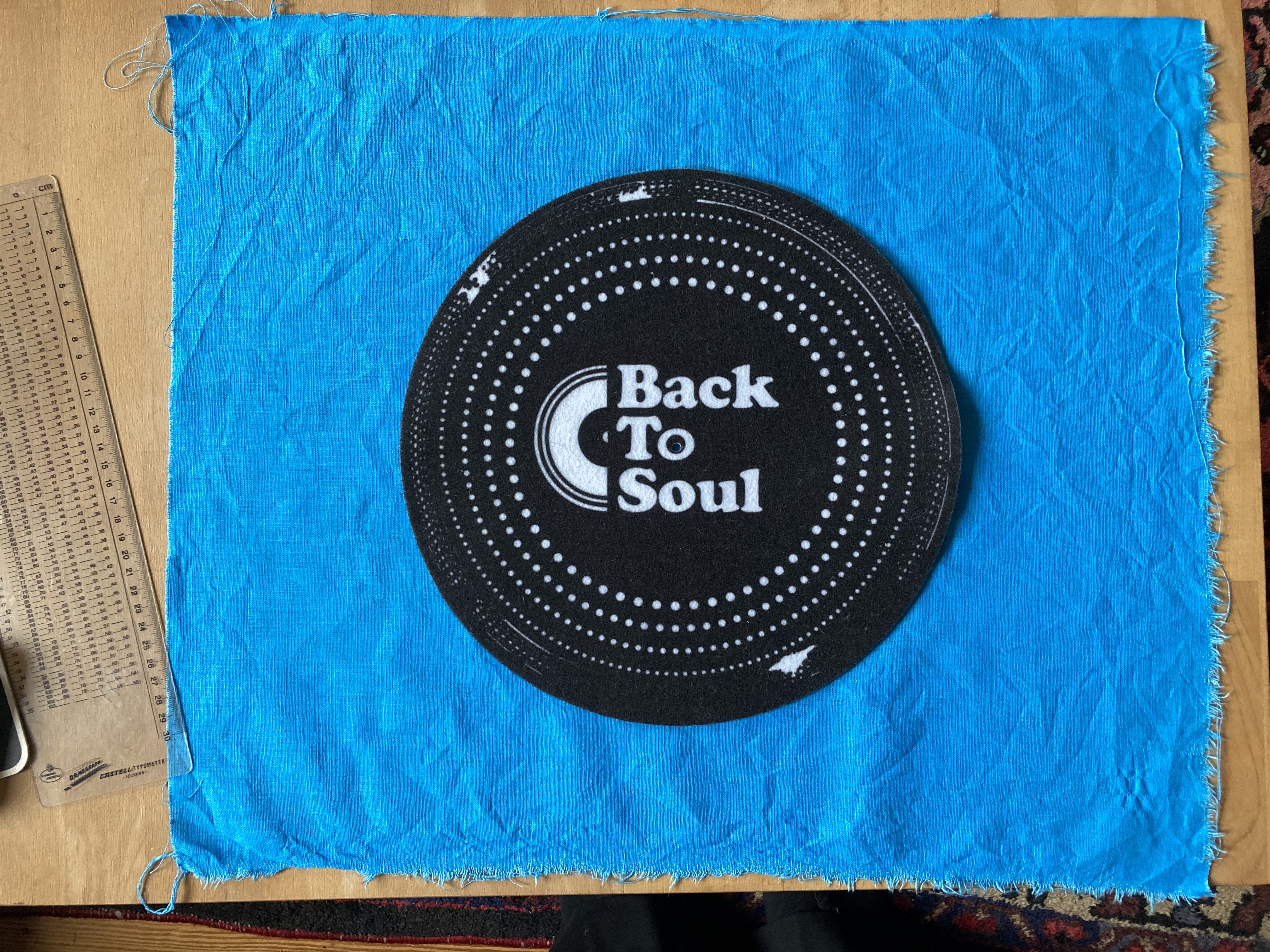
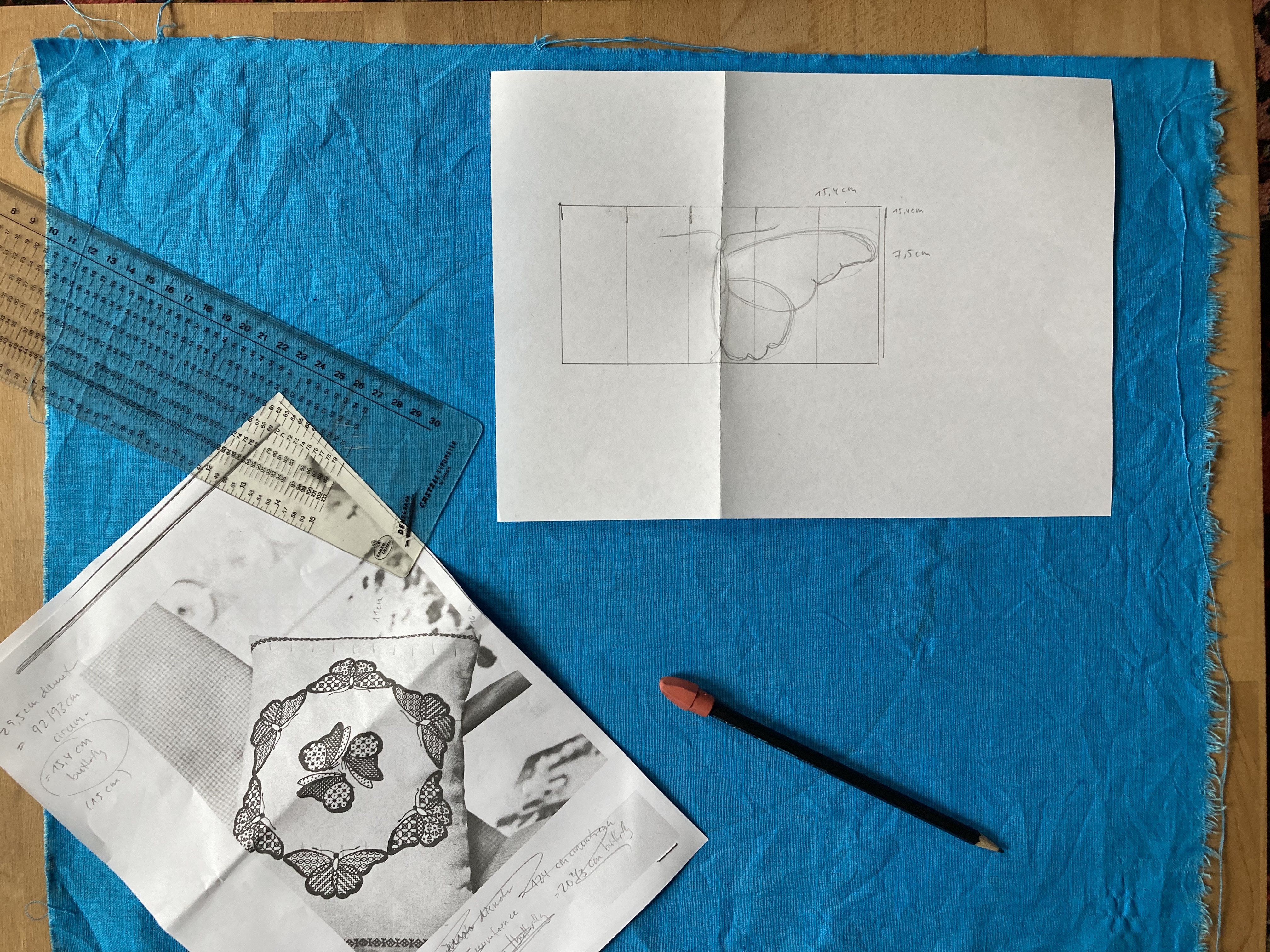
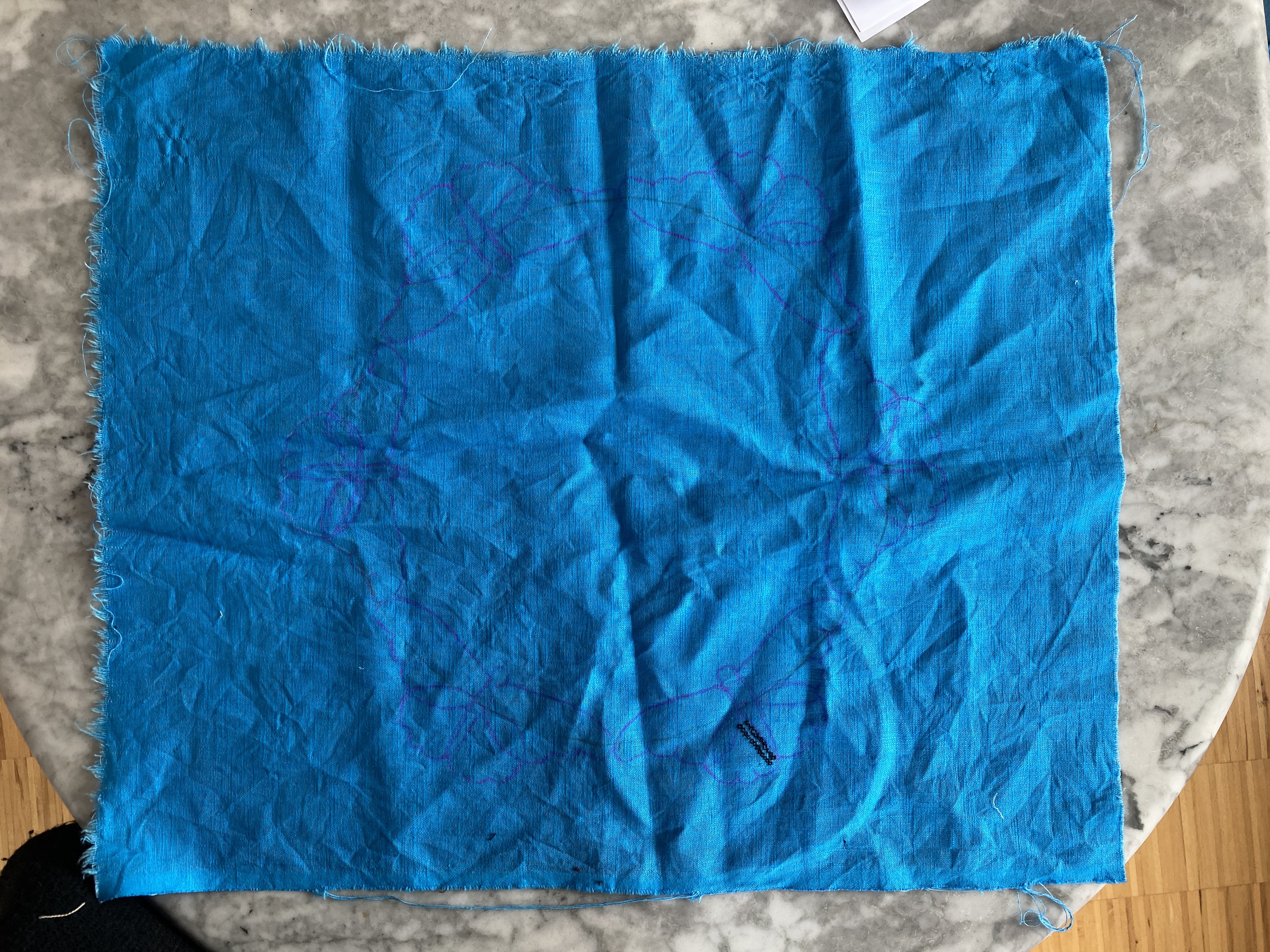
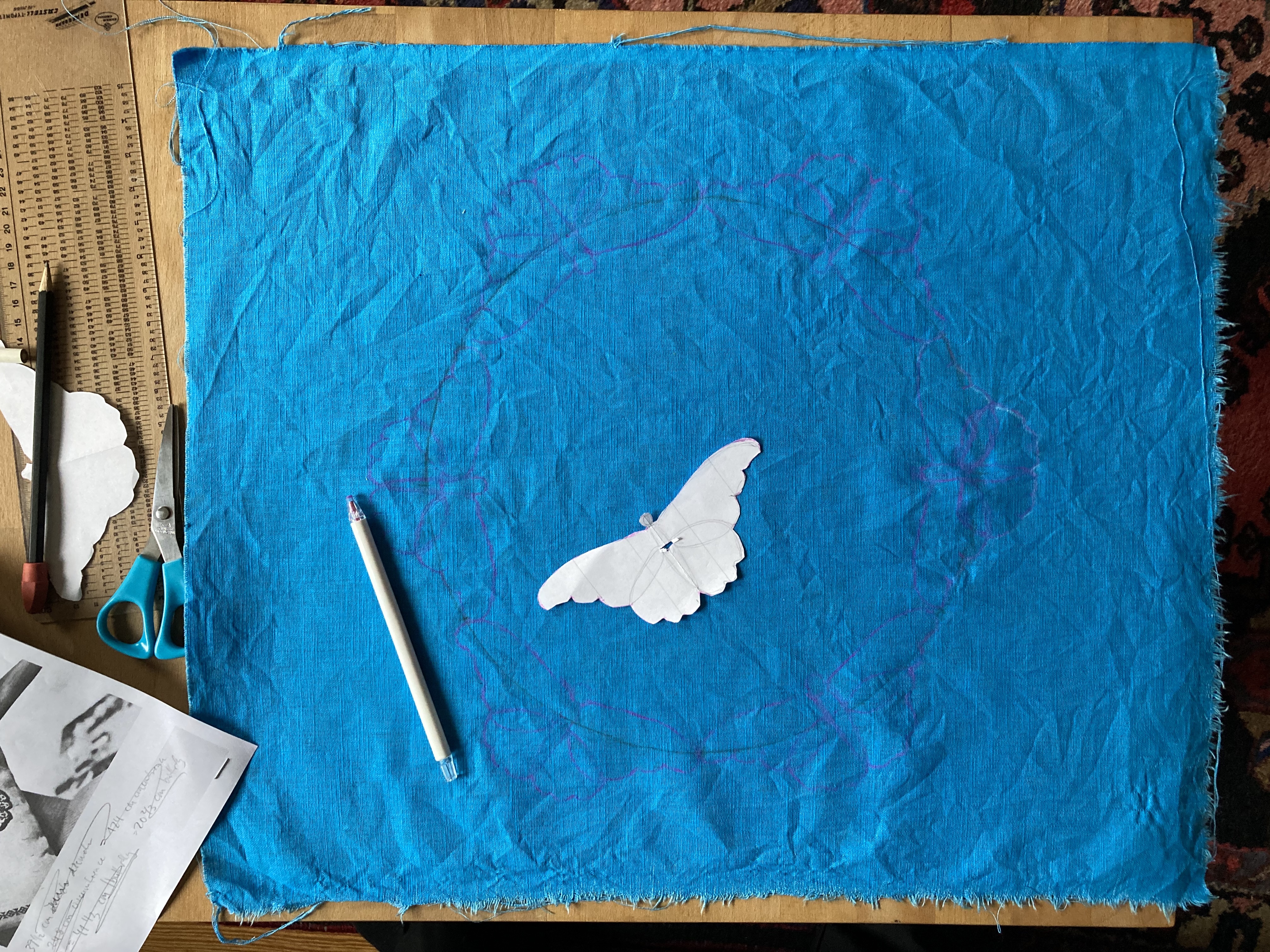
The first linen I bought was called something like “100% Linen Medium Blue” and I should have noticed right away that that meant it was regular furnishing linen, not specifically embroidery fabric — embroidery linens have special names according to their type and thread count. I loved the colour, though, and was determined to try. Of course I didn’t have a transfer, so I painstakingly calculated out the size of the circle for the main butterflies and from there, the size of each butterfly. I made a paper stencil for the butterflies and drew around a felt record-player cover (coincidentally the perfect size!) with a pencil to get the circle right. On starting the first butterfly, it was clear that the fabric was too tightly woven. It was pretty much the same type as the fish cushion. I was determined to make this project the right way, so after all the work I had put in marking the fabric and starting the pattern, back to the Internet I went and bought a few different kinds of embroidery fabric with a thread count between 11 and 12 threads per centimetre.
It is amazing how different fabrics can be that have the same or similar thread count!
Here is a photo below. For comparison, the fabric on the far left is the normal “Aida” used for cross-stitch at 6.4 threads to the inch. The light grey-blue is “Permin”, which has 11 threads/cm and is very open, almost like netting. The beige-ish fabric next to it is “Belfast” with 12.6 threads/cm and perfect for this project, but wasn’t available in blue. Next to it is “Murano”, which also has 12.6 threads/cm and is a cotton/viscose mix, not 100% linen like the others and the blue they had was a bit too dark. On the far right is the furnishing linen I had originally bought, and the only one in the colour I wanted.
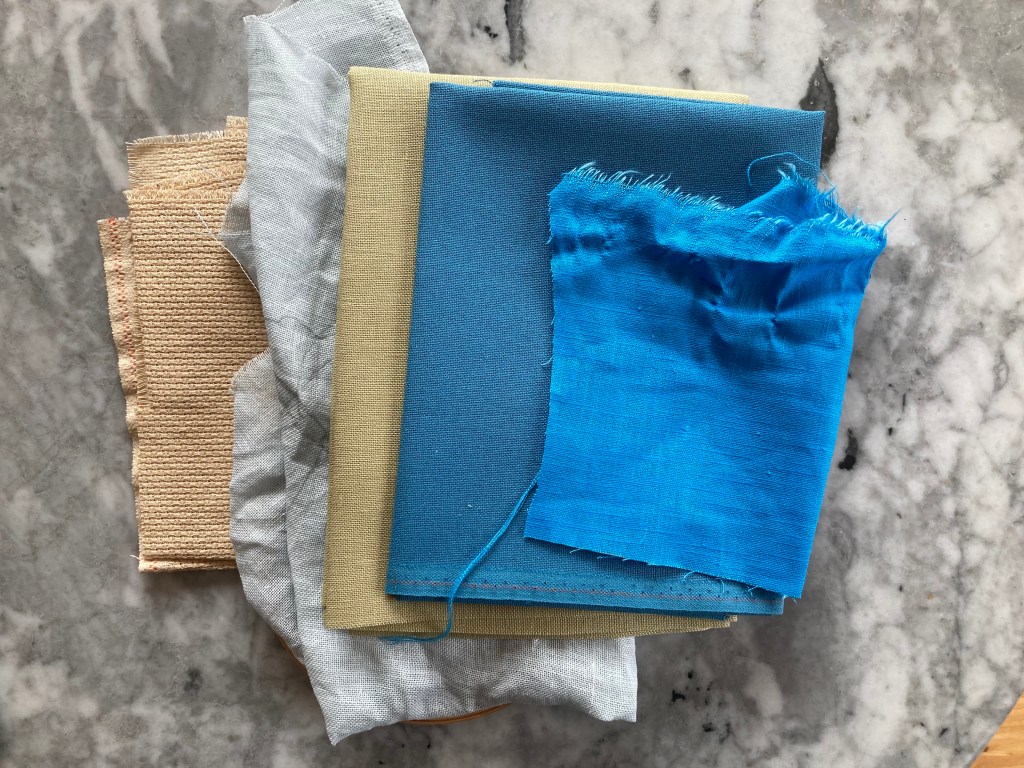
I wasn’t 100% happy with any of the the four options I had now bought, but I had spent a lot of time and money already and just wanted to get the project started in a way that I would be able to finish it. So I decided to use the Permin, which was not the perfect colour (a bit light, but I could try to dye it?) and very net-like (but at least it was easy to do the counted work).
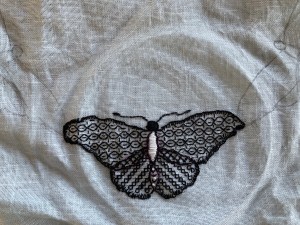
The slight difference in thread count and the net-like aspect of the fabric made me decide to work with 3 strands of thread instead of 2 as in the pattern. Other than that, I followed the pattern as best I could. My buttonhole stitch outline is more like blanket stitch and not as thick as in the pattern, but that’s OK. After almost finishing the second butterfly, I decided to go against the instructions and work the outlines of the butterflies first, then fill them in with the counted work. The other way around probably works well if you used an iron-on transfer with easy-to-follow lines, but my pencil tracings are less accurate.
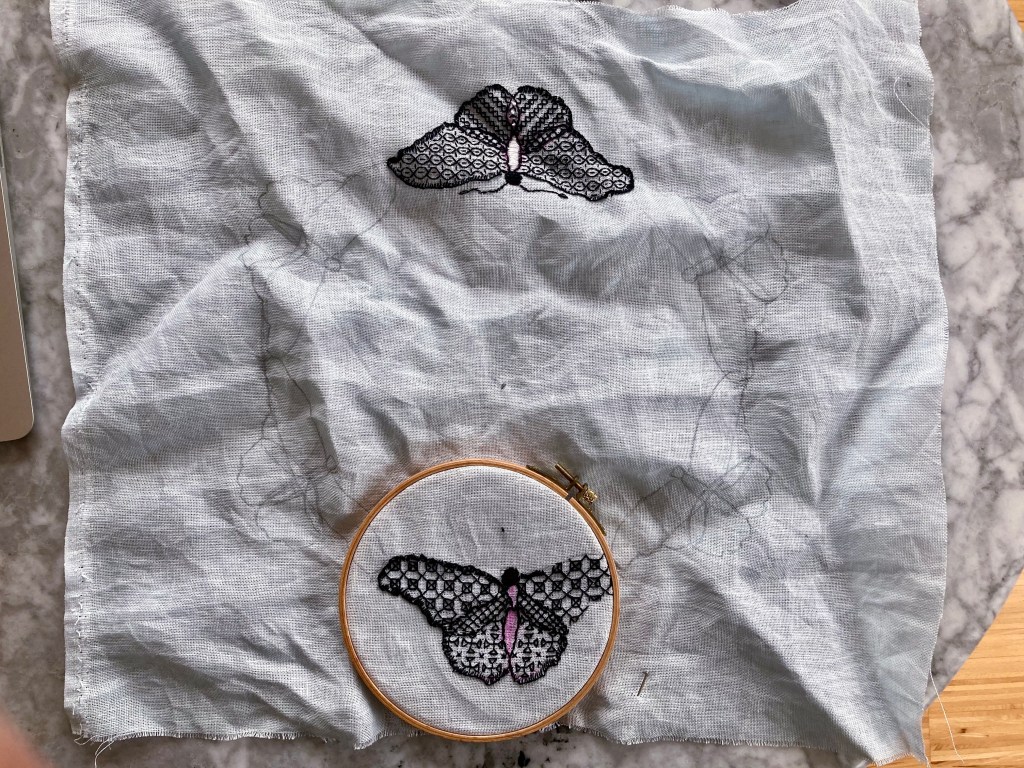
It was slow going, but there is something meditative about embroidering precise geometrical shapes.
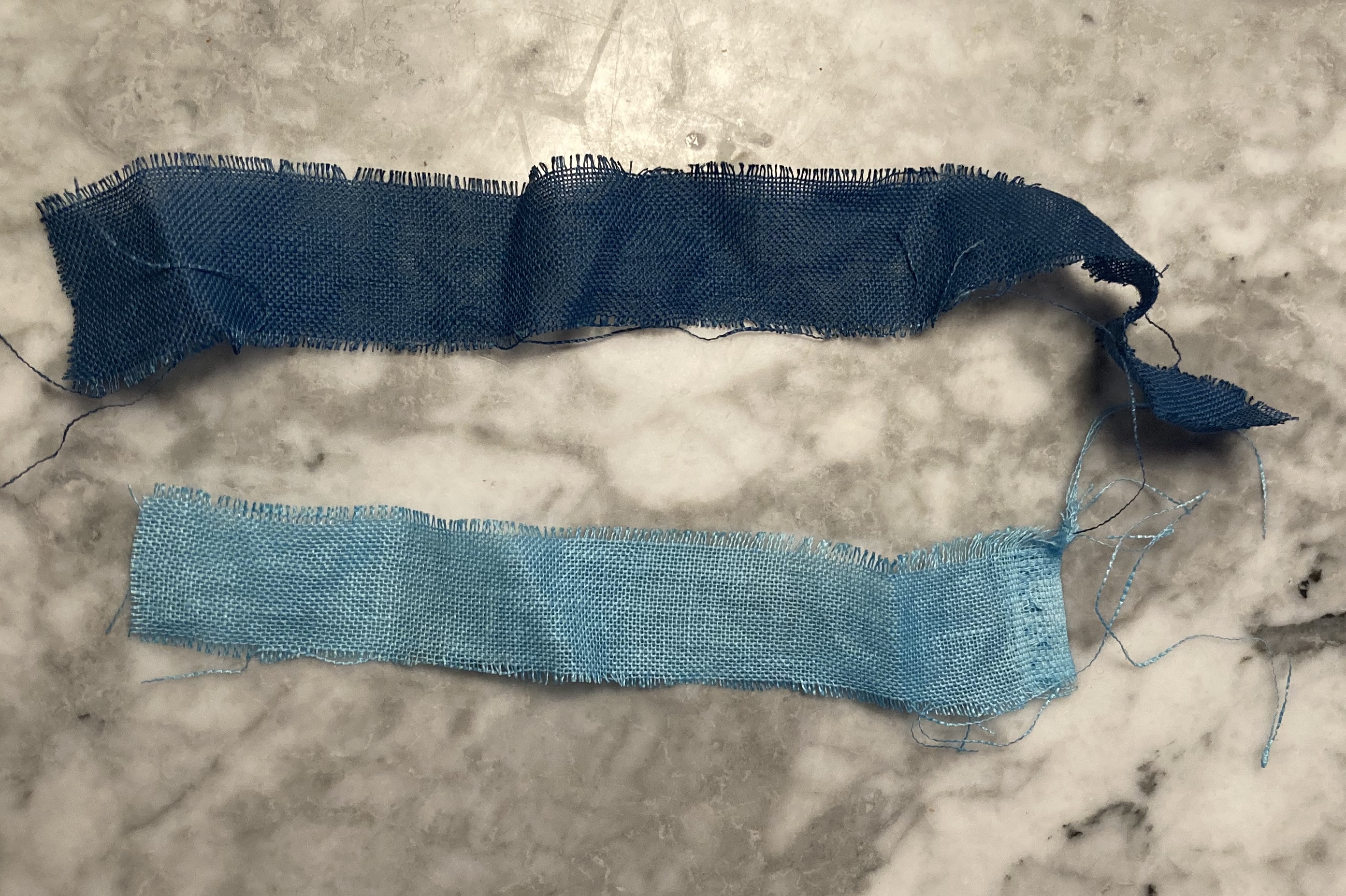
After embroidering two or three of the butterflies, I got my hands on some fabric dye and experimented with scraps of the cut fabric. “Deep Sea Green” (top) is actually blue, which was desired, but too dark and not vibrant enough. “South Sea Turquoise” (bottom) was the ideal colour, but I started liking the pale fabric more the more butterflies were embroidered. I decided to stick with the fabric as it was until the embroidery was complete, leaving off the white satin stitch body bits until after I dyed the fabric (or not).
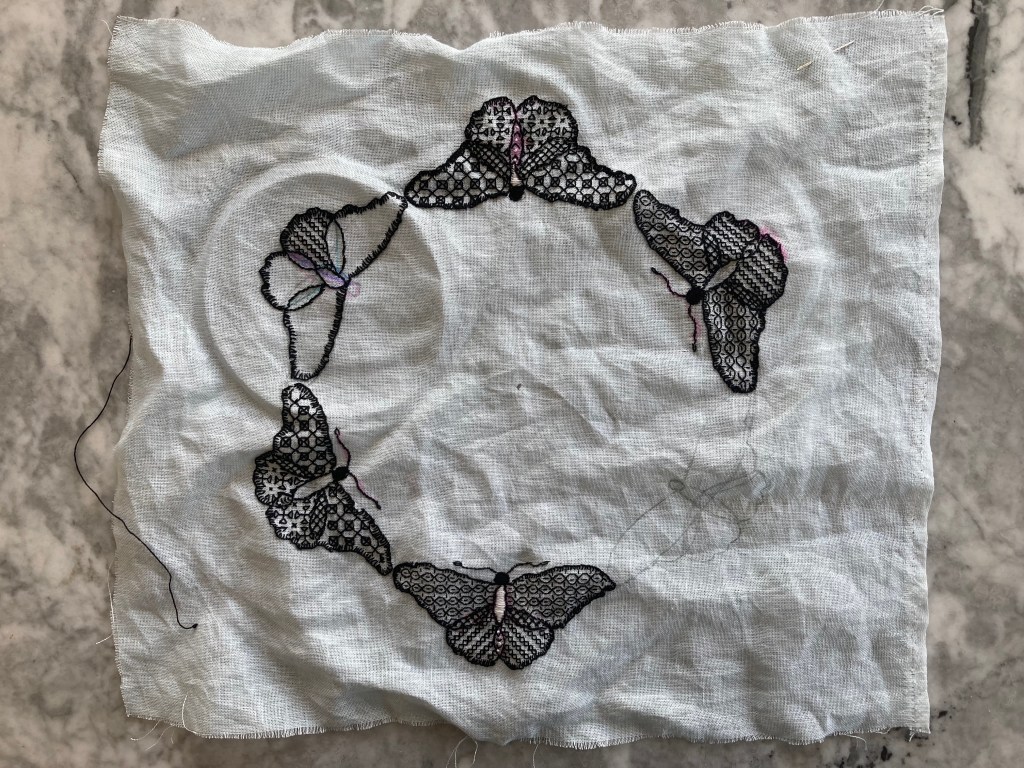
May 2021 passed very quickly and I hardly made progress on my May project, let alone this one. Here is a photo of my progress at the end of May:
After leaving it for a while to work on other projects, I picked it up again and tried to work a little bit each day. Things got complicated in the autumn, as the days got shorter and darker – I realised I could only work in bright, natural daylight, otherwise I couldn’t see the threads well enough to count them, even with a good lamp. But I kept going and eventually, there it was!
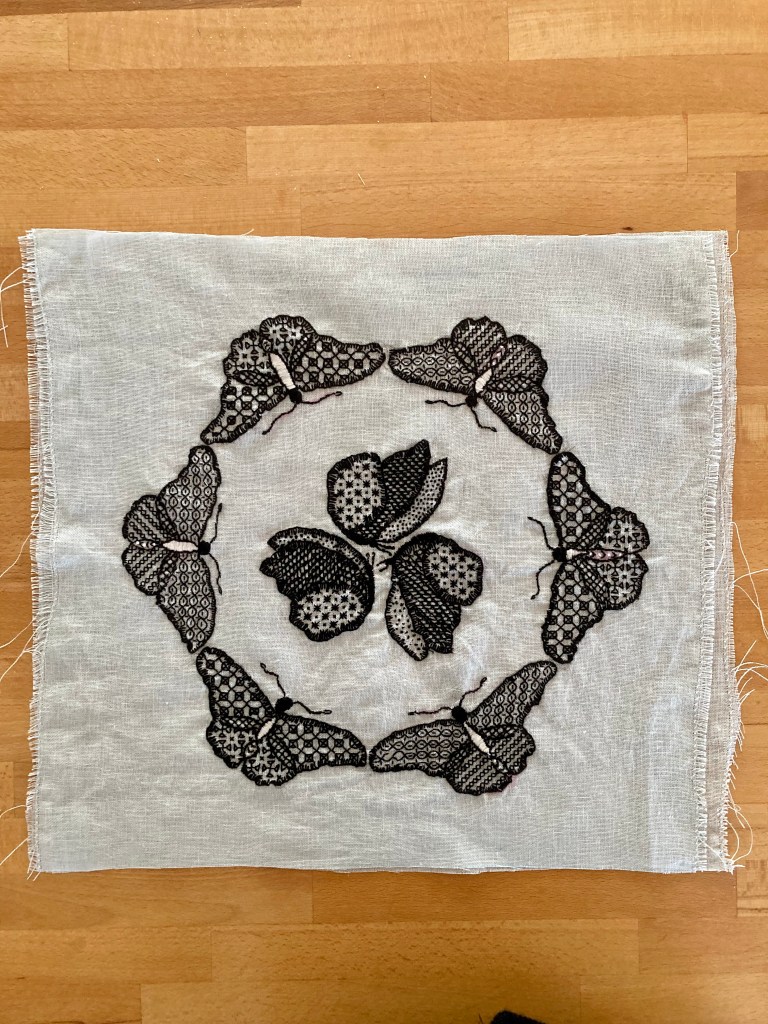
Making it up into a cushion was easy. I made the cushion itself from an old white pillowcase that had been retired to the upcycling drawer, made the back from more of the net and added a zipper. I had left off the extra embroidered borders, since the design turned out more square than rectangular.
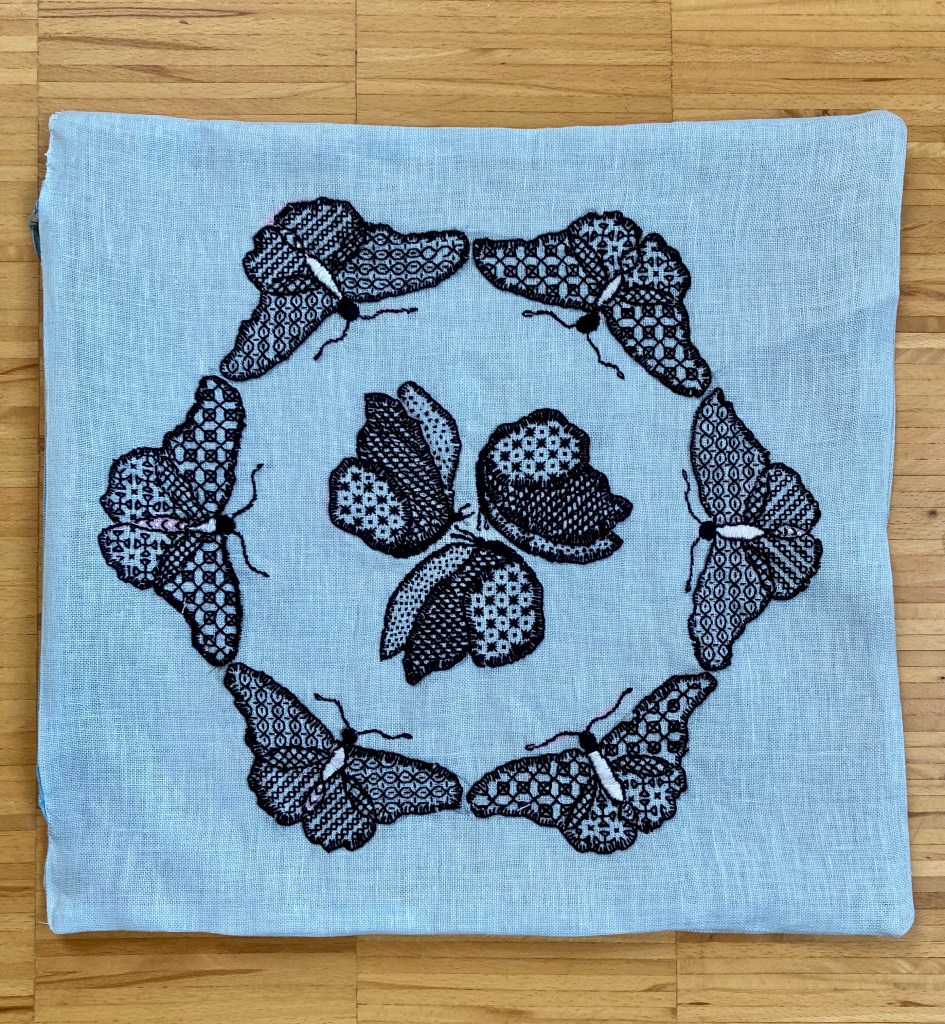
(The actual colour is somewhat less blue than the photo above, but more blue than the one below. I can’t get the colour correction to work properly on this device. )
The only problem was the transfer marker, which didn’t wash or iron out well. A tip in one of my old Stitchcrafts suggested using “solvent” if nothing else worked, Having no idea exactly what kind of solvent they meant, I tried alcohol, which didn’t work, and kitchen de-greaser, which worked somewhat. Any little bit left in will hopefully wash out in time.
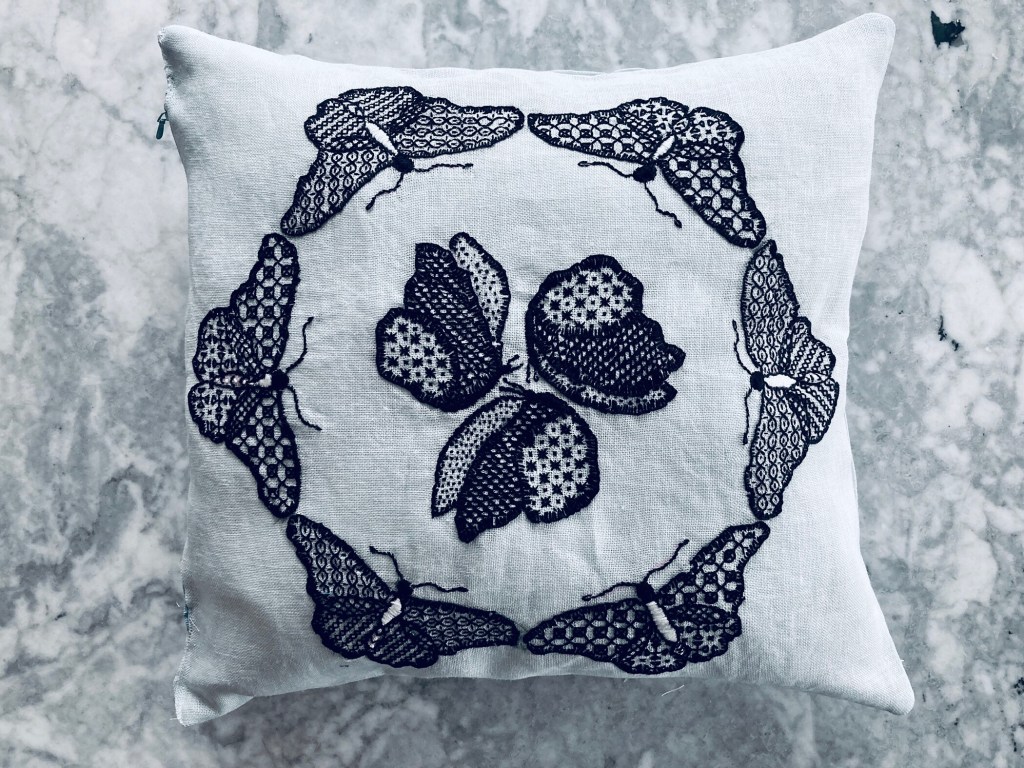
Wow, it’s finished! I am really impressed with myself for getting this done, but I think it will be my last blackwork project for the time being.

 The Stitchcraft Sixties
2 thoughts on “April 1963: Blackwork Butterflies”