 August is a weird month for knitting, as it’s often too hot to hold wool in your hands and hard to believe that autumn is around the corner. Appropriately, this month’s issue features easy embroidery and homewares, and seems to have fewer items than the average winter or “spring holiday” issue. But before we get into the contents, can we stop to admire this beautiful twinset on the front cover? I have been looking forward to making it since I started this blog! So much that I don’t care if the heat wave ever ends, or if I won’t be able to wear it until January. I am going to make it and love it.
We’ve got a few pieces in bulky Big Ben wool, which seems an odd choice to me for summer since it must be quite heavy and hot, even with September and October around the corner. The “slippy” is theoretically good for sailing, though, I’ll admit. A couple of casual sweaters for women, men and children round out the selections, plus a cute little bolero and baby dress for the little ones. Apart from the twinset, it’s basic fare.


The homeware pieces are more whimsical and probably a lot of fun to make. The three different aprons to sew and embroider are styled and decorated so differently that at first glance you would never notice that they are all made from the same fabric pattern. It’s quite a clever design, with a deep pocket in the middle. I imagine it would be just as useful as a “knitting apron” (where you put the working ball of wool in the pocket) as for sewing or kitchen work. The “charming novelty design” with little sewing birds (which remind me of the helpful birds in the Disney Cinderella movie) and the gingham “Briar Rose” are touted as “good bazaar items” and the third option can be made “from oddments”, so they are easy and useful all around.


Little mats for dining, dressing and living room tables can be very easy to make (a simple hardanger table set with tea and egg cosy, or table mats made of raffia), a bit more elegant (cutwork for the dressing table), or finely knitted (“for the expert, but well worth the time and effort”). There’s a chairback in Assisi work and cushions with traditional designs from Czechoslovakia (still one country in 1960) done in cross-stitch or pattern darning.


The best bits are often in the back pages, and there is a great, short how-to article about making your own embroidery sampler in the “Readers’ Pages” which gives good, concise beginner’s advice on choosing motifs, calculating gauge and placement and choosing stitches. Also, there’s an advertisement for Turabast, which was a brand of ribbon straw popular from the 1950’s to 1970’s. You could knit it up into a stiff, crinkly skirt that was probably very inconvenient to sit in, but had that perfect petticoat look without the petticoat. Ribbon straw is still perfectly available in modern times, but these days people use it for crocheted flowers or home decorations. I haven’t seen anyone wearing an actual garment made from it, but I might try it someday.


My project for this month will be the wonderful twin set from the front cover.
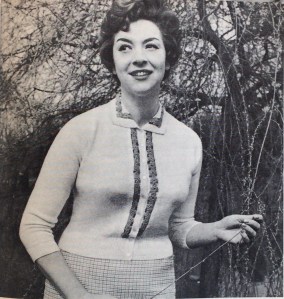 This “charming and unusual design for larger sizes” (37-38 or 39-41 inch bust) features narrow dolman sleeves, crochet insertions, and horizontal bust darts.
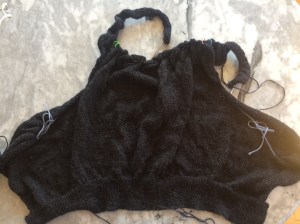 I was interested to see how it worked out with the dolman sleeves. When I think of “dolman sleeves”, I think of those 1950s, or worse, 1980s garments with a huge triangle of fabric under the arm, which must have been very uncomfortable and inconvenient to wear. But after my April 1960 blouse with the horizontal cap sleeves worked out so well, I was willing to give this one a try. And it turned out great! There is no more extra fabric under the arms than there would be with set-in sleeves, and the horizontal construction gives plenty of room in the upper chest/back area, where I am quite wide. I guess the secret lies with the number of stitches cast on for the sleeves per row — this one had 2×8 rows and then 10×16 rows, making the sleeves narrow and more horizontal, thus less triangle-like.
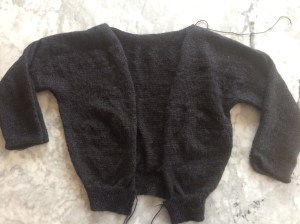 The knitting was slow-going at 7 stitches to the inch, but of course once the body was done, so were the sleeves. Seaming was a nightmare, as the yarn (Herriot Fine from
 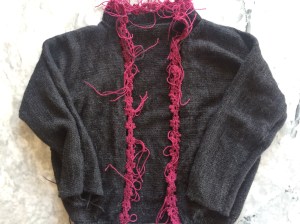 What took longer than expected was the whole crocheted edging-collar-button-band extravaganza. The crochet bands are extremely fiddly — they are crocheted onto each other as you go, it’s difficult to make them all exactly the same size, and each one needs its own, new piece of yarn. There are a total of 50 elements, so that’s 100 yarn ends to weave in right there. Then there’s the “inner” collar, the “outer” collar and the button bands, all of which are made separately and sewn on, and somehow need to end up symmetrical and fit properly on both sides. Of course, I sewed the collar on backwards the first time, forgot to switch the right and wrong sides at the collar fold, etc, etc. It all worked out in the end, though.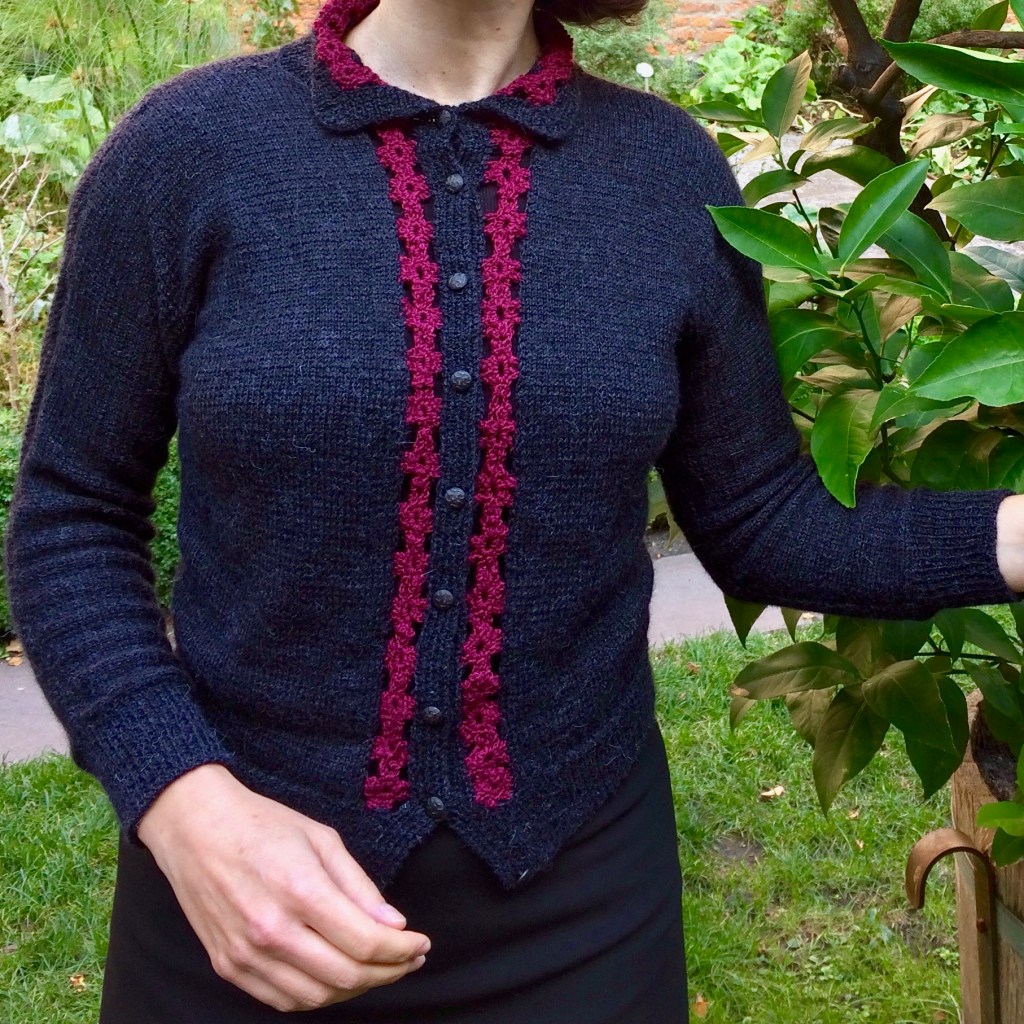
 The Stitchcraft Sixties