July 1966: Overview

It’s all about teamwork in Stitchcraft’s July 1966 issue: two-piece sets for casual, sport or city wear as well as matching designs for all members of the family. Appropriately for the theme and the season, the emphasis is on sports and leisure, with casual, loose-fitting designs.

Our cover ensemble pairs a checked, sleeveless top with a skirt whose pleated insets match the check pattern. The check pattern is stranded, and I hope the navy blue didn’t bleed into or show through the white at the first washing. It’s the dressiest of the designs in this issue, but still keeps a casual air with its loose, unshaped top and shorter skirt (hemlines are finally rising at Stitchcraft, long after the miniskirt became popular everywhere else) and the check pattern, which is reminiscent of a race-car flag. The “favourite continental look for casual wear” is a team of “overpull” (oversized pullover) and short-sleeved blouse with a polo (turtle) neck in matching colour.

For warmer days, there’s a trio of lightweight and/or sleeveless blouses: in a lacy striped pattern or textured rib in 4-ply, or a mini-top in eyelet rib. Pink, white and turquoise are fun ice-cream colours for summer and harmonise well with the maritime blue of the checked suit.

A high-buttoning cardigan in heavier DK is good for cooler weather. Twisted stitches are the summer knitting trend, seen in the cardigan as well as in the eyelet rib and the striped lace tops. Our male model teams up with a horse to show off his cleverly designed “Viennese sports pullover” in tan DK wool with white cable stripes going up and down the front and back as well as down the sleeves.

The ultimate 1960s team is, of course, the nuclear family, and this issue offers a design for (almost) everyone: a simple, casual pullover with a trellis pattern in three sizes. The trellis is formed by making a k2tog or sl-k-psso at the right point in the pattern with a yo right before it to keep the stitch count even. The purl stitches on the wrong side are worked into the back of the “made” stitches to close the yo holes even more and make the trellis stitches stand out. Here too, summery ice-cream pastels and neutrals are in: “Banana Cream” for him and light green “Linden” for her and the daughter.

I did say “almost” the whole family, right? The youngest members have their own designs. Junior’s play jersey in blue and white echoes the women’s check suit, but here the check pattern is made by slipping stitches and/or letting them drop and picking them up a few rows later. The baby gets its own “teamwork” set of matinee coat and bootees in pretty lace and moss stitch.

The homeware designs are pretty standard, but numerous and cover all the home bases. There are some easy floral cross-stitch and pulled-thread mats, a cushion and/or stool top in tapestry (a check design, once again) or a stitched rug in Florentine design. More ambitious tapestry fans can make a wall panel of boats at Norfolk Broads.

And for once, the “Summer Bazaar” designs are not weird! There’s a simple crochet tea cosy, crocheted lace coaster mats, or an apron and/or potholder set appliquéd and embroidered with cute images of vegetables. In the “Readers Pages”, there’s a reprint of a 1961 pattern for a knitted pram blanket, and Eustace the elephant gets very startled when he tries on a pair of spectacles and suddenly sees Mark the mouse in larger-than-life size.

That’s all for this issue! Since I didn’t get around to making the sun cushion last month, I’ll make it this month. (Technically, it’s sort of part of this issue as well, since it photo-bombed the picture of the ribbed polo blouse.) And nothing else from this issue really called to me. Sunny days ahead, and may your team always win.
June 1966: Basket Weave Blouse

EDIT July 17th, 2024: Finished!

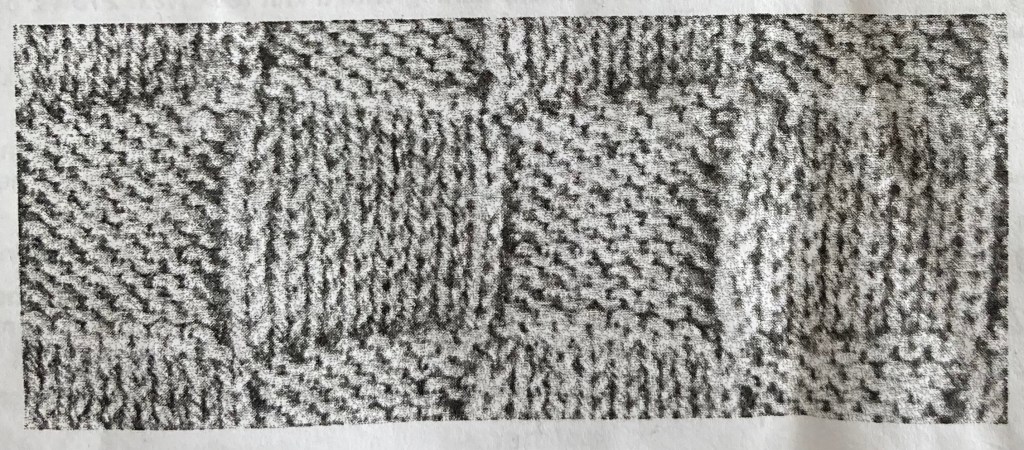
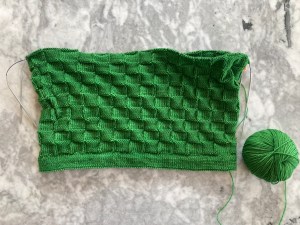
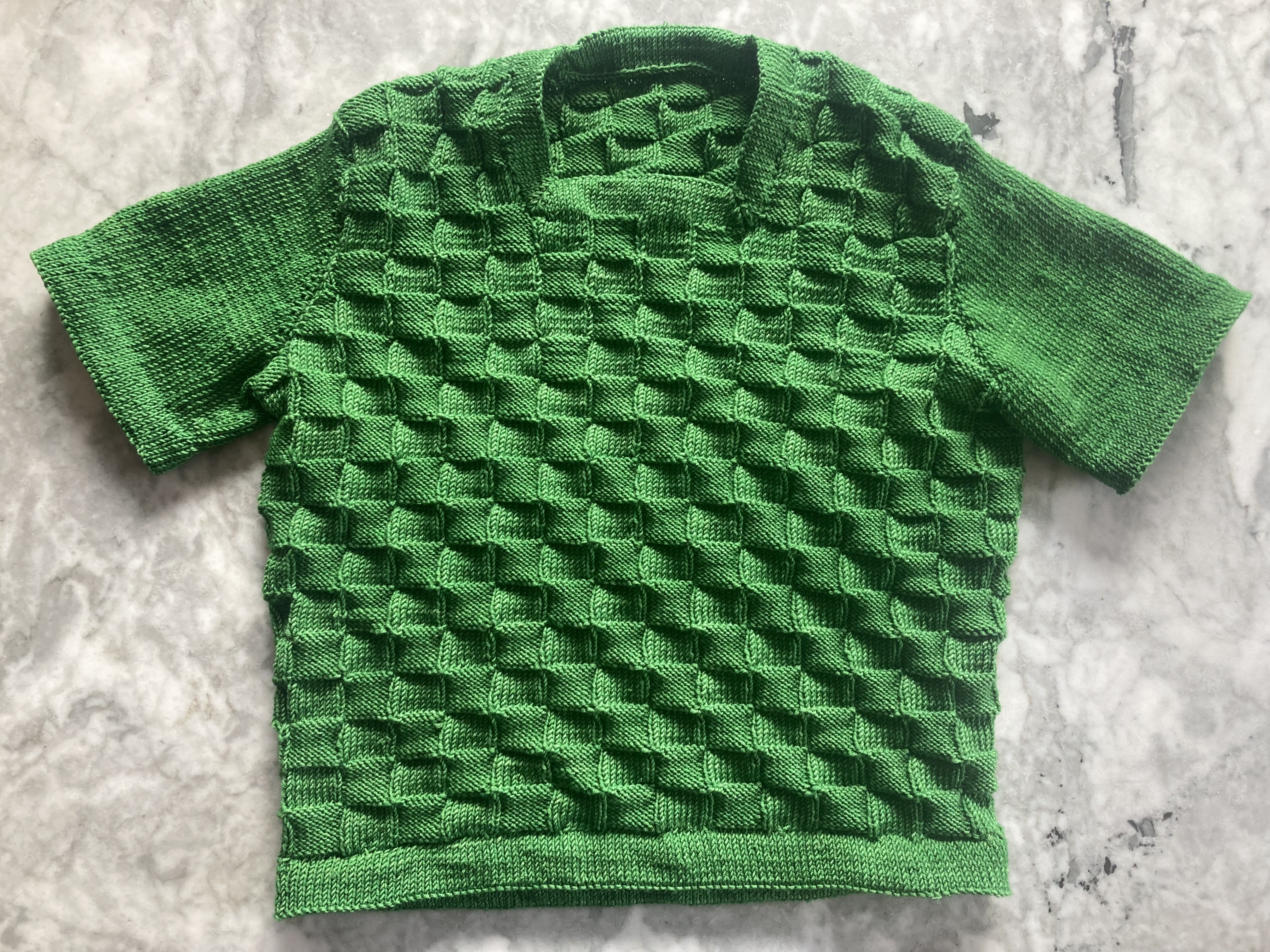
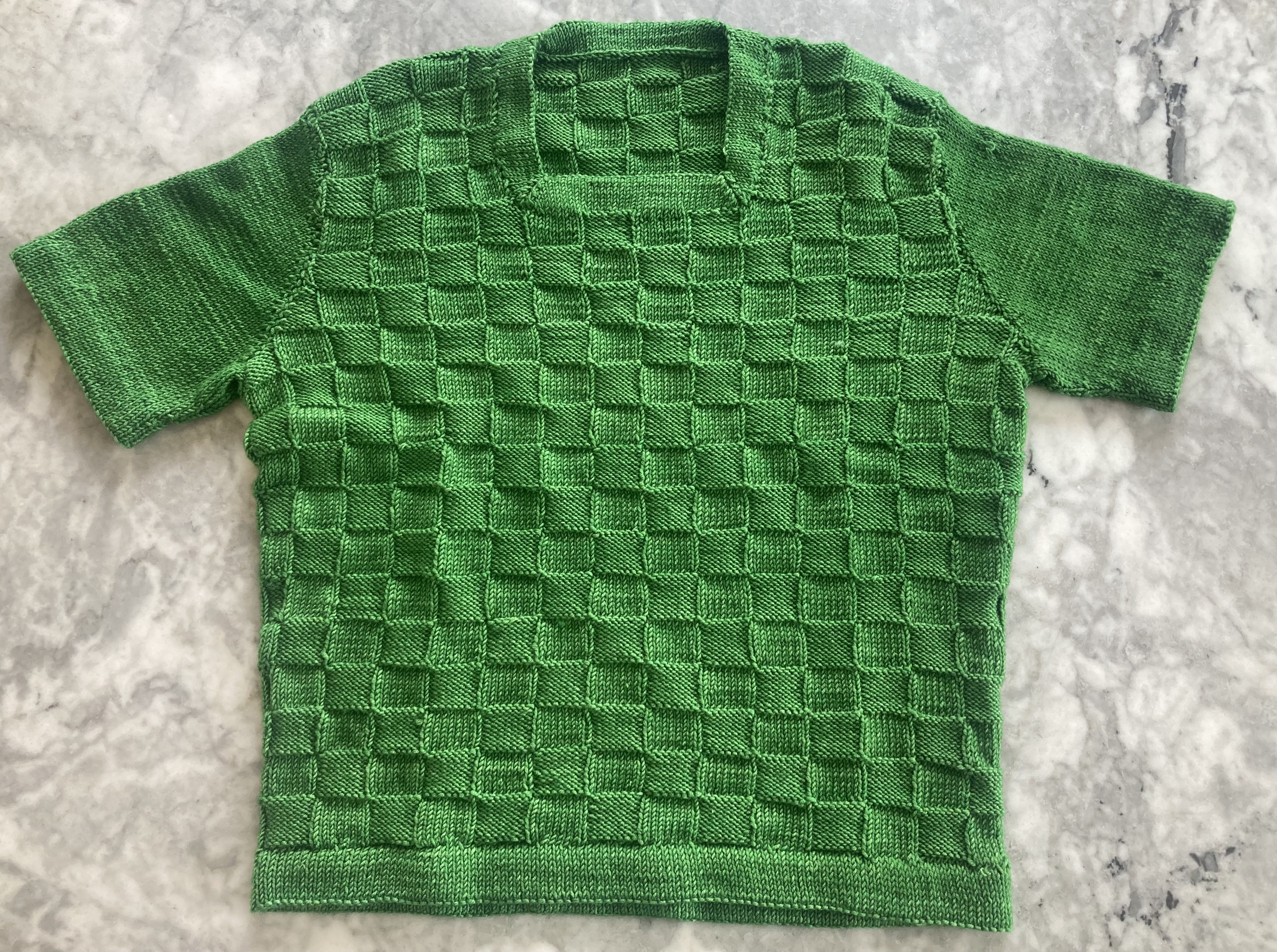
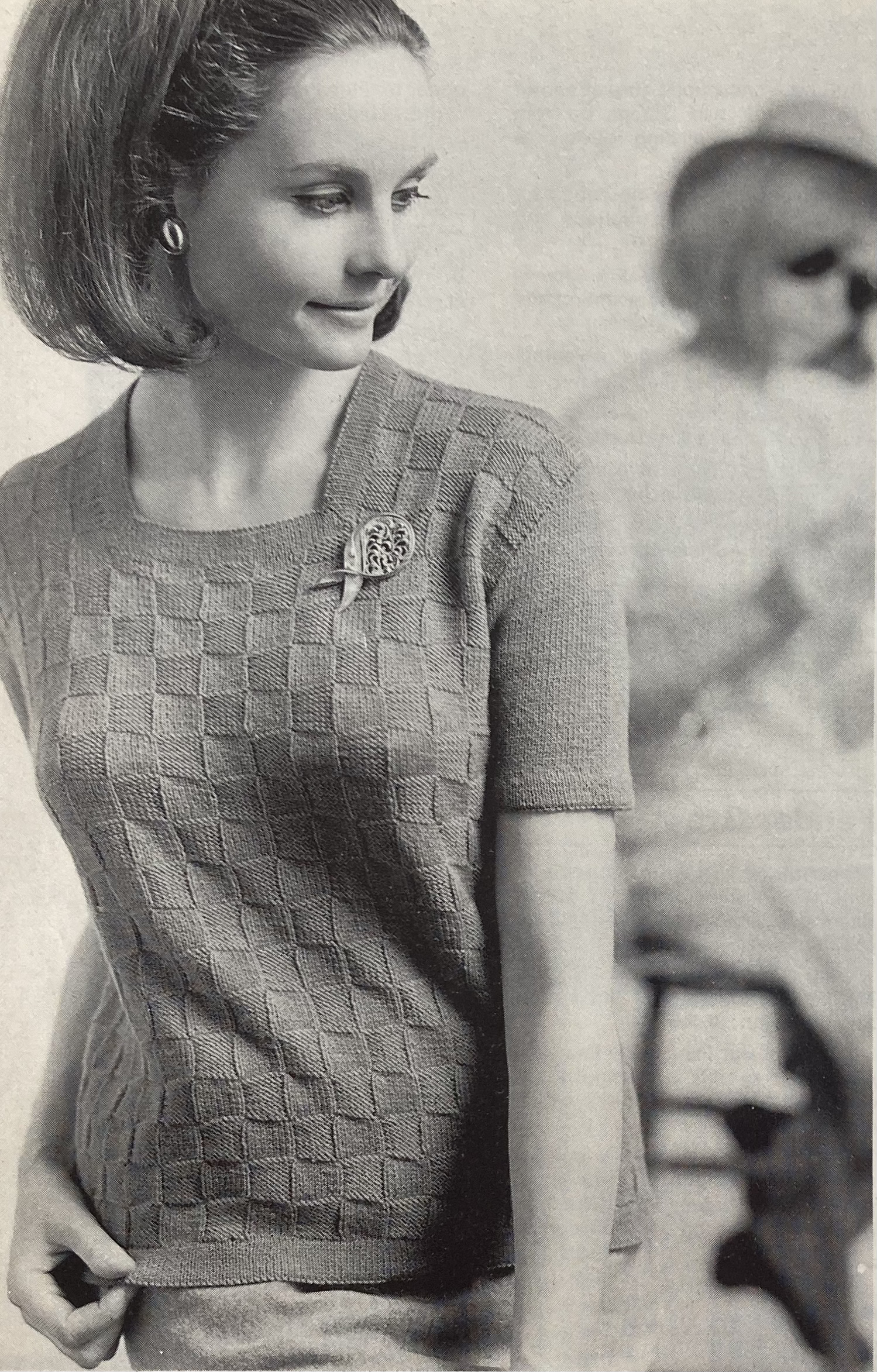
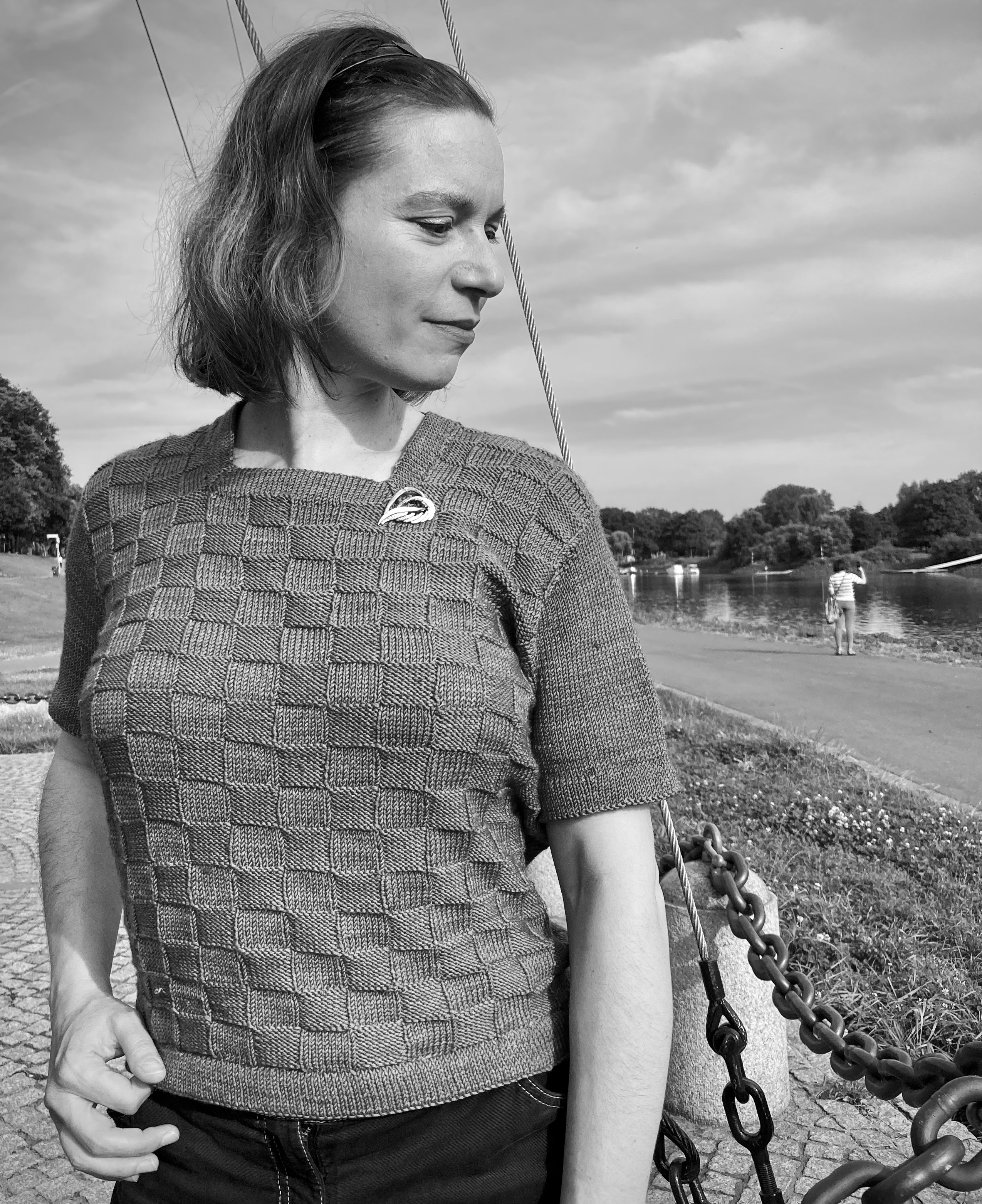
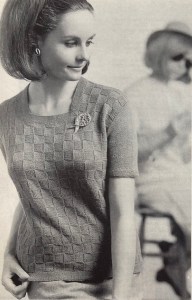
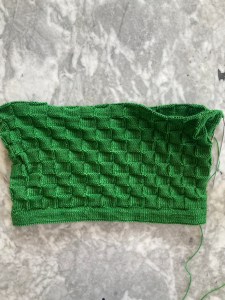
My June 2024 / June 1966 project was going to be the goofy garden cushion with the smiling purple and magenta felt appliqué sun, but I was traveling the first two weeks of June and it was easier to have a knitting project with me than an appliquéd cushion on hessian fabric. I loved the 3-ply blouse in this “Pattern texture from Paris” (note: I do not think the basket weave knitting pattern stitch was specifically invented in Paris, but whatever sells your magazine…) and a lovely colleague had given me a ball of Lana Grossa Cool Wool Vintage yarn in my favourite shade of green just the week before, so I was inspired to make it instead.

The pattern is written for Patons Nylox 3-ply, which existed in an earlier version with 80% wool and 20% nylon, and a later version with 60% wool and 40% nylon. This pattern would have to be written for the earlier version, as the later version was sold in 25-gram balls and UK wool weights didn’t change to metric until the early 1970s. It was 3-ply, so quite lightweight, and meant to be knitted up at a tension of 8 stitches to the inch in stocking-stitch. Cool Wool Vintage is more like regular 4-ply / fingering-weight wool, or even a little more on the “sportweight” side. The pattern also only offers one size — to fit 35-37 inch bust — which would fit me snugly at 8 sts / inch in stocking-stitch but surely be too large at the 6.7 sts/inch that I got in the pattern-stitch swatch, so I adjusted the stitch count and number of pattern repeats.

As usual for mid-1960s garments, there is no shaping from hem to bust, but unshaped garments always look like a sack on me. I started with a reasonable amount of positive ease at the hem (literal hem: the blouse features stocking-stitch hems at the bottom edge, sleeve edge and even at the neck edge) and increased up to a more or less zero-ease bust. It won’t have that authentic shape, but I will like it a lot better. The yarn was quite springy and holds its shape well, which is great, especially considering that a basket-weave pattern tends to stretch wider and shorter.

It went quite quickly. I made it in the round to the armhole openings. It was a bit snug when trying on, but I was sure it would stretch with blocking.

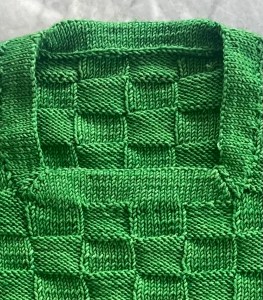
I made the back and front above the armholes, then sewed the shoulder seams and made the neck edging. The edging is a square hem just like the bottom edge and sleeves, but with mitred corners. In the pattern, you are supposed to make all four edges separately (picking up stitches from holders or knitting up on the neck sides, then decreasing and increasing at the corners) but of course I made them all together to avoid seaming. I put a purl ridge on the turning row as well. The neckline was weirdly small and not as low-cut as in the photo, even though I made it according to pattern / adjusted for gauge difference. It still fit over my head just fine.

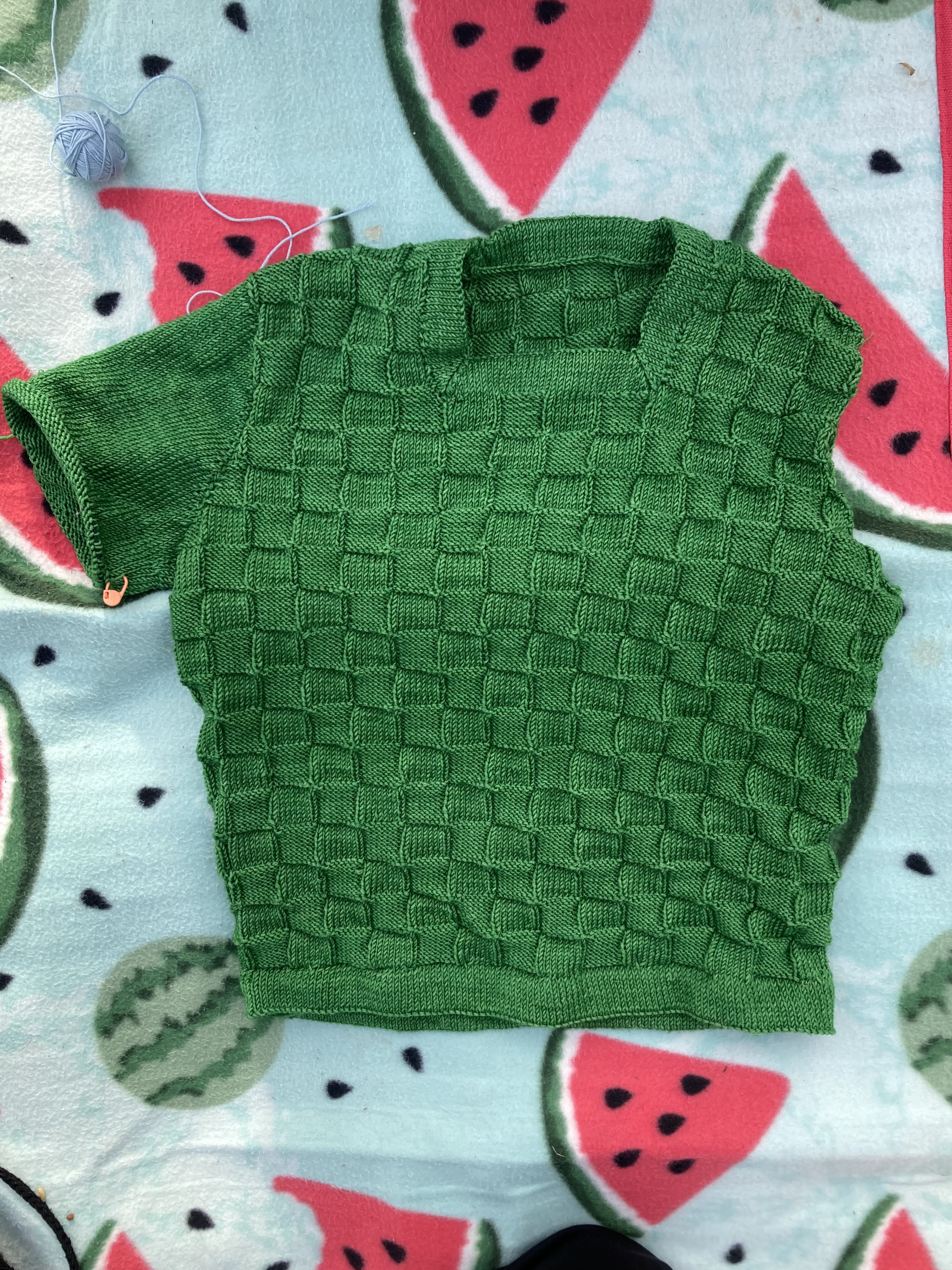
I didn’t know if I would have enough yarn or not — even with 300 grams — so I made the sleeves from the top down, picking up stitches around the armhole and working the pattern so to speak in reverse order. Even adjusting for gauge, the first sleeve was wide and a bit wing-like (the hem doesn’t pull the fabric in nearly as much as ribbing, of course). I recalculated and made the second sleeve narrower, which was better, so frogged the first sleeve and made it again. I did end up having to buy one more ball of yarn, too — I thought about making very short cap sleeves, but it was worth the extra ball of yarn to get the right length.

It was sweater-girl snug before blocking but as expected, it stretched out quite a lot in all directions. I put it in the dryer for a short spell when it was almost dry even tough technically the wool is not superwash. That was perfect and it turned out comfortably loose, but not sack-like. I even had a brooch that was similar to the one worn by the Sitchcraft model!

I love this top and am very happy with how it turned out.

June 1966: Overview

Colour for High Summer! The trending colour in Stitchcraft’s June 1966 issue is turquoise, and “High Summer” means casual, easy knitwear in washable synthetic yarns for holiday travel. Let’s dive in!

The knitted fashions are high-necked but loose-sleeved, knitted mostly without shaping in textured stitch patterns. Our cover cardigan is made in turquoise “Courtelle” synthetic wool with a pattern made by increasing and decreasing in the same stitch to create a sort of flattened bobble over multiple rows. There’s a white pullover with a bold intarsia turquoise flower, a his-and-hers white cabled rib for seafaring holidays, or sporty numbers for playing tennis in a dress shirt and tie. The colourwork pullover is also made in turquoise and white, and the sleeveless men’s tennis top in blue.

For warmer days, there’s a heavy-knit, but sleeveless and lacy, “jaunty beach top”, or a choice of two pretty T-shirt tops. The basketweave-patterned top is also blue, and the diamond-patterned top in “Banana Cream” beige — the colour trends are very clear. The last two tops are made in finer, 3- or 4-ply wool, but also make use of synthetic yarns like the wool-nylon “Nylox” three-ply used for the basketweave top. You can complete the outfit with one of two crocheted hats: pillbox style or with a corded brim, both in heavy “Capstan” wool.

Children can enjoy their holiday in a striped play-shirt with matching “overpull” or a bobbled cardigan and pleated skirt (though the skirt, like so many fashions for little girls, is quite impractical for any kind of actual playtime.) The cardigan features an interesting two-colour pattern made by dropping a yellow stitch down three rows and picking it back up together with three white loops. Interestingly, the children’s patterns feature neither turquoise nor blue of any kind, but are made in bright yellow and white or more subdued stripes of grey and light red.

Homewares are fun and easy, starting with a knitted “World Cup Willie” car rug. The 1966 FIFA World Cup football (soccer) tournament was held in England in July 1966, and “World Cup Willie” was its official mascot. England won the trophy that year, beating West Germany in the final match 4-2, so I guess Willie was indeed a bringer of good luck. Personally, I am much more interested in the Stitchcraft model’s dress, hat and shoes than Willie or the World Cup — I want that entire outfit! The rug is made in heavy “Big Ben” wool and a sturdy moss-stitch pattern, with the “Willie” motifs worked in intarsia technique from a chart included in the magazine issue.

Moving on, there’s an embroidered wall panel to commemorate the 900th (plus a year) anniversary of the consecration of Westminster Abbey — we haven’t had a commemorative wall panel for a while, so that’s a nice plus. As always, there are chair-accessories and cushions, this time with delicate embroidered satin-stitch poppies in wool on linen, or a very 1960s happy smiling sun worked in felt on Hessian/burlap fabric for tough use in the garden.

You can also make a beach bag from towelling material gathered with “Rufflette” curtain tape, or sew an easy sundress for a small child — basically a big rectangle of fabric gathered and sewn at the shoulders — and embroider a lucky fish on the pocket. Speaking of lucky fish, how about this masterpiece of 1960s advertising copywriting that accompanies a photo of a woman “caught” in a fish net? It’s all happening at your local Scotch Wool Shop.

That’s all for high summer! My project will be the sunny garden cushion, and possibly also the basketweave top.